

Inflation data for December came in weaker than economists expected, furthering expectations that the Federal Reserve would keep its target interest-rate range intact later this month. However, some experts advised taking the consumer price index (CPI) report with a grain of salt given comparisons to November’s noisy data.
The U.S. Bureau of Labor Statistics said Tuesday that December’s CPI, which measures the change in prices on a variety of consumer goods and services, rose by a seasonally adjusted 0.3% month-over-month—a hair faster than in November but on par with consensus expectations. On a year-over-year basis, consumer prices were up 2.7%, also matching economists’ estimates and level with the prior month’s print.
Where inflation was softer than expected was in the “core” CPI figures, which exclude food and energy costs (factors that are more volatile than the other costs tracked by the Labor Department). Core CPI for December was just 0.2% higher MoM versus estimates for 0.3%, while YoY core inflation of 2.6% was also a tenth of a point shy of expectations.

“The markets were reticent to buy the last lower than expected CPI report as questions about the veracity of the data were raised,” says Steve Wyett, Chief Investment Strategist at BOK Financial. “As a result, some were expecting this morning’s CPI report to show bounce higher in response. Instead, the report for December continues a trend of slowly improving inflation data.”
Still, some experts continued to warn that comparisons to November, which was both delayed and lacked month-over-month comparisons might have added some noise to December’s data.
The 16 Best ETFs to Buy for a Prosperous 2026
“The latest CPI should be interpreted with caution, as it could be heavily influenced by comparison effects tied to November’s report, which was distorted by the government shutdown and disruptions to normal price collection,” says Gargi Chaudhuri, Chief Investment and Portfolio Strategist, Americas at BlackRock. “While the latest data reflects a full month of price changes, the uneven base makes month-to-month signals less reliable than usual.”
Here’s a quick look at December’s key CPI figures:
- MoM CPI: +0.3% (estimate: +0.3%)
- YoY CPI: +2.7% (estimate: +2.7%)
- MoM Core CPI: +0.2% (estimate: +0.3%)
- YoY Core CPI: +2.6% (estimate: +2.7%)
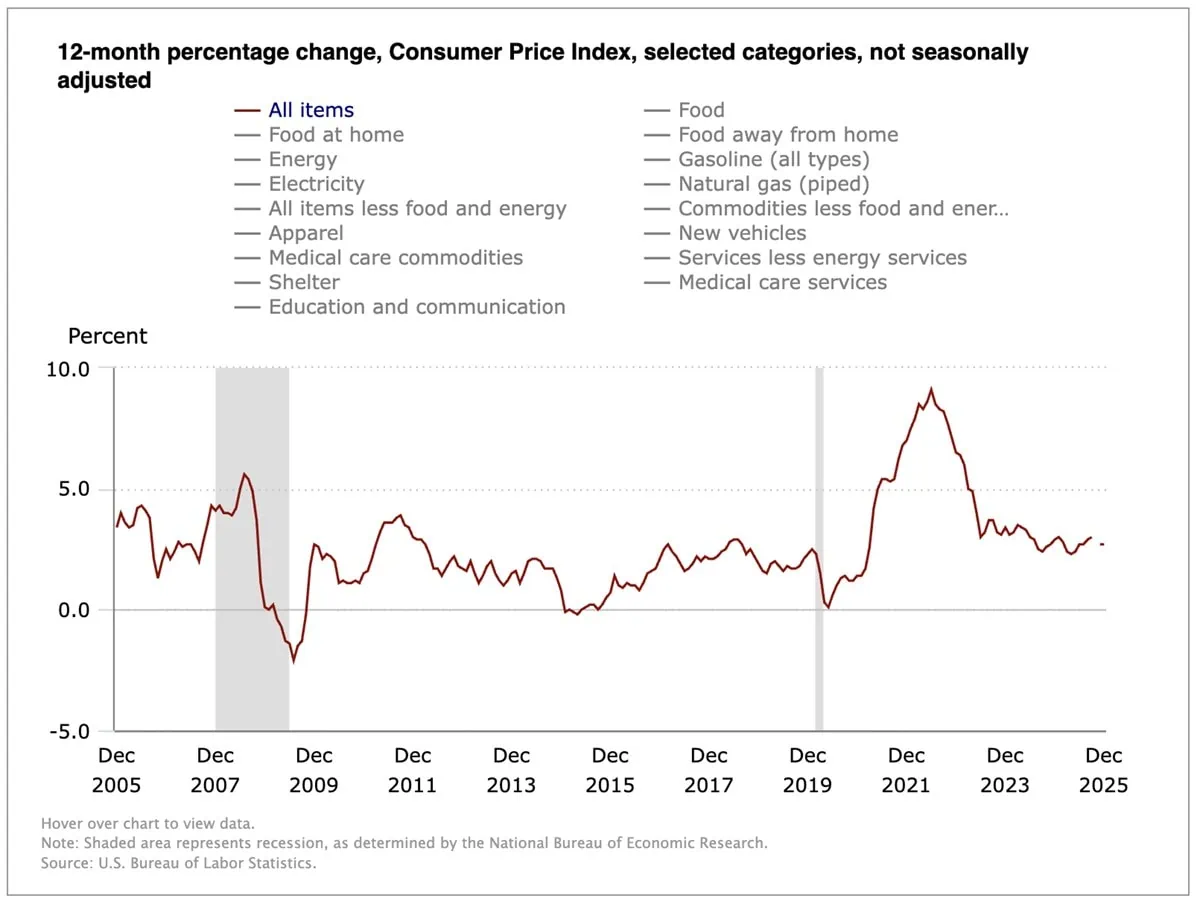
Among the most noteworthy cost increases in December were energy services, which rose 1.0% MoM thanks to higher utility gas service. Food prices were 0.7% higher, and apparel costs rose by 0.6%. Shelter prices remained sticky; the BLS said those costs, which grew by 0.4% MoM, were the largest factor in the all-items index’s monthly increase.
Do you want to get serious about saving and planning for retirement? Sign up for Retire With Riley, Young and the Invested’s free retirement planning newsletter.
“Shelter inflation, which typically moves slowly, has been unusually noisy in the aftermath of the government shutdown,” says Jason Pride, Chief of Investment Strategy and Research at Glenmede. “Some of that may be due to technical decisions made to bridge the gap in October, and it may take some time for the dust to settle on that before the shelter figures ultimately settle out. While some residual distortion may still be working its way through the data, alternative measures of rents and apartment vacancy rates point to a broader trend of easing shelter costs.”
Consumers did enjoy lower energy commodity costs (-0.4% MoM), including sharply lower fuel oil prices (-1.5%). Prices for used cars and trucks (-1.1%) dropped significantly, too.
The 13 Best Mutual Funds to Buy for 2026
Despite the noise, the report further solidified Wall Street’s expectations that the Federal Reserve will maintain the target range for its benchmark interest rate at the central bank’s next meeting later this month.
Specifically, the CME FedWatch Tool, which uses trading in federal-funds futures to determine Wall Street’s expectations for future Federal Reserve actions, now shows a 97% chance that the target range for the federal funds rate will stay at its current 3.50% to 3.75% at the conclusion of the next Federal Open Market Committee (FOMC) meeting, scheduled for Jan. 27-28. That figure, up from 96% yesterday, was significantly boosted last Friday after a weak December jobs report.
“While interest rates initially rallied on this news, they have since sold off and remain almost unchanged across the yield curve,” says John Kerschner, Global Head of Securitised Products and Portfolio Manager at Janus Henderson Investors. “We believe the market understands that now a January cut is off the table and is waiting for other economic data before drawing any major conclusions. For example, January inflation data often come in hot due to the year-end turn in the calendar.”
However, Alexandra Wilson-Elizondo, Global Co-CIO of Multi-Asset Solutions at Goldman Sachs Asset Management, added that inflation might have temporarily shifted to the backburner of Fed news to watch.
How to Rebalance Your Portfolio: A Quick Guide
“Ultimately, the data reinforces the Goldilocks environment. That said, inflation prints are likely to shift from being a primary market trigger to more of a background constraint as the market becomes increasingly focused on the risks to Federal Reserve independence,” she says. “We continue to like being long risk, avoiding the news treadmill and positioning instead for durable, tradeable themes.”
What the Experts Think About December’s CPI Report
Here, we outline more thoughts from the experts on what last month’s CPI numbers mean for consumers, markets, the Federal Reserve’s future actions, and more:
Jeff Schulze, Head of Economic and Market Strategy, ClearBridge Investments
“Categories that typically experience steep discounting in late November like apparel, airfares, and hotels witnessed a snap-back in pricing, but these increases should not be extrapolated by investors due to the one-time nature of this issue. Shelter inflation showed some strength and will be an area to monitor going forward since it will continue to be understated until the April CPI release due to the missed sampling window in October.
While investors will cheer this release as further evidence of disinflationary progress, the Fed will remain in “wait and see” mode given the uncertainty until more distance came be put between the data and the shutdown. This release is positive for risk assets and increases the odds that the Fed will provide additional monetary policy support in 2026.”
Sonu Varghese, Vice President and Global Macro Strategist, Carson Group
“Core CPI inflation was on the softer side, signaling lower upside risk for inflation (especially from tariff-impacted core goods). We’re still unlikely to get another cut from the Federal Reserve in Q1 thanks to more solid labor market data in December, including lower unemployment. Still, the lower inflation print will allow the Fed to continue focusing on labor market risks.”
Best Target-Date Funds: Schwab vs. Vanguard vs. Fidelity
David Russell, Global Head of Market Strategy, TradeStation
“Economists were worried about some statistical resets after the government shutdown, but the bigger disinflation trend continued. Cars and energy saved the day even as shelter ticked back up. This is good news for investors worried about inflation reaccelerating in December. Americans have waited for a long time since the pandemic, and now they’re starting to get relief on prices. Today’s data probably won’t have much influence on Fed policy given the coming change in leadership. But it keeps expectations on track for lower rates and likely supports risk appetite.”
Scott Helfstein, Head of Investment Strategy, Global X
“Inflation has been a little above the Fed target, but that masks some better news below the surface. The rate of increase has been relatively steady, and that should be good news for the markets. There are no indications that prices are likely to spike even after the impact of inflation and higher mortgage rates.
The Fed still has some room to move, especially given weaker job creation and downward revisions in the latest report, but they may choose to wait and see if the impact of tariffs is really transitory. Rates are still likely to come down, but the timing is getting a little more cloudy.”
Want to talk more about your financial goals or concerns? Our services include comprehensive financial planning, investment management, estate planning, taxes, and more! Schedule a call with Riley to discuss what you need, and what we can do for you.