

Empower is one of our top-rated financial services firms for people of any income level thanks to the quality and breadth of its offerings.
Most of the time, we talk about Empower’s free-to-use tools, which allows anyone—no matter the size of your assets, nor your level of financial experience—to get a holistic view of their finances, plan out their savings, analyze their investments, and more.
But today, we want to talk in more depth about Empower Personal Strategy, its fee-based financial advice and wealth management services, which may help investors who want a fuller advisory experience, and which are far more accessible than traditional advisors. How accessible? While people with half a million dollars in assets can’t even get a foot in the door at many advisory firms, anyone can get started with Empower Personal Strategy as long as they have at least $100,000 to work with.
In fact, if you have more than $100,000 in investible assets, you can use our dedicated link to schedule a free financial consultation with an Empower professional.
Read on, and we’ll tell you all you need to know about Empower’s Personal Strategy wealth management services. That includes the various levels of service, how much you’ll pay, and some insights into how the free financial consultation works based on my own experience as of May 2026.
The statement is provided to you by YATI Media, LLC, who has entered into a written referral agreement with Empower Advisory Group, LLC (“EAG”), The Referral Fee is only paid to the YATI Media if you ultimately hold a qualified meeting with EAG. YATI Media is not a client of EAG.
- Empower Advisory Group offers a comprehensive wealth management service known as Personal Strategy Investment Services. This managed account solution provides clients with discretionary investment management, personalized portfolio construction, and access to financial planning support. Accounts investing $100,000 to $250,000 receive unlimited advice and retirement planning help from financial advisors,** as well as a professionally managed ETF portfolio with reviews upon request.
- Personal Strategy Wealth Management, for those with $250,000 to $1 million in assets, provides you with a pair of dedicated financial advisors, adds access to individual equities in your managed portfolio, regular portfolio reviews, and access to investment topic specialists.
- Private Client unlocks priority access to specialists and the investment committee, access to private banking products and services, private equity investments, and more.
- If you have $100k+ in investible assets, use our link to schedule a free initial 30-minute financial consultation with an Empower professional.
- Tax-loss harvesting (Personal Strategy)
- Dividend reinvestment (Personal Strategy)
- Automatic rebalancing (Personal Strategy)
- Low investment expense ratios (Personal Strategy)
- High number of investment accounts supported (Personal Strategy)
- Private banking options (Private Client)
- Access to private equity (Private Client)
- Estate and legacy planning (Private Client)
- Low minimum for financial planning
- Low investment management fees compared to traditional advisors. (Personal Strategy and Private Client)
- Moderately high investment management fee (0.89% AUM) compared to online robo-advisors (Personal Strategy)
- No dedicated advisor unless you have $250k+ in assets

Empower’s Wealth Management Services: 3 Service Tiers
Empower’s services differ depending on how much in assets you bring to the table. Anyone with at least $100,000 who uses our signup link is privy to unlimited financial advice and a managed portfolio, among other services—but understandably, the greater your assets, the greater your choices become.
Here’s a look at each of Empower’s tiers:
| TIER | Empower Personal Strategy Investment Services | Empower Personal Strategy Wealth Management | Empower Private Client |
|---|---|---|---|
| ASSETS* | $100,000-$249,999 | $250,000-$999,999 | $1 million or more |
| ADVISORY ACCESS | Includes unlimited financial advice and retirement planning guidance from Empower's advisory team. | Includes two dedicated financial advisors providing advice and planning. | Also includes a pair of dedicated financial advisors, as well as Priority access to Empower's specialists and the investment committee. |
| ADDITIONAL FEATURES** | — Professionally managed portfolio of ETFs — Portfolio can be reviewed upon request — Empower's state-of-the-art digital tools — Eduation/college planning | — Fully customized portfolio of both stocks and ETFs, which allows for more flexibility and better tax optimization — Portfolio will be reviewed regularly — Access to specialists in real estate, stock options, and other areas — Access to private banking products and services — Access to tax planning services | — Fully customized portfolio may include not just stocks and ETFs, but also individual bonds and private equity — In-depth specialist support for retirement and wealth planning — In-depth tax return analysis — Access to estate and legacy planning services |
| * This represents the dollar amount of assets you must have Empower manage to be eligible for services. ** Higher tiers generally also include features found in lower tiers. For instance, Personal Strategy Wealth Management users also have access to digital tools, and Private Client users also have access to private banking and tax planning services. | |||
Empower’s Free Financial Consultation: My Experience
Are Empower’s Personal Strategy wealth management services worth considering? Well, you won’t have to tackle that question all by your lonesome. If you have at least $100,000 in investible assets, you can use our signup link, and Empower will provide you with a free financial consultation, which as of May 2026 is split into a pair of calls:
- Discovery call: A roughly 30- to 45-minute initial call to discuss your financial situation, current investments, goals, and more.
- Financial review: A roughly 60-minute follow-up call to review your financial analysis. This also includes a discussion of how Empower could manage your money (including a personalized portfolio) as a Personal Strategy customer, as well as what tier you’d likely fall under, the fees that would apply and the services you can take advantage of.
In the hope of communicating exactly what you should expect, I’ll tell you about my own Empower consultation.
Disclosure: I informed Empower of who I am, who I work for, and my call’s purpose ahead of time. We’re not a “gotcha” media outlet, after all, and there’s no reason to believe the experience would be tainted by having that knowledge. Importantly: I wanted to be able to not only see the entire process, but also talk to the advisor about how the call might differ based on a person’s circumstances.
The Discovery Call
The first call, scheduled for less than a week after reaching out through their signup process, was very much exactly what you would expect in an initial discovery call with a financial professional. For those who haven’t gone through this kind of call, they’ll typically ask you for a host of information, including:
- Age
- Marital status
- Whether you have dependents
- Your (and your spouse’s) employment status
- Household income
- Types of investment accounts
- Amounts saved
- Outstanding debt
- Age (range) at which you hope to retire
- Your “retirement number” (how much you think you need to have saved by retirement)
- What you want your retirement to look like
- What kinds of services you might want from an advisor
On that last point: Not everyone wants the same things out of a financial advisor. For instance, I mentioned that I personally have no wish/need for someone to manage my investment assets given my background as a financial journalist. However, there are certain services—say, tax planning and estate planning—I might prefer to put in the hands of an outside professional.
That’s me. Many, many people would prefer for an advisor to also manage their investments given a lack of experience, time, interest, or a combination of those factors.
The advisor was friendly, a good listener, and (most importantly) a good communicator. Because it’s a discovery call, you’ll do most of the talking; but if your experience was anything like mine, you’ll walk away with a clear picture of what the second call will look like, and a more accurate view-from-10,000-feet of what Empower provides to clients.
A really important note: On the initial call, the advisor will explain to you that they’re acting as an investment advisor representative in an educational capacity. In other words, they’re not providing you with investment or financial advice. They’re merely providing information so you can make educated decisions about your financial situation and evaluate what Empower is offering. This is par for the course in the advisory world; discovery calls are not for providing advice.
This first call took more than an hour, but it’s because I’m a chatterbox, and because I asked a multitude of questions after the discovery part of the call was done. My advisor said these calls typically go 30 to 45 minutes.
The Financial Review
Our next call was scheduled for a week after the first, which was on par with my expectations and generally a good turnaround time.
A few minutes before our meeting began, I received an email with my investment review—an extensive, illustration-heavy roundup that included:
- The wealth management tier I’m eligible for
- A recap of my assets, debt, cash flow, goals, time horizon, and risk tolerance
- The asset allocation of my current investments
- Empower’s alternative asset allocation (and a great comparison page of how my allocation compares)
- A deeper breakdown of the investments involved with each asset class
- An explanation of Empower’s “Smart Weighting” system and how it compares to both my portfolio and the S&P 500.
- Explanations of some of the included services, including financial and education planning and other available products at Empower including Empower Personal Cash
- Withdrawal strategy illustration
- Proposed next steps
The point of the review call is to go over the analysis and proposal. And this time around, the advisor explained that they are indeed acting as an investment advisor. Which makes sense—after all, they’re explaining, in no small amount of detail, how they would manage your money if you hire them.
For pretty obvious reasons, I can’t go over every finding with you, but I do want to show you a few things I think everyone would be interested in.
Asset Allocation Comparison
Empower dedicates a page each to a prospective client’s current allocation and their proposed allocation, but then they tie it together with a comparison page that looks something like this:
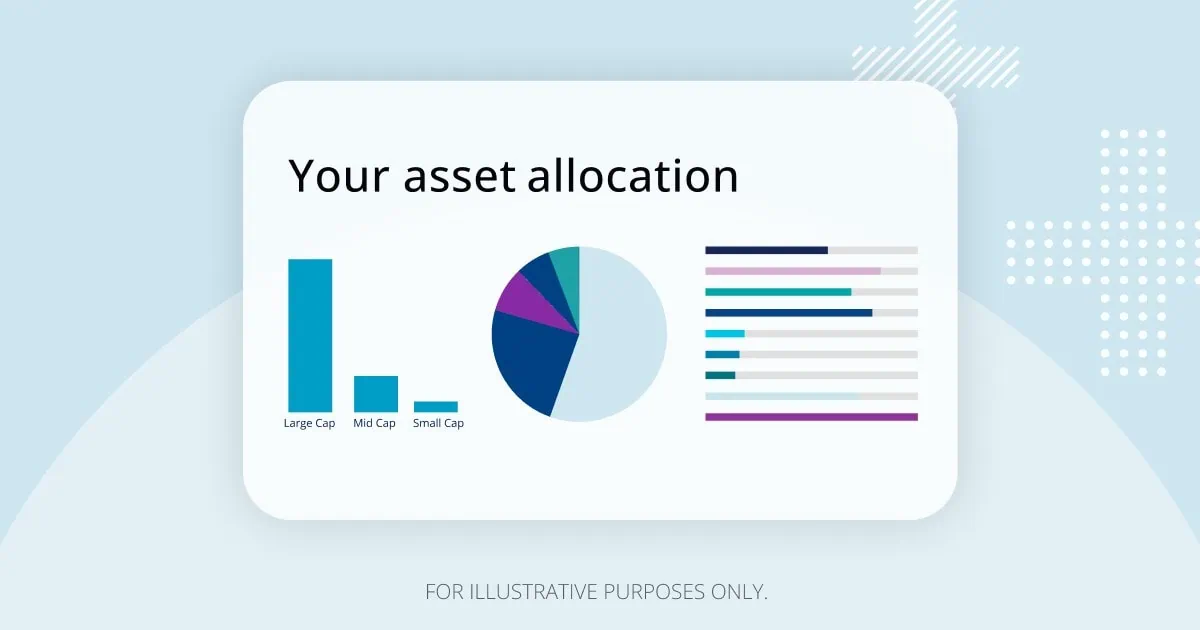
In short: Here’s how much you have invested in certain major asset classes, and here’s how much Empower would invest in them.
I’m trying to think of a way to spin this, and all I’ve got is that I’m apparently more patriotic than Empower Personal Strategy would like me to be. Because I own way more in U.S. stocks than international stocks (as a percentage of my portfolio) than what Empower is suggesting. If I’m being completely honest, I could’ve told you beforehand that I was underallocated to international stocks … but I’d have undershot the size of the gap.
Under the allocations, they’ll show you what your portfolio would be expected to return (based on historical returns), as well as the portfolio’s risk, the median expectation for your portfolio’s value at retirement, and the expectation for retirement based on the bottom 10% of all outcomes (a worst-case scenario).
One thing the page wasn’t clear about was the nature of those projections. That is, these are the numbers you could expect based on the portfolios gradually becoming more conservative over time (as they typically would), not based on the portfolio mix staying the same over time. That’s a more conservative and realistic estimate, and thus, it’s more useful.
Sub-Asset Allocation Page
It’s helpful to know broadly how your portfolio will be allocated to stocks, bonds, and alternatives, but you’d probably want a little more detail than that. The sub-asset allocation page shows you what you need to know:
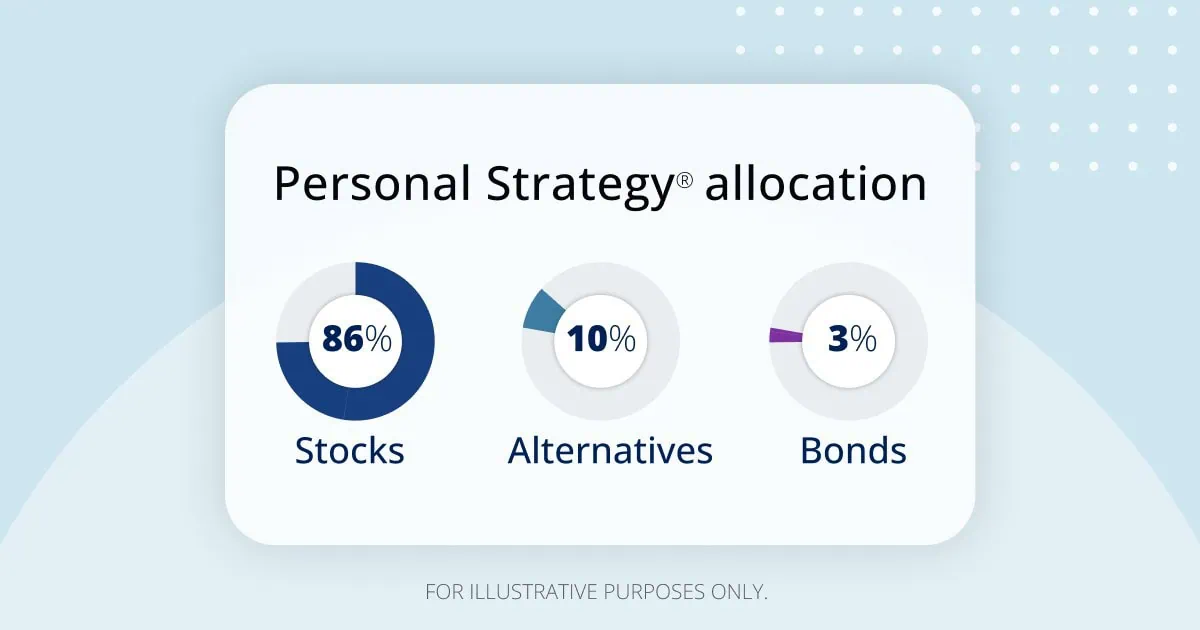
If you don’t already manage your own portfolio, you might look at this, say “OK, I trust you” and move on. But I’m glad they showed me this. I can tell you off the cuff that virtually all of my alternatives exposure is in real estate, and that’s intentional. I can also tell you that I’m purposely more aggressive in what little bond exposure I have.
At a bare minimum, being able to see this more granular breakdown will better educate you on what you’ll own through Empower. But for some of us who want more control, this page can help us ensure that Empower’s portfolio is more aligned with our wishes.
Smart Weighting
Smart Weighting is Empower’s proprietary system for allocating U.S. equities in accounts, and this page shows you how it would distribute your stock allocation across style (so, both large/mid/small and core/growth/value) and sector.
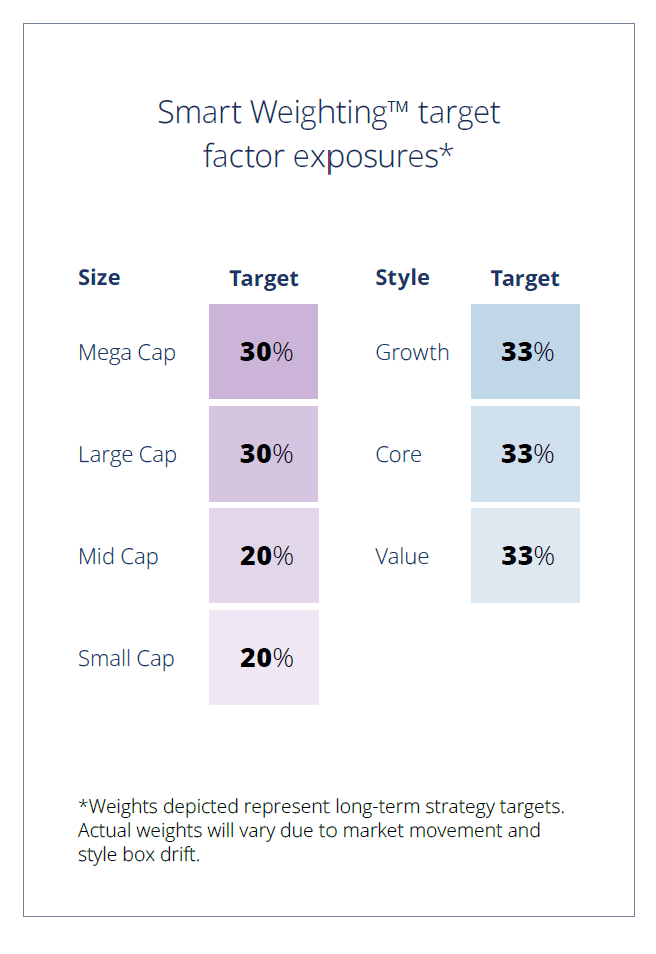
The very quick explanation of this is that Empower prefers to be more balanced across size, style, and sector than both the S&P 500 and myself. This is really apparent in a few places, such as technology, where Empower is looking for closer to a 10% allocation versus the 30%-plus my current portfolio and the index offer. I also have much less small-cap exposure than Empower’s proposed portfolio, and that the S&P 500 has none.
On the one hand, I’d probably bark a little at what is a significant underweighting to tech. Technology has stomped the market over the past couple decades, and I’m generally bullish on its ability to continue outperforming going forward.
On the other, the advisor pointed out that between 1992 and 2025, Empower’s Smart Weighting program has outperformed the S&P 500, with a lower standard deviation to boot. Put differently: It has produced higher returns than the index with lower risk. “That doesn’t happen every single year,” the advisor said, “but over the long run, the program has demonstrated that outcome.”
While I don’t practice what Empower is preaching, I understand it and appreciate its virtues.
I’m also obliged to say that, whether you agree with me or Empower, past performance isn’t an indication of future returns.
The Call Itself
Despite knowing my background, the advisor didn’t just talk shop with me—he went over the presentation just like he would with a prospective client without investment experience. He communicated ideas clearly and simply. And he endured a lot of nitpicky questions.
When I was done, I had a better picture of my own portfolio than when I started, and I knew exactly what my options were if I wanted to invest, plan, or both through Empower.
Something I think is worth mentioning: I didn’t start out in finance. I began my career as a sports journalist. So while I’ve been doing this for 15 years, I still remember what it was like to make the transition into money media and fumble my way through basic concepts until I was more educated. And I can tell you, the advisor was exactly the kind of person I’d have wanted talking to me about my portfolio back then.
And that’s my experience!
I’m going to move on to Empower Personal Strategy costs and a bit more information about the core components of Empower’s Personal Strategy offerings. But if you want to go ahead and set up a free consultation with Empower, you can do so through our link.
How Much Do Empower’s Wealth Management Services Cost?
Much like Empower’s Personal Strategy services are broken down into tiers by assets, so too are the advisory fees.
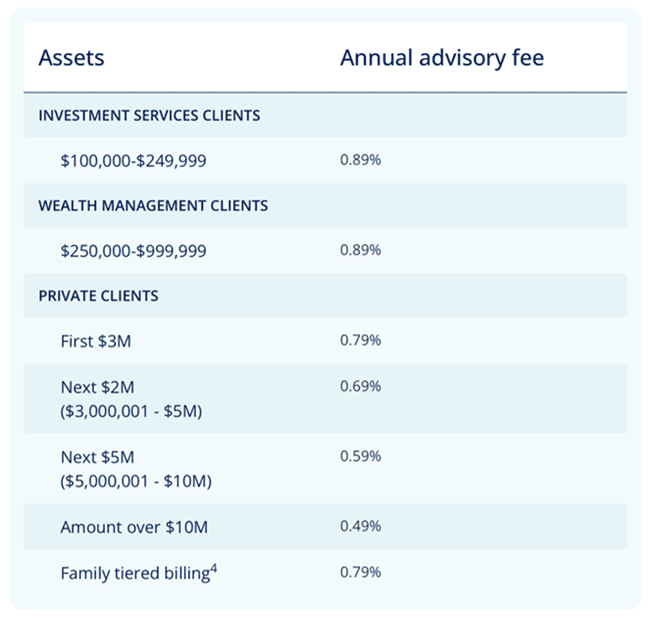
Fees per Empower website as of July 6, 2026.
Under $1 million invested, it’s not too complicated—you’ll pay 0.89% of your assets in annual fees. And for context, the typical “benchmark” for advisor fees is 1% annually, though higher is normal. So even Personal Strategy’s highest charged rate is below what you can typically expect to pay elsewhere for a managed portfolio and financial advice.
The Private Client tiers work a little differently. You’ll pay 0.79% on the first $3 million in assets you allow Empower to manage. After that, the fees charged are on each “sleeve” of assets.
So, let’s say you had $11 million to invest with Empower:
- You would pay 0.79% on the first $3 million.
- You would pay 0.69% on the next $2 million.
- You would pay 0.59% on the next $5 million.
- You would pay 0.49% on the remaining $1 million.
Also, if you’ve never had a financial advisor before, understand that you don’t pay these fees by stroking a check from your bank account. Similar to how a mutual fund or exchange-traded fund (ETF) will automatically take its fees from the fund’s total assets, advisory fees are automatically taken out of your managed account(s).
What Do You Get?
Now, we want to zoom in on the two most important aspects of Empower Personal Strategy wealth management Services: how you’re invested, and the other financial services you enjoy.
Investment Portfolios
Regardless of your assets, Empower will build your portfolio based on your age, goals, and risk tolerance.
Empower will manage your portfolio with “Smart Weighting”—Empower’s proprietary U.S. stock indexing approach—in mind. In a nutshell, Empower sees many indexes as too beholden to large-cap stocks, and instead prefers to invest across not just size, but economic sector and stock style. Empower also manages assets with tax optimization in mind; not only does it favor stocks and ETFs over mutual funds, but management will optimize holdings for taxable and tax-advantaged retirement accounts, and even perform tax-loss harvesting,
The big differences from one tier to the next is what Empower will use to construct your portfolio.
- Personal Strategy Investment Services portfolios are entirely made up of low-cost ETFs; the average ETF expense ratio across Empower’s portfolios is a mere 0.08%, or $80 for every $100,000 invested.
- Personal Strategy Wealth Management portfolios gain the option of investing in individual equities as well.
- And people in the Private Client tier unlock additional asset options, including individual bonds and even private equity.
Financial Services
Anyone who joins up with Empower Personal Strategy will have access not just to managed investment portfolios, but a variety of financial services as well.
- In the Personal Strategy Investment Services tier, the Empower team can help you with general financial planning, as well as retirement planning and education/college planning.
- Personal Strategy Wealth Management adds a couple of services that align with some of the financial complications that come from having a larger level of assets. One is on the tax front—you can receive a personalized tax report within your Empower Personal Dashboard, and specialists can provide you with tax planning support as well. The other is private banking, which is provided through Empower’s relationship with BNY Mellon and includes securities-based lending, investing credit lines, real estate financing, business funding, and more. Not to mention, you’re upgraded from working across Empower’s advisory pool to having a pair of dedicated advisors.
- Private Client opens up the full arsenal of services, including taking existing services from good to great. For instance, you won’t just get access to Empower specialists—you’ll be at the front of the line. Tax planning also includes an in-depth tax return analysis. And you’ll also open up estate and legacy planning, as well as advice on how to maximize your charitable giving.
- Empower Advisory Group offers a comprehensive wealth management service known as Personal Strategy Investment Services. This managed account solution provides clients with discretionary investment management, personalized portfolio construction, and access to financial planning support. Accounts investing $100,000 to $250,000 receive unlimited advice and retirement planning help from financial advisors,** as well as a professionally managed ETF portfolio with reviews upon request.
- Personal Strategy Wealth Management, for those with $250,000 to $1 million in assets, provides you with a pair of dedicated financial advisors, adds access to individual equities in your managed portfolio, regular portfolio reviews, and access to investment topic specialists.
- Private Client unlocks priority access to specialists and the investment committee, access to private banking products and services, private equity investments, and more.
- If you have $100k+ in investible assets, use our link to schedule a free initial 30-minute financial consultation with an Empower professional.
- Tax-loss harvesting (Personal Strategy)
- Dividend reinvestment (Personal Strategy)
- Automatic rebalancing (Personal Strategy)
- Low investment expense ratios (Personal Strategy)
- High number of investment accounts supported (Personal Strategy)
- Private banking options (Private Client)
- Access to private equity (Private Client)
- Estate and legacy planning (Private Client)
- Low minimum for financial planning
- Low investment management fees compared to traditional advisors. (Personal Strategy and Private Client)
- Moderately high investment management fee (0.89% AUM) compared to online robo-advisors (Personal Strategy)
- No dedicated advisor unless you have $250k+ in assets
Bottom Line
The thing that stands out most about Empower’s Personal Strategy advisory services is how it really does “democratize” financial advisory services. Again, it’s often difficult for people with even $500,000 in assets to get personalized financial advice and portfolio construction from real human beings—Empower provides those services to people with as little as $100,000.
But importantly, Empower adds value across the asset spectrum with its tiered system. Greater assets aren’t just rewarded with lower fees (which, to be fair, is common among financial advisors), but with wider and better services, too.
Use our dedicated link to schedule a free 30-minute call with an Empower professional.
Disclosures
The statement is provided to you by YATI Media, LLC (“Promoter”) who has entered into a written referral agreement with Empower Advisory Group, LLC (“EAG”), through which Promoter will be paid $1,000 (“Referral Fee”) for each person who uses this webpage to hold a qualified Personal Strategy information gathering call through EAG. The Referral Fee is only paid to the Promoter if you ultimately hold a qualified meeting with EAG. Promoter is not a client of EAG. Promoter is not affiliated with EAG or its affiliates and Promoter’s services consist solely of referrals of prospective clients.
No fees or other amounts will be charged to Personal Strategy clients, prospective clients, or any other clients of Promoter or EAG as a result of this arrangement. Investors should conduct their own research and seek advice before making investment decisions. For more information about EAG, refer to its Form ADV through the SEC’s website or linked here.
Advisory services are provided for a fee by Empower Advisory Group, LLC (EAG). EAG is a registered investment adviser with the Securities and Exchange Commission (SEC) and an indirect subsidiary of Empower Annuity Insurance Company of America. Registration does not imply a certain level of skill or training. Investing involves risk. Past performance is not indicative of future returns. You may lose money. Advisory fees are calculated based upon the amount of assets being managed (as detailed further in the Empower Advisory Group, LLC Personal Strategy Form ADV).
BNY Mellon is not affiliated with Empower.