

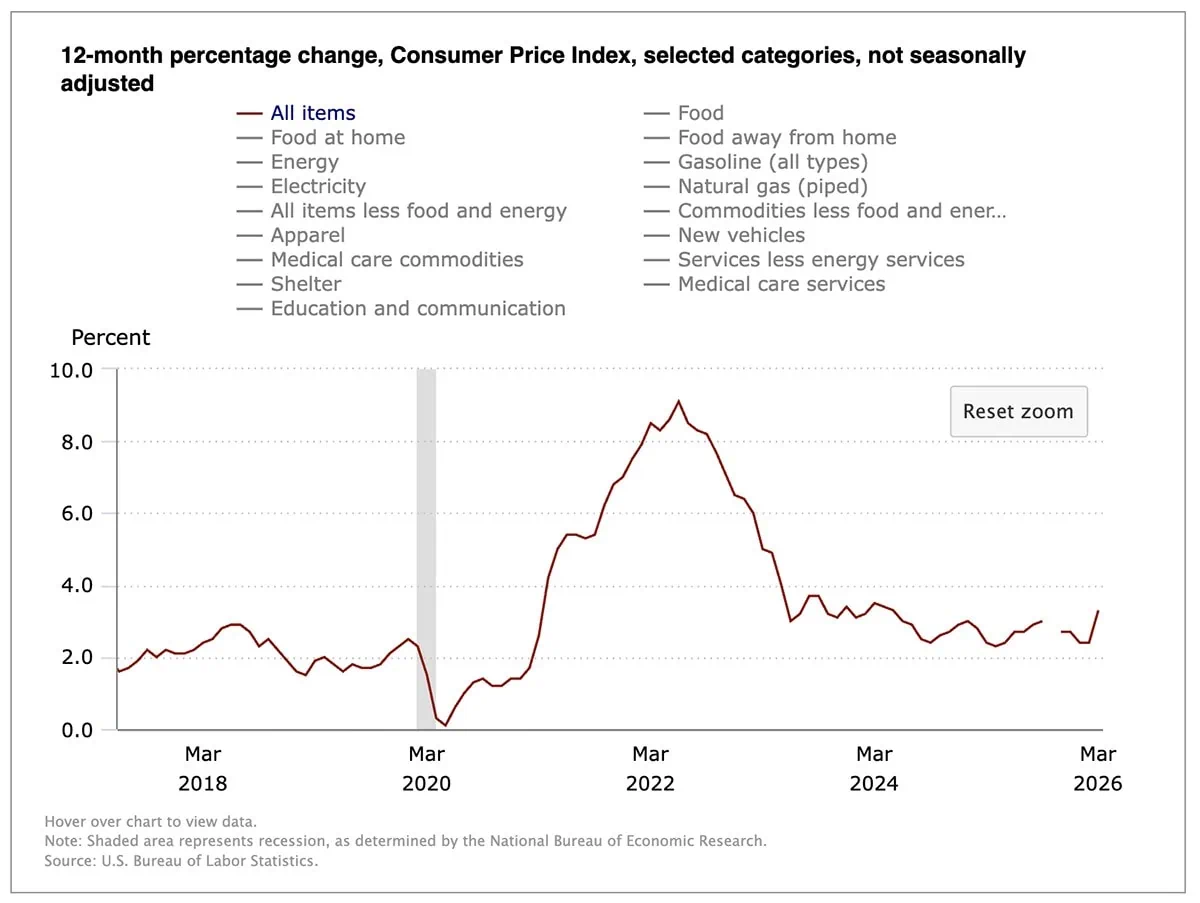
U.S. consumer prices expectedly shot higher in March as the war in Iran sent energy prices through the roof, leading to multiyear highs in American inflation readings that actually obscured softening prices elsewhere.
The U.S. Bureau of Labor Statistics said Friday that March’s consumer price index (CPI), which measures the change in prices on a variety of consumer goods and services, rose by a seasonally adjusted 0.9% month-over-month—a significant jump from February (0.3%) and the fastest such pace since June 2022 amid the inflationary peak sparked by the Russian-Ukraine war. Meanwhile, the year-over-year reading was 3.3% higher, which was well ahead of February’s 2.4% and marked the fastest such pace since May 2024.
But there were no surprises: Both figures came in as economists expected.
“The market was braced for a hot print, so today’s inline number is a slight relief,” says Alexandra Wilson-Elizondo, Global Co-CIO of Multi-Asset Solutions at Goldman Sachs Asset Management. “However, it may be the best headline inflation number we see for a while as it may only partially capture the full force of the Iran conflict, which sent U.S. crude and U.S. gas up 70% at peak.
“With input costs globally surging to their highest levels since Covid, the next print may tell a different story, at least at the headline level.”
That said, “core” CPI—a measure of inflation that excludes food and energy costs (factors that are more volatile than the other prices tracked by the Labor Department)—actually came in below estimates as certain price categories showed signs of softening.
5 Best Energy ETFs for the Rise of Oil, Natural Gas + More
Core CPI for March was just 0.2% higher month-over-month, which was the same as the past three months and a hair below projections for 0.3%. On a year-over-year basis, the core CPI rate of 2.6% was also below projections for 2.7%.
Here’s a quick look at March’s key CPI figures:
- MoM CPI: +0.9% (estimate: +0.9%)
- YoY CPI: +3.3% (estimate: +3.3%)
- MoM Core CPI: +0.2% (estimate: +0.3%)
- YoY Core CPI: +2.6% (estimate: +2.7%)
“This inflation data is good enough for now because the core reading was light,” says David Russell, Global Head of Market Strategy at online brokerage firm TradeStation. “Given the global situation and strong earnings growth, some investors may view the current inflation data as manageable and expect energy pressures to moderate. But a resolution to the Hormuz crisis will be key to improvement.”
Energy prices as a whole were up 10.9% month-over-month, driven by a 21.3% surge in gasoline and a 30.7% leap in fuel oil, resulting from Iran’s closure of the Strait of Hormuz—a crucial pathway for 20% of the global oil supply.
“Energy inflation tends to be more volatile and may not persist if energy prices stabilize,” says Gargi Chaudhuri, Chief Investment and Portfolio Strategist, Americas at BlackRock. “The extent of that stabilization will depend on the normalization of shipping flows through the Strait of Hormuz, where ongoing disruptions continue to put upward pressure on oil prices. Even if flows return to normal, the risk of future disruptions may keep a higher floor under energy prices.”
10 Best ETFs to Beat Back a Bear Market
Other consumer prices, for now, remained muted and even saw some pullback.
Apparel costs were 1.0% higher month-over-month, while electricity rose 0.8% and transportation services costs rose 0.6%. Medical care commodity prices actually retreated by 1%, utility gas service costs retreated by 0.6%, used cars and truck prices were down 0.4%, and food at home became 0.2% cheaper.
“There is actually some good news in the recent inflation reports,” says Scott Helfstein, Head of Investment Strategy at Global X. “Prices for shelter and utilities, which have largely driven above target inflation for the past months, seem to be stabilizing.”
Fed Expected to Stay Its Hand on Interest Rates
Wall Street largely has expected the Federal Reserve to keep its benchmark interest rate level amid the data noise generated by the Iran war, and that didn’t change Friday.
“Today’s report complicates the Fed’s calculus without fundamentally rewriting it,” says Jason Pride, Chief of Investment Strategy and Research at wealth management firm Glenmede. “A single energy-driven spike is unlikely to trigger a policy response on its own, particularly when core inflation remains close to target. But the Fed will be watching whether the bleed of higher energy prices into other components is a preview of broader re-acceleration.
“Rate cuts in 2026 are not off the table, but the bar to act has risen. Investors should expect the Fed to hold until there is clearer evidence that energy pressures are fading rather than spreading.”
The CME FedWatch Tool, which uses trading in federal-funds futures to determine Wall Street’s expectations for future Federal Reserve actions, shows a 98% chance that the target range for the federal funds rate will stay at its current 3.50%-to-3.75% range at the conclusion of the next Federal Open Market Committee (FOMC) meeting, scheduled for April 28-29. They also project 90%-plus probabilities of rates remaining where they are for the June and July meetings. In fact, “no Fed action” is the greatest probability shown for every remaining meeting of 2026.
“Even given the better than expected print this morning, the Fed faces a major dilemma over its next few meetings,” says John Kerschner, Global Head of Securitized Products and Portfolio Manager at Janus Henderson Investors. “Does the Fed look through this hopefully short-term aberration in the inflation numbers or do they actually consider a hike in rates when economic growth seems to be somewhat stalling? The answer obviously lies in the length of the conflict, which honestly, no one can accurately forecast at this moment. What we do know is that even if the Strait of Hormuz opens today, energy prices will be elevated for months and potentially years to come.”
Do you want to get serious about saving and planning for retirement? Sign up for Retire With Riley, Young and the Invested’s free retirement planning newsletter.
What the Experts Think About March’s CPI Report
Here, we outline more thoughts from the experts on what last month’s CPI numbers mean for consumers, markets, the Federal Reserve’s future actions, and more:
Steve Wyett, Chief Investment Strategist, BOK Financial
“This morning’s CPI release could be a harbinger of things to come. Headline inflation surging .9% on higher gasoline prices and we know a bit more is to come. Food prices were flat, but we believe higher prices could be the horizon. While this met expectations, this pushed headline CPI to 3.3% year-over-year. On the core side, the reading came in a tenth of percent less than expected as rents continue to moderate. The material part of this sector in the core reading means we could see some period of hot headline readings and more tame core readings.
Do These 7 Bear Market Tips Hold Up to Scrutiny?
“Subdued core readings, along with continued stable longer-term inflation expectations, should allow the Fed to not raise rates here but, this is the problem for consumers, particularly lower income consumers. We had just begun to make some progress in narrowing the gap between aggregate inflation and aggregate wage gains since the onset of the pandemic. The conflict in Iran will now widen that gap further and continue the squeeze many consumers are feeling.
In short, while the Fed might be able to justify looking through this period, consumers are going to feel more pain.”
Sonu Varghese, Chief Macro Strategist, Carson Group
“Headline CPI rose 0.9% in March, pushing the 3-month annualized inflation rate to 5.3%. Core inflation was more subdued at 0.2%, helped by continued easing in shelter costs, though even there the three-month annualized pace remains 2.9%. This is little cause for comfort as the shock from the Middle-East crisis is yet to fully bite. The Federal Reserve’s preferred inflation measure, the personal consumption expenditures index, is running even hotter than CPI. Taken together, this suggests rate cuts this year are increasingly unlikely. If inflation stays near or above 3%, the Fed risks falling behind the curve, and the conversation could ultimately shift from cuts to hikes.”
Related: How Does Medigap Work? Our Guide to Medicare Supplemental Insurance
Want to talk more about your financial goals or concerns? Our services include comprehensive financial planning, investment management, estate planning, taxes, and more! Schedule a call with Riley to discuss what you need, and what we can do for you.