


America’s employment situation sharply improved in May, with job growth last month more than doubling up economists’ expectations—and as a result, Wall Street now believes the Federal Reserve is now likely to raise its benchmark interest rate before 2026 is over.
The Labor Department reported Friday that nonfarm payrolls (NFP) grew by 172,000 in May. That’s just a little less than April’s upwardly revised 179,000, but more than double Dow Jones-polled economists’ expectations for 85,000 jobs created. March’s payrolls figure was revised higher for a second straight month, by 29,000 jobs to 214,000.
Unemployment didn’t budge yet again, staying at 4.3%, which was right where economists expected the figure to fall. The rate has now remained at or below 4.5% since October 2021. Meanwhile, average hourly earnings grew by 0.3%, to $37.53, which was slightly below expectations for 0.4%. Year-over-year, hourly earnings have improved by 3.4%.
“A barnburner of a print,” says Bradford Smith, Portfolio Manager at Janus Henderson Investors. “172,000 tops even the most rosy economist estimate, while positive revisions raise previous understandings of the labor market. This strong payrolls number follows three prints of positive jobs data.”
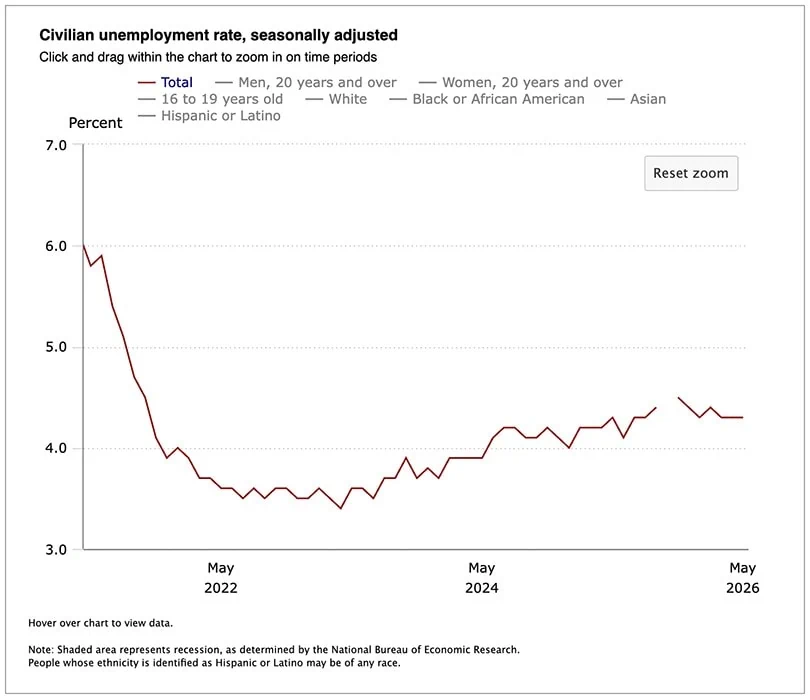
Here’s a brief look at the May jobs report’s most pertinent details:
- May payrolls: +172,000 MoM (estimate: +85,000)
- May unemployment: 4.3% (estimate: 4.3%)
- May hourly earnings: +0.3% MoM (estimate: +0.4%)
- April payrolls (revised): +179,000 (+115,000 previously)
- March payrolls (revised): +214,000 (+185,000 previously)
Healthcare remained a pillar of employment strength last month, adding 35,000 jobs in May that aligned with the sector’s 38,000 monthly average over the past year. Jobs in leisure and hospitality surged by 70,000 as businesses prepare for the summer travel season. Local government payrolls growth was also robust, at 55,000 jobs added over the month.
“The consumer turns up, and the job growth in leisure and hospitality is one more example,” says Scott Helfstein, Head of Investment Strategy at Global X ETFs. “Summer is here and the expectation is that people want to be out and about. This is a solid setup going into the second half.”
Related: 7 Space ETFs for the Next Frontier of Investing
Despite the broad-based gains, there were sector-level signs in the data that artificial intelligence is taking a toll on certain industries.
“Beneath the solid headline, the sectors most associated with knowledge work continued to contract,” says Jason Pride, Chief of Investment Strategy and Research at Glenmede. “Financial activities shed 22,000 in May and have now shed 107,000 since their peak a year ago, with losses spread across insurance carriers, commercial banking, and nondepository credit. Information employment fell further, and professional and business services added only 6,000.
The cumulative pattern across these sectors is consistent with ongoing restructuring, including the displacement effects of automation and artificial intelligence, and warrants monitoring as a potential leading indicator of broader white-collar labor market pressure.”
Also worth noting: Transportation and warehousing was effectively unchanged in May (up just 1,000 jobs), but is still off by 92,000 since hitting a top in February 2025.
Do you want to get serious about saving and planning for retirement? Sign up for Retire With Riley, Young and the Invested’s free retirement planning newsletter.
Futures Now Pricing in a 2026 Interest-Rate Hike
The markets are now all but certain the Federal Reserve won’t budge on interest rates at the next Federal Open Market Committee (FOMC) meeting, scheduled for June 16-17, and the longer-term path of least resistance appears to be up.
The CME FedWatch Tool, which uses Fed funds futures prices to track the probability of a change to the federal funds rate, shows a 98% chance that the central bank will keep its benchmark rate at 3.50%-3.75%. That’s slightly up from the 96% chance implied before the report.
“We’ve gained more and more confidence in the last prints that the Fed doesn’t have to be worried about the labor market,” says Lindsay Rosner, head of multi sector fixed income investing at Goldman Sachs Asset Management. “Laser-focused on inflation, and it will all come down to the duration of this war to determine the Fed’s next move. For now, the move is to not move.”
Related: 5 Best Energy ETFs for the Rise of Oil, Natural Gas + More
However, going out to December, futures are now implying a nearly 70% chance that we’ll actually see a rate hike by year’s end, versus a 30% chance that rates will remain in place and a marginal chance they’ll be cut. The chances of a rate hike were priced in at below 50% ahead of the release.
“We now expect the Fed to reverse 2025’s three ‘insurance’ rate cuts at sequential meetings, beginning in December,” says James Egelhof, Chief U.S. Economist at BNP Paribas. “The aim is to reduce the level of monetary stimulus, contain inflation expectations and stabilize the unemployment rate at a low level, in our view. The US unemployment rate looks set to decline gradually going forward, reaching 4% by year end.”
BofA Global Research economists noted ahead of Friday’s release that, before April’s NFP report, the market was only pricing in five to six basis points of rate hikes over the next year. (A basis point is one one-hundredth of a percentage point.) However, the market was pricing in nearly 35 basis points Thursday, and the economists believed a strong report Friday could shift the Fed’s dual mandates in the same direction.
“The market has started to price more risk of Fed hikes but the 2Y still lags labor surprises. The market would likely view this setup as requiring a greater potential premium for rate hikes, even with [new Fed Chair Kevin] Warsh,” BofA’s team wrote. “Warsh likely wants to look through tariff or other supply-driven inflation, which may shift the bar for actual hikes to a tightening in labor market conditions.”
Need Help Picking Stocks? Consider These Top-Rated Services
|
Best Introductory Stock Picking Service

|
Best Overall Stock Research Service

|
Best Proprietary Ranking System

|
|
Primary Rating:
4.7
|
Primary Rating:
4.8
|
Primary Rating:
4.2
|
|
$99/yr. ($100 first-year savings)
|
Premium: 7-day free trial, then $269/yr. ($30 discount)* Pro: 1 month for $89, then $2,149/yr.**
|
30-day free trial, then $249/yr.
|
More Expert Reactions to May’s Jobs Report
Here’s what other strategists, financial managers, and experts had to say about last month’s employment situation:
Jerry Tempelman, Current VP of Economic and Fixed Income Research, Mutual of America Capital Management; Former Senior Analyst, NY Fed
“Both [the payrolls figure and unemployment rate] reflect the third consecutive month of solid jobs growth. Today’s numbers are consistent with other positive recent labor market indicators as well, such as better-than-expected job openings and declining layoffs. Employers appear to be looking past economic and financial uncertainties brought about by the ongoing conflict in the Middle East.”
Steve Rick, Chief Economist, TruStage
“Recent private-sector data suggest hiring momentum improved heading into the summer. Payroll growth broadened across industries in May, with gains extending beyond healthcare and into sectors such as transportation, professional services and construction. Even so, the labor market remains better characterized as stable than booming. Job openings remain elevated, but hiring activity and worker mobility continue to run below historical norms, reflecting a labor market that remains selective rather than expansionary.
“Consumers are still facing significant financial pressure despite a relatively healthy employment backdrop. Rising credit card balances, elevated delinquency rates and the lingering effects of inflation suggest many households are relying on employment stability to maintain spending.”
Related: 10 Best Schwab ETFs to Buy [Build Your Core for Cheap]
Steve Wyett, Chief Investment Strategist, BOK Financial
“While the first meeting with Kevin Warsh as Chair of the FOMC might still include some conversations about changes he wants to implement, in practice, they will only be hypothetical. Today’s employment report adds to the reality that, at best, the Fed should do nothing.
“Not only did new job creation exceed estimates by a wide margin for the third month in a row, but previous months’ job growth was revised upward a total of 93,000. The headline rate remained stable and hourly earnings were restrained, so there isn’t much inflationary pressure coming from the job market, but The Fed should remove their bias towards easing as energy-induced inflationary pressures persist. The forces moving our economy forward remain stronger than the headwinds from the Iran conflict, for now.”
Sonu Varghese, Chief Macro Strategist, Carson Group
“We’ve argued the labor market is stronger than the bears think, and the data are backing that up. Payroll gains are running at a 188,000 three-month average, while unemployment remains near historic lows at 4.3%. That pushes back against the ‘AI is killing jobs’ narrative, and with inflation rising, it also means Fed policy is becoming increasingly easy.”
Related: BofA Upgrades UnitedHealth Group (UNH) on Improving Trends
Jeff Schulze, Head of Economic and Market Strategy, ClearBridge Investments
“The May payroll report provides further confirmation that the labor market has stabilized and accelerated in 2026 following last year’s malaise, with a clearly positive direction of travel that’s consistent with the momentum from the strong job openings report earlier in the week. From the Fed’s vantage point, strong job creation and steady wage gains alongside a resilient U.S. consumer suggest that labor-driven inflationary concerns cannot be ignored: a hawkish development. We believe that today’s print is modestly negative for equity markets with higher yields likely to pressure valuations to a greater degree than labor resiliency will lift growth expectations.”
Brad Conger, Chief Investment Officer, Hirtle & Co.
“May nonfarm payrolls were stronger than expected. If you were pressed for a conclusion, you could say the non-AI economy (health care, local government, hospitality) is picking up. Meanwhile, the AI impacted roles (financial, professional services) might be showing some displacement. What is not a stretch is to say that Warsh is going to face a very conflicted FOMC.”