
Federal Reserve policymakers have acted as Wall Street largely predicted, electing to keep their benchmark interest rate steady in what Jerome Powell confirmed would be his final time heading an Federal Open Market Committee (FOMC) meeting. Less expected was an extremely split vote that demonstrated the highest level of dissent from the committee’s members in more than three decades.
The central bank on Wednesday voted to keep the federal funds rate in a range of 3.5% to 3.75%. The standard rate for overnight lending level has remained level throughout 2026.
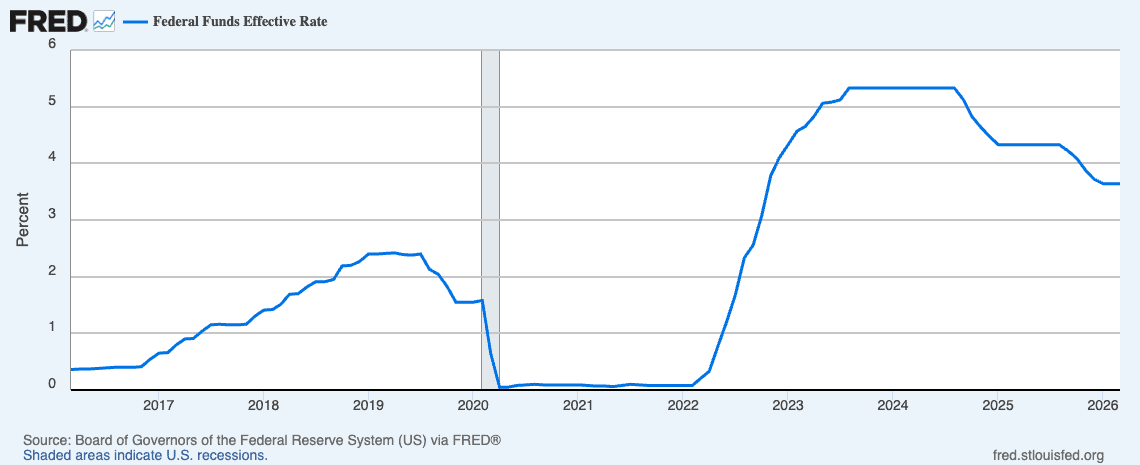
“It wasn’t a surprise that the FOMC left the target federal funds rate unchanged today, and the incoming Federal Reserve Chairman Kevin Warsh will likely have to keep overnight rates unchanged for the balance of the year,” says Brian Henderson, chief investment officer at BOK Financial. “Any rate cuts in the short term with the current low unemployment rate, and inflation expectations and CPI rates trending higher would be counterproductive.”
Related: 14 Best Investing Research & Stock Analysis Websites
However, the decision came on an 8-4 vote, marking the first time four FOMC members have dissented since October 1992. Among the no votes was Board Governor Stephen Miran, who wanted a quarter-point cut. Regional presidents Beth Hammack (Cleveland), Neel Kashkari (Minneapolis), and Lorie Logan (Dallas) also dissented, but not on the current rate. Instead, they took issue with language in the Fed’s statement that could indicate the Fed is likely to lower rates going forward. The language in question:
“In considering the extent and timing of additional adjustments to the target range for the federal funds rate, the Committee will carefully assess incoming data, the evolving outlook, and the balance of risks.”
“The Fed’s updated guidance indicates that it’s in a stable place when it comes to policy direction, although some members pushed for more two-sided language,” says Kay Haigh, global co-head of Fixed Income and Liquidity Solutions in Goldman Sachs Asset Management. “While upside risks to inflation have increased, the Fed is keeping one eye on potential weakness in growth and the labor market. This balance could see rates being brought back down to neutral later this year; however, the FOMC will be sensitive to a re-escalation in Iran and rising energy prices, and could keep policy restrictive in that scenario.”
The CME FedWatch Tool, which uses trading in federal-funds futures to determine Wall Street’s expectations for future Federal Reserve actions, shows that the market is pricing in no change in rates for the remainder of 2026. Currently, it shows a nearly 89% chance that the target range for the fed funds rate will remain at 3.50% to 3.75% at the conclusion of December’s FOMC meeting.
Warsh on His Way In, Powell on His Way Out?
All eyes were on Powell’s 2:30 p.m. Eastern press conference. Given the looming passing of the baton, any discussion about topics such as his views on the Iran war’s impact on inflation were likely to take a backseat to commentary about his future, as well as the Federal Reserve itself.
“The comments this afternoon will be interesting,” says Adrian Helfert, Westwood CIO of Multi-Asset Strategies and PM of the Enhanced Income Opportunity ETF (YLDW). “Powell’s parting shot could be making a statement on the importance of Fed independence but the impact will be on reflecting any concerns on inflation extensions and a resurfacing of “transitory.'”
Powell ultimately did discuss policy and the economic backdrop, noting that inflation remained elevated amid rising energy prices. But perhaps more importantly, he insisted he would not step down until the Department of Justice probe was fully concluded, and that he would also continue serving as governor “while keeping a low profile.”
Do you want to get serious about saving and planning for retirement? Sign up for Retire With Riley, Young and the Invested’s free retirement planning newsletter.
Warsh, Powell’s potential successor, made another step toward helming the Fed on Wednesday. The Senate Banking Committee advanced nominee Kevin Warsh earlier in the morning, which sets him up for a final Senate confirmation vote.
“What is likely to change at the Fed after Warsh takes over in May is less communication and forward guidance that have been used as powerful monetary policy tools when rates were pinned near zero,” Henderson says. “Similarly, the new Chairman would like to break away from the Bernanke to Powell [quantitative easing] regimes of relying too much on the Fed’s balance sheet, but that’s going to require changes in bank capital and liquidity regulations which take a long time to change.”
But with Powell sticking around, Warsh’s ability to stake out a new identity for the board could be hampered, at least for another couple years.
“The ‘shadow chair’ question is looming,” Helfert says. “Powell has the option to stay on as governor through 2028. If Warsh wants to cut and Powell dissents, you have an effective two-headed Fed. That’s a governance story I haven’t seen anyone write yet. It’s underappreciated as the market may actually watch Powell as the steadier hand in the FOMC room.”
Related: 8 Best-in-Class Bond Funds to Buy
Other Expert Insights on April’s FOMC Meeting
Here, we outline more thoughts from investment managers, strategists, and other experts about the Federal Open Market Committee’s April meeting.
Dan Siluk, Head of Global Short Duration & Liquidity and Portfolio Manager, Janus Henderson Investors
“On growth, the Fed’s assessment was essentially unchanged. Economic activity is still described as expanding at a solid pace, offering no indication that demand has softened enough to force the Committee’s hand. This continuity matters: despite tighter financial conditions and slower hiring, the Fed sees no compelling evidence that growth itself is faltering.
The labor market language, however, continues to evolve. The statement again notes that job gains have remained low, on average, reinforcing the idea that hiring momentum has cooled. But this acknowledgement is carefully balanced by the observation that the unemployment rate has been ‘little changed.’ In effect, the Fed is recognizing labor market moderation without interpreting it as deterioration, a distinction that keeps policy firmly in wait‑and‑see mode.
The most notable shift is on inflation. Inflation is now described as ‘elevated,’ with an explicit reference to recent increases in global energy prices. Compared with the previous statement, this represents a subtle but important re‑framing. Rather than emphasizing progress or stability, the Fed is drawing attention to renewed upside risks, particularly those emanating from outside the domestic economy.”
Related: 10 Best Fidelity ETFs You Can Buy [Invest Tactically]
Scott Helfstein, Head of Investment Strategy, Global X ETFs
“There is some good news in Fed inaction. With the next rate cut now priced for late-2027, markets may be less sensitive to rate policy and Fed statements, potentially putting greater emphasis on corporate fundamentals, productivity improvements, and capital expenditure. Fed policy impacts markets broadly, but we may be moving into a period where other factors prove more important.
The Fed seems to be ignoring recent data and overly focused on prices. Producer prices showed little evidence of inflation despite the jump in energy prices. Consumer prices excluding shelter have been very close to Fed target in recent months. There is a risk that Fed is underestimating the risk to their employment mandate.”
Brad Conger, Chief Investment Officer, Hirtle & Co.
“A minor food fight broke out at the FOMC today. The dissenters’ preference for a tightening bias stakes out the battle lines for the incoming Chair. Bonds have been pricing this scenario out for several weeks now. We think the hawks have the upper hand here based on stronger growth in both private consumption and booming business investment. The question is whether equities will hear the message over the siren song of strong corporate earnings.”
Make sure you sign up for The Weekend Tea, Young and the Invested’s free weekly newsletter that over 10k monthly readers use to level up their money know-how.