


The health savings account (HSA) is arguably one of the most underappreciated retirement savings vehicles.
It’s understandable. The primary reason HSAs exist is to give people a tax break on money they plan to spend on qualified health care expenses. Retirement savings are an HSA’s secondary use. But still, a health savings account offers a wild amount of flexibility (use it next month, use it in five years, use it in 20 once you retire) with at worst the same tax advantages as a 401(k) or individual retirement account (IRA), and an extra level of tax savings as long as you eventually use that money to pay health care costs.
That said, whether you plan to use your HSA money next month or decades from now, you might very well be interested on putting your funds to work until it’s time to spend them. And today, I’m going to talk about some of the best ways to do that, no matter your risk appetite.
Read on as I introduce you to some of the best Vanguard funds you can stash in an HSA. Some of these funds are most appropriate for people looking to earn a little money on funds they plan to spend in the short-term, while other funds will better serve people who can put their money to work over a much longer time horizon (and thus can accept a higher level of risk).
Don’t have an HSA? That’s OK. These funds can also make hay with tax-advantaged accounts such as 401(k)s and IRAs.
Editor’s Note: Tabular data included in this article is up-to-date as of June 30, 2026.
Disclaimer: This article does not constitute individualized investment advice. Individual securities, funds, and/or other investments appear for your consideration and not as personalized investment recommendations. Act at your own discretion.
Table of Contents
Can You Invest Through Your HSA?

You certainly can.
A health savings account (HSA) can best be described as part cash account, part investment account. Yes, the primary purpose of an HSA is to spend the money on qualified medical expenses, but the rules allow you to invest some or all of it—and many people (myself included) do.
You’ll often need to meet a minimum balance in your HSA before you can start investing—for instance, some HSA administrators might require you to have at least $2,500 in your cash account before you can invest—but some accounts don’t have this requirement. Your best bet, then, is to remember to inquire about whether your current or prospective provider has a minimum requirement.
How to Invest in Your HSA

How exactly you should invest your HSA funds is largely dependent on the investments your HSA provider offers, and that can vary widely.
I’ll cover our top Vanguard retirement picks for your HSA account momentarily. But you should know that you could be choosing from a vast array of investments. That’s because some HSAs are self-directed and let you choose from thousands of stocks, bonds, exchange-traded funds (ETFs), and mutual funds. In that case, how you invest is just about the same as how you’d invest in a traditional brokerage account or individual retirement account (IRA).
However, other HSAs might require you to choose from a very limited set of mutual funds or ETFs. Even then, the process is pretty simple—just select which fund or funds you want to purchase with your available funds.
If you have a high-deductible health care plan (HDHP) and are eligible for an HSA, research the different HSA providers and their investment choices to determine which investments are available to you.
Related: The 10 Best Vanguard Index Funds You Can Buy
What Should You Look for When Evaluating a Retirement Fund?
Here are some of the most critical factors to consider when you start investing your retirement savings in an HSA:
- Costs: When you buy an investment fund, you pay an “expense ratio.” For instance, if a fund charges a 0.5% expense ratio, that means for every $1,000 you have invested in that fund, $5 is spent paying the fund company every year. That’s $5 that can no longer grow and compound for you over time. The general idea, then, is if all else is equal, the lower the cost, the better. Some funds can justify their fees with historically superior performance, but Vanguard has nothing to apologize for—the best Vanguard retirement funds charge fees that are near or at the bottom of their category.
- Taxes: A taxable account (like a standard brokerage account) is better suited to take advantage of certain tax-advantaged investments, such as municipal bonds. For tax-advantaged accounts, such as HSAs, some of the best investments include bond funds (where the interest income won’t be taxed) and actively managed stock funds (where the capital gains distributions from heavy trading, aka “turnover,” won’t be taxed).
- Diversification: You’ve likely always been told that you should hold a diversified portfolio, which means that you hold a variety of investments, not just one or two. That could mean holding multiple assets (stocks, bonds, commodities), but that could also mean holding, say, stocks from different countries, or stocks from different sectors. And investment funds, which can own any number of stocks, bonds, or other holdings all at once, can help you achieve that diversification. But every fund has its own level of built-in diversification. Some funds hold dozens of stocks while others hold thousands. Some funds invest heavily in their biggest stocks while others spread their assets out more evenly. So always consider how diversified a fund really is, as well as whether that level of diversification suits your needs.
- Income: You probably want your retirement portfolio to produce regular income—in the form of both bond interest and dividend income. Stock prices can suffer during nasty corrections and bear markets, but income-generating funds can help provide for your living expenses without forcing you to sell at an inopportune time.
Fortunately, Vanguard’s retirement-focused funds provide just about any investor with the tools to address these and other vital planning considerations.
Make sure you sign up for The Weekend Tea, Young and the Invested’s free weekly newsletter that over 10k monthly readers use to level up their money know-how.
Why Vanguard?
Vanguard Group is a massive firm that, as it points out itself, “is owned by its funds, which in turn are owned by Vanguard’s fund shareholders.” Its sheer scale—at more than $12 trillion in global assets currently—and alignment with shareholders’ interests allow it to charge a laughably low 0.06% expense ratio (a mere 60¢ for every $1,000 invested) on average across its 400-plus mutual funds and ETFs.
The average asset-weighted expense ratio for U.S. mutual funds and ETFs is more than seven times that, at 0.44%.
Translation: Even when a Vanguard fund isn’t the absolute cheapest in its category, it’s still going to be one of your most cost-efficient options.
Related: 8 Best Vanguard Retirement Funds for a 401(k)
The Best Vanguard Retirement Funds for an HSA in 2026
I want to look at some of the best Vanguard funds to hold in an HSA, and I’m going to do so with an eye on serving a variety of risk tolerances and goals.
To do so, I started by dividing my list into two categories based on investor needs:
- People who just want to earn a little money on their health savings. These people plan on using their HSA for health-related expenses, but would like to make at least a little money while those funds are just sitting around.
- People treating their HSA as a second IRA. They’re looking for some long-term growth, and they’re willing to accept some—not a lot, but some—risk.
From there, I chose seven funds that cover a wide spectrum of risk, as represented by their Morningstar Portfolio Risk Score for the trailing 10-year period. Here are the risk levels each score range represents:
- 0-23: Conservative
- 24-47: Moderate
- 48-78: Aggressive
- 79-99: Very aggressive
- 100+: Extreme
These scores are a general gauge of risk compared to all other investments. For example, a bond fund with a score of 20 might be considered a conservative strategy overall, but it could simultaneously be riskier than a number of other bond funds.
The Vanguard retirement funds I’ll discuss are listed in reverse order of their risk score (from most conservative to most aggressive).
One last note: Each fund has a required minimum initial investment of $3,000 unless otherwise indicated. So if you want to invest in these funds via an HSA, you’ll need to be able to purchase at least $3,000 worth of shares up front (once invested, you can buy as little or as much as your HSA provider allows on subsequent purchases). That said, Vanguard offers many of its mutual funds in ETF form, and you can buy those for the much more affordable price of one share; I’ve listed the ETF shares wherever applicable.
Related: The 13 Best Mutual Funds You Can Buy Right Now
Earn Money on Health Savings Fund #1: Vanguard Ultra-Short-Term Bond Fund Investor Shares

- Style: Ultrashort bond
- Management: Active
- Assets under management: $15.7 billion*
- SEC yield: 4.2%**
- Expense ratio: 0.20%, or $2.00 per year for every $1,000 invested
- Morningstar Portfolio Risk Score: 3 (Conservative)
Bonds play an important role in lowering volatility and providing regular income. However, bond interest is taxable at your federal income tax rate—if you’re in the 37% tax bracket, then you’re losing 37% of your bond interest to taxes—and because interest is the predominant source of returns on bonds, bond funds are best held in tax-advantaged accounts such as HSAs.
Related: 7 Best Vanguard Dividend Funds [Low-Cost Income]
Let’s start with short-term bonds, which are typically used as defensive investments. Because of their shorter maturities, a change in interest rates won’t affect their potential return nearly as much as longer-dated bonds—important in the current environment, where a Federal Reserve rate hike seems more likely than a rate cut. But they also don’t have to offer as much yield to compensate investors for the risk, either. Still, for now, short-term bonds offer a fair amount of income relative to that risk, so investors just looking to make a little money off their HSA balance can hold these with confidence.
The Vanguard Ultra-Short-Term Bond Fund Investor Shares (VUBFX) is a particularly conservative variety of short-term bond fund. “Ultrashort” bond funds typically hold debt that matures in one year or less. VUBFX’s portfolio of 990 bonds, managed by Arvind Narayanan and Thanh Nguyen, technically exceeds that right now at an average effective maturity of 1.4 years—but it’s still mighty short.
Narayanan and Nguyen currently invest about 60% of assets in corporate bonds, and another 30% in asset-backed securities (ABSes). The remainder is sprinkled across U.S. Treasuries, U.S. agency debt, foreign bonds, commercial mortgage-backed securities (CMBSes), and other debt. Virtually the entire portfolio is investment-grade in nature, with about a quarter of that earning the highest possible rating of AAA.
Related: 6 Best Money Market Funds [Protect Your Savings in 2026]
To understand how low VUBFX’s interest-rate sensitivity is, we want to look at duration. As an example, a bond with a duration of two years would see its price rise by 2% if interest rates fell by 1 percentage point (or conversely, would see its price fall by 2% if interest rates rose by 1 percentage point). The actual calculation of duration is fairly complex; it’s the weighted average of the bond’s cash flows. But the key takeaway is that, all else equal, the longer a bond’s time to maturity, the higher its duration—and thus the higher the interest-rate risk.
VUBFX has a duration of just 1 year, which is exceedingly low. Yet in return, you’re earning a yield north of 4% right now. This low risk and competitive income make the Vanguard Ultra-Short-Term Bond Fund one of the very best Vanguard funds to hold in an HSA.
* Many Vanguard funds have multiple share classes, including ETFs. Listed net assets for Vanguard funds in this story refer to assets under management across all of a given fund’s share classes.
** SEC yield reflects the interest earned across the most recent 30-day period. This is a standard measure for funds holding bonds and preferred stocks.
Want to learn more about VUBFX? Check out the Vanguard provider site.
Do you want to get serious about saving and planning for retirement? Sign up for Retire With Riley, Young and the Invested’s free retirement planning newsletter.
Earn Money on Health Savings Fund #2: Vanguard Total Bond Market Index Fund Admiral Shares
- Style: Intermediate-term core bond
- Management: Index
- Assets under management: $394.4 billion
- SEC yield: 4.5%
- Expense ratio: 0.04%, or 40¢ per year for every $1,000 invested
- Morningstar Portfolio Risk Score: 15 (Conservative)
While bond funds play an important role in lowering volatility and providing regular income, they don’t need to be as conservative as the aforementioned VUBFX.
Take, for instance, the Vanguard Total Bond Market Index Fund Admiral Shares (VBTLX), which holds longer-dated bonds but remains one of the very best Vanguard retirement funds because of its high-quality portfolio, competitive yield, and rock-bottom fees and expenses.
VBTLX holds more than 11,400 debt issues, providing extremely broad exposure to the investment-grade bond universe. A little less than half of its portfolio is made up of Treasury or agency debt backed by the U.S. government, 25% is corporate debt, another 20% is invested in government mortgage-backed securities (MBSes), and the rest is spread across foreign bonds, CMBSes, and other debt. The average maturity of VBTLX’s holdings is roughly 8 years, which is much longer than Vanguard Ultra-Short-Term.
Understandably, then, Vanguard Total Bond Market Index is considered riskier than VUBFX. Its duration of 5.8 years implies a percentage-point hike in market interest rates would result in a drop of 5.8% for VBTLX.
The good news? Vanguard Total Bond Market Index’s higher duration means you also have a lot more potential upside should rates head lower. You’re also rewarded with a slightly better yield. The razor-thin expense ratio means less of that income is eaten by fees, too.
VBTLX is also available as an ETF: the Vanguard Total Bond Market ETF (BND, 0.03% expense ratio), which currently trades around $75 per share.
Want to learn more about VBTLX? Check out the Vanguard provider site.
** SEC yield reflects the interest earned across the most recent 30-day period. This is a standard measure for funds holding bonds and preferred stocks.
Make Young and the Invested your preferred news source on Google
Simply go to your preferences page and select the ✓ box for Young and the Invested. Once you’ve made this update, you’ll see Young and the Invested show up more often in Google’s “Top Stories” feed, as well as in a dedicated “From Your Sources” section on Google’s search results page.
Earn Money on Health Savings Fund #3: Vanguard Wellesley Income Fund Investor Shares

- Style: Moderately conservative allocation
- Management: Active
- Assets under management: $48.1 billion
- SEC yield: 3.7%*
- Expense ratio: 0.22%, or $2.20 per year for every $1,000 invested
- Morningstar Portfolio Risk Score: 29 (Moderate)
If you want both stocks and bonds in your portfolio, you have three choices: 1.) buy individual stocks and/or bonds, 2.) buy stock funds and bond funds, or 3.) buy an “allocation” fund.
The latter is the lowest-friction option. Allocation funds (aka “balanced” funds) own both stocks and bonds, so if you really wanted, you could invest all your money in a single fund and have exposure to both of the major asset classes. That’s not to say investors necessarily should do this (the portfolio won’t change with your needs over time like a target-date fund would), but they certainly can.
Still, if you find one of these funds that has an excellent track record and savvy management, they can be useful for allocating certain portions of your nest egg—like, say, the money in your HSA.
Enter Vanguard Wellesley Income Fund Investor Shares (VWINX), a “moderately conservative” allocation fund that’s much more defensively positioned. Here, bonds make up more than 60% of the portfolio. VWINX holds about 1,320 debt issues—primarily corporate debt, but also Treasury and agency bonds, and even sprinklings of foreign bonds and MBSes. The remaining equity portion is spread across 75 stocks, with a distinct tilt toward value stocks and a little exposure to developed international markets.
Related: Direct Indexing: A (Tax-)Smarter Way to Index Your Investments
And per that track record and well-regarded management? Well, VWINX has both.
“Vanguard Wellesley Income’s disciplined approach, experienced leadership, and attractive fees make this fund an appealing choice for investors seeking steady income and a defensive profile,” Morningstar analyst Stephen Margaria says in explaining his firm’s Gold Medalist rating on VWINX. “The fund’s long-term performance has been buoyed by its durability in market downturns, like during 2022’s double stock and bond market declines. The fund dropped 9% that year compared with 13% for the average peer, with the benchmark falling by 4.9 percentage points more.”
From a tax perspective, Wellesley generates a lot of interest income (taxed at ordinary income rates) and has a high turnover of 63%, which means that, on average, 63% of the portfolio changes every year. That means it can make significant capital-gains distributions, some of which may be short-term in nature and thus also taxed at higher ordinary income rates.
Translation: VWINX is best held in a tax-advantaged account, and HSAs very much fit the bill.
* SEC yield is used instead of dividend yield here because of the fund’s bond-heavy allocation.
Want to learn more about VWINX? Check out the Vanguard provider site.
Related: 15 Best Long-Term Stocks to Buy and Hold Forever
HSA-as-an-IRA Fund #1: Vanguard Global Minimum Volatility Fund Investor Shares

- Style: Global large-cap stock
- Management: Index
- Assets under management: $2.0 billion
- Dividend yield: 2.2%
- Expense ratio: 0.21%, or $2.10 per year for every $1,000 invested
- Morningstar Portfolio Risk Score: 50 (Moderate)
Vanguard Global Minimum Volatility Fund Investor Shares (VMVFX) checks off a lot of boxes. It invests in U.S. stocks. It invests in international stocks. It provides an above-average level of yield. And it’s designed to reduce volatility.
If you want to diversify your portfolio to also hold non-U.S. stocks, you’ll need a quick terminology lesson. An “international” fund invests only in companies outside the U.S., while a “global” fund invests in both U.S. and international companies. VMVFX is the latter.
Like many global funds, Vanguard Global Minimum Volatility dedicates the largest chunk of its portfolio to the U.S., which sits at a little more than 55% of assets right now. The remaining chunk is spread across about 25 other countries, including the U.K. (6%), Taiwan (6%), South Korea (4%), Canada (4%), and France (4%). This 208-stock portfolio is chock-full of dividend-paying large caps that deliver a fund yield of 2.2%—not massive, but still twice as much as you’re getting out of America’s blue-chip S&P 500 Index.
Manager Scott Rodemer has built this portfolio to deliver less volatility than your average global equity fund. He uses a rules-based strategy that’s similar to what an index would provide, but he’s not forced to rebalance the portfolio on a set schedule, and he also uses forward contracts to hedge against currency risk.
Low- and minimum-volatility funds are generally a trade-off: You sacrifice some upside potential in bull markets to get portfolio protection when markets decline. “You really get what they’re selling,” Daniel Sotiroff, Senior Analyst for ETF and Passive Strategies at Morningstar, said in an interview with Young and the Invested. “When the market just keeps going higher and higher, they don’t look all that great, but they consistently show up during drawdowns; they definitely provide the cushion.”
A couple other things to note? For one, Vanguard Global Minimum Volatility tends to waver between “Moderate” and “Aggressive” on Morningstar’s risk scale, and it’s about as tame as equity funds get. Also, VMVFX has a fair bit of turnover, at 43%, so it’s turning over roughly a third of its portfolio every year. As a result, the fund can and does make capital gains distributions, making this a fine fit for a tax-advantaged account such as an HSA.
Want to learn more about VMVFX? Check out the Vanguard provider site.
Related: The 7 Best Vanguard Retirement Funds for an IRA
HSA-as-an-IRA Fund #2: Vanguard Equity-Income Fund Investor Shares

- Style: U.S. large-cap dividend stock
- Management: Active
- Assets under management: $66.4 billion
- Dividend yield: 2.1%
- Expense ratio: 0.26%, or $2.60 per year for every $1,000 invested
- Morningstar Portfolio Risk Score: 63 (Aggressive)
Vanguard Equity Income Fund Investor Shares (VEIPX) is a somewhat more aggressive fund that still provides an above-average level of dividend income.
Co-managers Matthew Hand and Sharon Hill are tasked with providing investors with an above-average level of dividend income. They split the assets, with Hand overseeing two-thirds, and Hill the rest, using two different strategies to achieve the same goals:
“Using traditional qualitative analysis, [Hand] assembles a portfolio of 60-70 dividend-paying stocks that he thinks have solid growth prospects,” says Todd Trubey, Senior Analyst at Morningstar, which gives VEIPX a Silver Medalist rating. “He takes modest sector differences from its benchmark and also invests abroad, typically about 10% or more of assets. The strategy will considerably overweight favored stocks versus the index.
Related: What Is a 529 Plan? [Save for College + More]
“Hill joined Vanguard in August 2019 as a quantitative investing veteran after two decades at Macquarie Group. She has revamped QEG’s quantitative approach for this fund. It closely tracks the FTSE High Dividend Yield Index’s sector weightings, sticks to US stocks, and only modestly overweights top stocks.”
The resulting portfolio of 216 dividend stocks is predominantly large-cap in nature. Top holdings are full of cash-distributing blue chips such as Merck (MRK), Cisco Systems (CSCO), and Dividend Aristocrat Johnson & Johnson (JNJ).
VEIPX has a fair bit of turnover, at about 50%, so it’s turning over about half of its portfolio every year. As a result, the fund can and does make capital gains distributions in addition to its dividend payments, making this a fine Vanguard fund for an HSA.
Want to learn more about VEIPX? Check out the Vanguard provider site.
Do you want to get serious about saving and planning for retirement? Sign up for Retire With Riley, Young and the Invested’s free retirement planning newsletter.
HSA-as-an-IRA Fund #3: Vanguard 500 Index Fund Admiral Shares

- Style: U.S. large-cap stock
- Management: Index
- Assets under management: $1.7 trillion
- Dividend yield: 1.0%
- Expense ratio: 0.04%, or 40¢ per year for every $1,000 invested
- Morningstar Portfolio Risk Score: 72 (Aggressive)
If we’re talking about tax consequences alone, a taxable account is much better positioned to take advantage of an index fund’s tax efficiency than a tax-advantaged account. Still, if you’re looking to use your health savings account as a second IRA, and if performance is your ultimate goal, an S&P 500 index fund absolutely belongs in any HSA.
Why? Well, the S&P 500 is hard to beat. According to S&P Dow Jones Indices data from year-end 2025, only about 14% of actively managed large-cap funds** managed to beat the S&P 500 over the trailing 10-year period, and that number trickles down to just 10% when looking at the trailing 15-year period.
“I know guys that rate active managers in all these categories,” Sotiroff says, “and even they’re like, ‘I’m not buying actively managed large blend [relatively even exposure to value and growth stocks]; I’m just indexing.’ Because it’s so brutally tough to beat a dirt-cheap index fund in the large blend category.”
If you’re thinking of going the same route, consider the Vanguard 500 Index Fund Admiral Shares (VFIAX).
Vanguard 500 Index holds shares of 500 large U.S. companies. But it doesn’t hold them equally. The S&P 500 is “market-cap weighted,” which means the larger the company, the more weight the stock has in the index (and thus the more impact it has on returns). Thus, right now, VFIAX dedicates the largest portions of its assets to companies such as Nvidia (NVDA), Apple (AAPL) and Google parent Alphabet (GOOGL), whose market caps are measured in trillions of dollars.
Turnover tends to be low, as only a handful of stocks enter or leave the index in any given year. So it typically makes little to no capital gains distributions. This makes VFIAX an extremely tax-efficient option for taxable accounts. Again, if you’re treating your HSA like a second IRA, and your goal is simply to maximize performance, VFIAX makes a lot of sense in your health savings account. Though it is worth noting that VFIAX’s ETF share class, the Vanguard S&P 500 ETF (VOO, 0.03% expense ratio), has no investment minimum. It trades around $685 per share.
VFIAX is Vanguard’s oldest index strategy, and it remains one of the very best Vanguard retirement funds—for HSAs or wherever else you can stash it.
Want to learn more about VFIAX? Check out the Vanguard provider site.
Related: The 11 Best Fidelity Funds You Can Own
HSA-as-an-IRA Fund #4: Vanguard Explorer Fund Investor Shares

- Style: U.S. small-cap growth stock
- Management: Active
- Assets under management: $22.4 billion
- Dividend yield: 0.4%
- Expense ratio: 0.39%, or $3.90 per year for every $1,000 invested
- Morningstar Portfolio Risk Score: 81 (Very Aggressive)
Vanguard Explorer Fund Investor Shares (VEXPX) is an actively managed mutual fund that invests in predominantly American small- and midsized growth stocks.
Explorer’s 735-stock portfolio has an average market cap of about $8 billion, which is well within the traditional mid-cap range of $2 billion to $10 billion. (But different systems view cap in their own way. For instance, in Morningstar’s system, small-caps effectively make up the smallest 10% of capitalization within a fund’s “style,” mid-caps make up the next 20%, and large caps are the highest 70%. Within that system, VEXPX is a 30/70 blend of mid- and small caps. Moving on …)
Holdings right now include the likes of HVAC firm Comfort Systems (FIX), independent oil-and-gas firm Permian Resources (PR), and insurance software company Guidewire Software (GWRE).
While larger companies also have the potential for outsized growth, smaller companies, as a group, tend to be more explosive—for better or worse. They benefit from investing’s rule of large numbers (effectively, doubling your revenues from $1 million to $2 million is a lot easier than doing so from $1 billion to $2 billion). And when institutional investors become interested in these stocks, large influxes of new investment money can send their stocks skyward.
But they’re riskier. Smaller firms have fewer and narrow revenue streams, meaning if a core product line struggles, it can more easily lead to stock turbulence and losses. They also have less access to capital than larger companies, so if times get tight, it’s harder for them to survive.
Funds like VEXPX help defray that risk by allowing you to buy many smaller companies at once, so one stock’s failure doesn’t torpedo your portfolio’s worth. That risk is further reduced by Explorer’s management style—holdings are selected by five different investment advisors that manage independent subportfolios, allowing them to use their specialities to generate outsized returns while preventing any one manager’s strategy from upending the entire fund’s performance.
Turnover is elevated, too, at more than 50%, and capital-gains distributions can be quite large. But you can snuff out that liability by holding VEXPX in an HSA or other tax-advantaged account.
Want to learn more about VEXPX? Check out the Vanguard provider site.
Want to talk more about your financial goals or concerns? Our services include comprehensive financial planning, investment management, estate planning, taxes, and more! Schedule a call with Riley to discuss what you need, and what we can do for you.

Related: 8 Best High-Yield Dividend ETFs for Income-Hungry Investors
Track Your Portfolio With Empower
- Available: Sign up here
- Price: Tools: Free. Wealth Management: Starts at 0.89% of assets annually.*
Empower is one of our top-rated financial services firms for people of any income level thanks to the quality and breadth of its offerings:
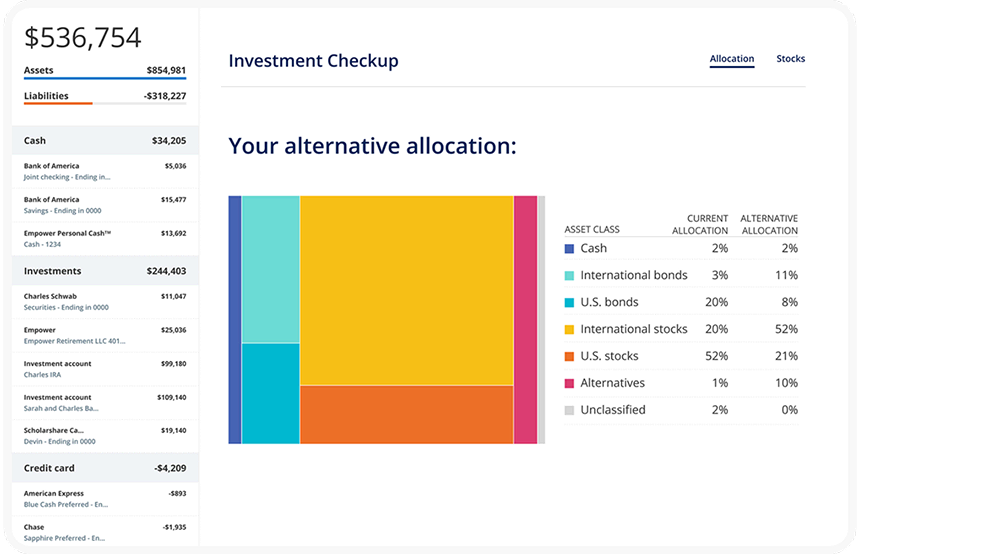
- Free financial tools: Empower’s free Personal Dashboard includes a host of useful tools, including a savings planner, retirement planner, financial calculators, and even a cost planner for your children’s education. But the tool that sets Empower apart is its Investment Checkup tool, which assesses portfolio risk, analyzes past performance, provides a target allocation for your portfolio, and lets you compare your portfolio to the S&P 500 and Empower’s “Smart Weighting” Recommendation.
- Fee-based wealth management services: Empower also offers several suites of advisory services depending on your investible assets. People with as little as $100,000 can get unlimited financial advice and retirement planning and a professionally managed portfolio. Clients with higher assets can access more services, including dedicated financial advisors, specialists in areas such as real estate and stock options, and even access to private equity.
Use our exclusive link to sign up for the Empower Personal Dashboard, whether that’s for the free tools or the advisory services. If you have $100,000 or more in investible assets, you’ll also be able to schedule a free initial 30-minute financial consultation with an Empower professional.
- Empower offers both a free set of portfolio, net worth, and cash flow tracking tools, as well as paid asset management service.
- Link Empower to your bank and investing accounts, credit cards, and more to see a single view of useful information and data, including your net worth.
- Empower Advisory Group offers a comprehensive wealth management service known as Personal Strategy. This managed account solution provides clients with discretionary investment management, personalized portfolio construction, and access to financial planning support. Accounts investing $100k to $250k receive unlimited advice and retirement planning help from financial advisors, as well as a professionally managed ETF portfolio with reviews upon request. Higher asset tiers offer access to dedicated advisors, estate planning, and tax specialists, plus additional investment options like access to private equity.**
- Special offer: If you have $100k+ in investible assets, sign up with our link to schedule a free initial 30-minute financial consultation with an Empower professional.
- Free portfolio tracker (Dashboard)
- Free net worth, cash flow, and investment reporting tools (Dashboard)
- Tax-loss harvesting (Personal Strategy)
- Dividend reinvestment (Personal Strategy)
- Automatic rebalancing (Personal Strategy)
- Low investment expense ratios (Personal Strategy)
- High number of investment accounts supported (Personal Strategy)
- Low $100k minimum for investment management (Personal Strategy) compared to traditional advisors.
- Moderately high investment management fee (0.89% AUM) compared to other online advisors (Personal Strategy)
- No dedicated advisor unless you have $250k+ in assets

Is Investing Health Savings Account Funds a Good Idea?
Yes, it can be a good idea to invest the funds in your health savings account—after all, investing is generally the best way to grow wealth over time. But you should also keep at least a portion of your HSA balance saved as cash so you can still easily spend it if you need it.
For instance, I typically keep my estimated annual out-of-pocket expenses in the savings portion of my HSA and invest the remaining balance for long-term needs, such as medical expenses in retirement. This gives me added peace of mind that the money is available if we can’t afford to cover unexpected health care costs with our normal checking account.
Related: 12 Best Vanguard ETFs You Can Buy [Build a Low-Cost Portfolio]
3 Benefits of Investing in an HSA

Some people just aren’t in a financial position where they can invest their HSA funds. But if you are, there are oh-so-many reasons to put at least some of that HSA money to work.
1. Triple Tax Advantage
HSAs offer an impressive trifecta of potential tax benefits, including:
- Pre-tax contributions: Contributions to an HSA made via payroll deduction are pre-tax. Any contributions you make on your own (not via payroll deduction) may be 100% tax-deductible.
- Tax-free investment growth: Your HSA investment earnings and interest earned on the savings portion aren’t subject to taxes either.
- Tax-free withdrawals for qualified medical expenses: If you withdraw HSA dollars for a qualified medical expense, you won’t be taxed on the withdrawal.
You will pay income taxes and a 20% penalty on withdrawals for non-qualified costs before age 65. However, after age 65, while you’ll still have to pay ordinary income tax on non-qualified withdrawals, you’ll no longer have to pay any penalties.
Related: HSA Rollover: How to Transfer HSA Funds to a New Provider
2. Long-Term Growth
Chances are your health care expenses will probably rise as you age. If you have a high-deductible health plan and start investing in an HSA early, you can build a sizable nest egg for medical costs (or other expenses) in retirement. This will provide some assurance that your future health care costs will be covered even if they grow more expensive when you’re older.
Related: 6 Common HSA Mistakes to Avoid
3. Investment Options
Similar to what you’d see with a taxable brokerage account, HSAs sometimes offer numerous investment options, including individual stocks, bonds, certificates of deposit (CDs), funds, and more.
For instance, with a self-directed HSA, investors can allocate a portion of their investments to individual equities, fixed-income assets, exchange-traded funds (ETFs), and mutual funds.
Do I Qualify for a Health Savings Account (HSA)?
To be eligible for a health savings account, you’ll need to be enrolled in a qualifying high-deductible health plan (HDHP). If you enroll in a high-deductible health plan through your employer, you can open an HSA account through your employer if they also offer that, but if not, you can sign up for your own personal HSA account.
For 2026, deductibles with an HDHP are at least $1,700 for self-only coverage or $3,400 for family coverage (up from $1,650 or $3,300, respectively, in 2025), which can be a hefty sum to pay out of pocket. But pre-tax money saved in your HSA can be used to offset those costs and other qualified medical expenses.
Also note that in 2026, the HSA contribution limit is $4,400 for individuals and $8,750 for families (up from $4,300 and $8,550, respectively, in 2025). And HSAs do have catch-up contributions for those 55 and older: In 2026, that’s an extra $1,000, bringing the limits to $5,400 and $9,750, respectively ($5,300 and $9,550 in 2025).
Vanguard Funds for Retirement: Frequently Asked Questions (FAQs)

What is the minimum investment amount on Vanguard mutual funds?
Vanguard funds are known for being shareholder-friendly. The Vanguard mutual fund company blazed new trails with the index fund, and Vanguard has done more than any other investment firm to keep costs to a minimum for investors.
But there is one hitch. Many of Vanguard’s cheapest funds in terms of fees have initial investment minimums of around $3,000.
If that is a problem for you, don’t sweat it. Most popular Vanguard index funds are also available as ETFs. Most self-directed HSAs will allow you to buy as little as one share, and some even allow for fractional shares. And if you use a commission-free brokerage, you can buy those ETFs without incurring additional fees. ETF prices vary, of course, but many cost less than $100, and they rarely exceed $400 per share.
Why does a fund’s expense ratio matter so much?
Every dollar you pay in expenses is a dollar that comes directly out of your returns. So, it is absolutely in your best interests to keep your expense ratios to an absolute minimum.
The expense ratio is the percentage of your investment lost each year to management fees, trading expenses and other fund expenses. Because index funds are passively managed and don’t have large staffs of portfolio managers and analysts to pay, they tend to have some of the lowest expense ratios of all mutual funds.
This matters because every dollar not lost to expenses is a dollar that is available to grow and compound. And over an investing lifetime, even a half a percent can have a huge impact. If you invest just $1,000 in a fund generating 5% per year after fees, over a 30-year horizon, it will grow to $4,116. However, if you invested $1,000 in the same fund, but it had an additional 50 basis points in fees (so it only generated 4.5% per year in returns), it would grow to only $3,584 over the same period.
Want to talk more about your financial goals or concerns? Our services include comprehensive financial planning, investment management, estate planning, taxes, and more! Schedule a call with Riley to discuss what you need, and what we can do for you.