


America’s employment situation took a turn south in February as poor weather and a strike by Kaiser Permanente nurses led to a “shocking” loss of jobs in the U.S. last month.
The Labor Department reported Friday that nonfarm payrolls fell by 92,000 in February—sharply below Dow Jones-polled economists’ expectations for 55,000 jobs created. That tally was also lower than January’s revised total of 126,000 jobs, which was down 4,000 from the initial print last month.
December suffered a steep negative revision, with the prior count of 48,000 jobs gained slashed to a loss of 17,000. That cements 2025 as one of the worst years for jobs creation (outside of recessions), with just 181,000 additions across the year, versus 584,000 expected.

“The employment report this morning was shocking, and not in a good way,” says Steve Wyett, Chief Investment Strategist at BOK Financial. “The market is already on its heels based on events in and around Iran, and the last thing we needed was an indication the economy was not as stable or positive as we thought. But that is exactly what we got: an outright decline in job growth, decline in labor force participation and an increase in the headline unemployment rate.”
Meanwhile, February’s surprise payrolls reading marked the third time in five months that the U.S. shed jobs.
“The trifecta of negative private payrolls, downward revisions, and a higher unemployment rate create an unambiguous negative print for the labor market,” says Jeff Schulze, Head of Economic and Market Strategy at ClearBridge Investments. “This release shows that the labor market remains stuck in 2025’s trend of weak job creation.”
10 Best ETFs to Beat Back a Bear Market
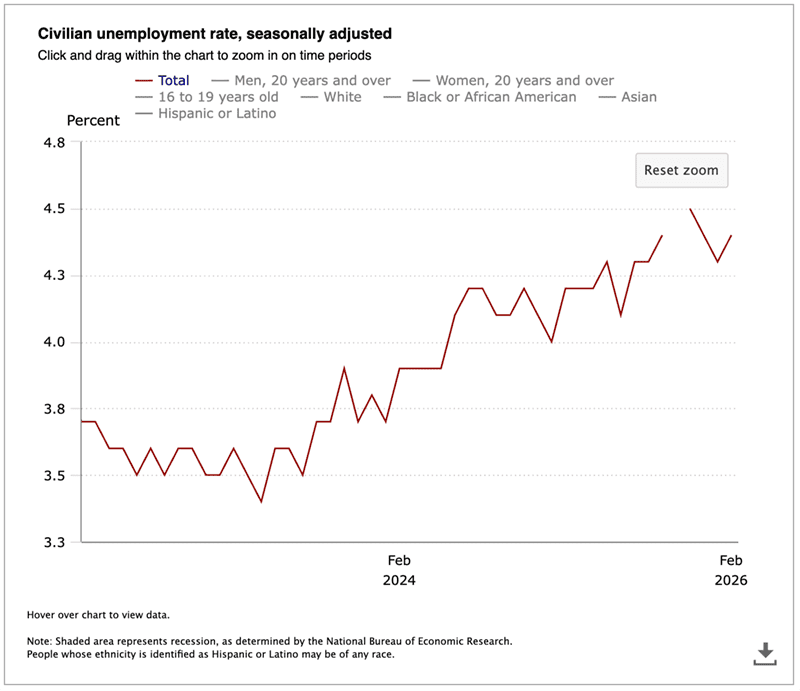
Unemployment—”considered a first among equals data point given the uncertainty around labor supply stemming from reduced immigration flows,” Schulze says—also ticked higher, to 4.4% from 4.3% the month before. Economists had expected unemployment to remain level.
February’s hourly earnings figure, however, came in a little higher than forecasts. Growth of 0.4% month-over-month, to $37.32, was even with January and a touch better than the 0.3% improvement expected. Over the past year, average hourly earnings have increased by 3.8%.
Here’s a brief look at the February jobs report’s most pertinent details:
- February payrolls: -92,000 MoM (estimate: +55,000)
- February unemployment: 4.4% (estimate: 4.3%)
- February hourly earnings: +0.4% MoM (estimate: +0.3%)
- January payrolls (revised): +126,000 (+130,000 previously)
- December payrolls (revised): -17,000 (+48,000 previously)
The payrolls decline follows a string of major layoff announcements over the past month, most notably at Twitter founder Jack Dorsey’s financial technology company, Block.
“February’s employment report resumed the trend of a weakening labor market from last year,” says Brad Conger, Chief Investment Officer at Hirtle Callaghan. “Block’s (XYZ) decision to lay off 40% of its workforce is a sign of the job bloat in the economy. Artificial intelligence is not replacing jobs, but job cuts are funding AI expenditures.”
7 Low- and Minimum-Volatility ETFs for Peace of Mind
While information payrolls declined by 11,000 in total over the month, it was hardly the only contributor to America’s net job loss.
Health care employment, which has been one of the nation’s greatest sources of payroll strength for years, lost 28,000 jobs in February; the sector was previously averaging 36,000 jobs gained per month. The decline reflected a massive strike of 31,000 nurses and other workers in California and Hawaii.
Federal government jobs declined by another 10,000, too. Since peaking in October 2024, the federal government has shed 330,000 jobs, or 11%. Transportation and warehousing employment was down 11%; the industry has lost 157,000 jobs, or 2.4%, since peaking in February 2025.
The greatest job gains were seen in social assistance, which added 9,000 jobs.
“There really is not much good news coming out of the employment report,” says Scott Helfstein, Head of Investment Strategy at fund provider Global X. “There were declines in almost every category. Transportation, manufacturing, construction, information, and business services were all down.”
Fed Still Expected to Stay Put in March
Despite the news, there was little change to expectations about the Federal Reserve’s next action at the upcoming Federal Open Market Committee (FOMC) meeting, set for March 17-18.
The 12 Best Budgeting Apps We’ve Reviewed
“The February payroll report saw a big negative surprise with job losses and a higher unemployment rate—a reminder that labor market risks haven’t disappeared,” says Sonu Varghese, Chief Macro Strategist at Carson Group. “At the same time, inflation is already elevated even before the upcoming energy price shock and AI-related bottlenecks. That’s going to stay the Fed’s hand when it comes to interest rates cuts; it’s unlikely we see cuts anytime soon.”
The CME FedWatch Tool, which uses Fed funds futures prices to track the probability of a change to the federal funds rate, now shows a 95% chance that the central bank will keep its benchmark rate at 3.50%-3.75%, virtually unchanged from yesterday.
However, futures strongly suggest the Fed will have cut by 25 to 50 basis points by the December 2026 Fed meeting. (A basis point is one one-hundredth of a point.)
“Developments in Iran and their potential consequences on inflation have overshadowed the U.S. employment picture to a degree, making the path forward to potential policy normalization less clear,” says Lindsay Rosner, head of multi sector fixed income investing at Goldman Sachs Asset Management. “We expect that the Fed will eventually complete the remaining two ‘normalization cuts’ to return rates to neutral; however, the timing is up in the air given current uncertainty.”
More Expert Reactions to February’s Jobs Report
Here’s what other strategists, financial managers, and experts had to say about last month’s employment situation:
Jerry Tempelman, VP of Economic and Fixed Income Research at Mutual of America Capital Management, Former Senior Analyst at the NY Fed
“With 92,000 jobs lost in February, the unemployment rate at 4.4% and still elevated PCE inflation data, there is some, but not yet strong, reason for the Fed to resume its easing cycle any time soon. Despite the impact of tariffs on household budgets, delinquencies and net charge-offs in the fourth quarter of last year remained well within their 2025 range, which also supports a rate-hold viewpoint.”
Jason Pride, Chief of Investment Strategy and Research, Glenmede
“Investors should be careful not to place too much stock into one individual month’s nonfarm payrolls print. The data have a notorious history of significant revisions that can notably change the tenor of a report several months after the fact. What may be more helpful is looking at the last three months’ trend, which is still clearly sluggish but a good deal more constructive than the February report appears at face value.
The 13 Best Mutual Funds You Can Buy
“The uptick in the unemployment rate was mostly a numerator effect, as the size of the labor force changed little in February. Instead, it was mostly those losing their jobs and others re-engaging in the job hunt leading to the increase in unemployed persons, in equal proportions. The unemployment rate remains well within the neighborhood of the natural rate of jobless, consistent with a well-functioning economy dealing with normal frictional factors, though its recent upward drift warrants monitoring.”
Brad Smith, Portfolio Manager, Janus Henderson Investors
“Well, this is messy. … While a negative sign for the labor market narrative, there are one-time events in the month that make the print less useful. Labor strikes, adverse weather and benchmark methodology revisions all cloud the signal from this single data point. Averaging the strong print from January and this print shows a labor market that is tepid and below replacement in line with the ‘low hire low fire’ economy. A silver lining comes from average hourly earnings that came in above estimates by a 10th at 3.8%, indicating those employed are seeing real wage growth as a reward for the ongoing productivity boon.
“The emerging narrative from the Fed was one of stability in the labor market. This print will call that into question, but the institution will certainly not lean on one data point. The market will bring the probability of a cut forward on this print but quickly move to the CPI print next week and await clarity on the duration of the developments in the Middle East.”
Peter Graf, Chief Investment Officer, Amova Asset Management Americas
“Today’s jobs report is a bracing splash of cold water for investors who assumed that the US economy could emerge unscathed from both the AI productivity revolution and capricious government policy zigzags. With a war-driven supply shock seemingly likely to lift prices higher, 2022-style stagflation concerns will now return to the fore. However, the fact that this report is a mirror image of the January data may couple with lingering questions about the quality of government statistics and cause many to discount the significance of one weak month.
“So far, inflation and fiscal deficit concerns have outweighed the usual wartime bid for the safety of bonds, and skeptical investors seem unlikely to reverse the trend higher in yields based on questionable data when uncertainty about the cost and knock-on effects of the Iran conflict remains so high.”