


Anyone just getting started as an investor could be forgiven for being overwhelmed. After all, anyone with access to a brokerage or retirement account that offers stocks, mutual funds, and exchange-traded funds have literally more than 10,000 different investments to choose from.
One suggestion to simplify things at first: Pick a couple “building block” products from a fund family that has built a reputation for quality.
To us, that includes looking at Fidelity—and more specifically, low-cost Fidelity index funds that can serve as the building blocks of a starter portfolio. Warren Buffett himself has repeatedly said that index funds are the best option for most investors. And Fidelity is one of the leading managers of index funds, offering some of the lowest fees in the business.
The question becomes: How do you go about deciding which Fidelity mutual funds or exchange-traded funds to buy? Well, we can help.
Read on as we explore the best Fidelity index funds for the beginning investor. These funds span a number of investing strategies, meaning there should be at least one fund here for everyone—and most investors should see several suitable options for building a starter portfolio. Better still? Unlike many other mutual funds that require hundreds if not thousands of dollars to get started, you can buy these Fidelity funds for as little as $1.
And for those who are very new to the game, we’ll also introduce you to index investing as well as Fidelity itself. then we’ll finish things off by answering a few frequently asked questions.
Editor’s Note: Tabular data presented in this article is up-to-date as of Oct. 7, 2026.
Featured Financial Products
Disclaimer: This article does not constitute individualized investment advice. Individual securities, funds, and/or other investments appear for your consideration and not as personalized investment recommendations. Act at your own discretion.
What Is an Index Fund?

The best way to explain index funds is to compare them to their cousins: actively managed funds.
Actively managed funds are run by one or more fund managers, who collect money from investors, then allocate that money to stocks, bonds, or other assets. With active funds, the managers are often tasked with beating some sort of benchmark index, but they’ll generally have a lot of discretion as to what they can buy and sell to accomplish that.
Index funds, in contrast, are passive. The fund manager isn’t actively looking to “beat the market” or “beat an index.” They’re simply looking to mimic a stock market index—like, say, the S&P 500—enjoying that underlying investment exposure.
Let’s use the S&P 500 as an example.
The S&P 500 holds the stocks of 500 companies, but it doesn’t hold equal amounts of each—it “weights” each stock by size. The larger the market capitalization (stock price times number of shares outstanding), the larger the percentage of the index is allocated to that stock. As of October 2026, the S&P 500’s heaviest weights go to tech stocks Nvidia (NVDA, ~9%), Apple (AAPL, ~7%), and Microsoft (MSFT, ~6%). So an index fund mimicking the S&P 500 should have about 9% of its assets invested in NVDA, another 7% in AAPL, and 6% in MSFT.
An active manager, on the other hand, doesn’t have those constraints. Their research might lead them to allocate the same 7% to AAPL, but 15% to NVDA and none to MSFT. It’s up to the manager’s discretion.
The primary advantage of actively managed funds is that a talented manager can potentially outperform over time and might be adept at navigating a difficult period such as a bear market. But you pay for that possibility in the form of higher fees and often worse tax efficiency.
Index investing generally comes with much lower costs in terms of management fees and trading expenses. It’s also more tax efficient, and performance often ends up being better than that of many active managers.
If you believe the stock market will generally rise over time, an index fund is the easiest and most direct way to get exposure.
Why Index Funds?
Most investors own index funds, whether they realize it or not.
Index funds are the dominant investment vehicle in most retirement plans these days, and with good reason: Low-cost index funds generally perform as well or better than most actively managed funds.
Fidelity index funds are leaders in this space. Many of the best Fidelity index funds (and many Fidelity funds period) have no minimum required investment, meaning you can buy with as little as 1. Plus, they feature some of the lowest fees among mutual funds.
But if you’re new to investing, you need to understand what index funds do. So let’s look under the hood to see what makes these best index funds tick.
Featured Financial Products
Why Fidelity?
Fidelity is a leader in investment funds—both mutual funds and exchange-traded funds (ETFs).
Today, this premier mutual fund company boasts almost $20 trillion in assets under administration. That’s in large part because it has smoothly adapted with the times. The company rose to fame on the backs of its star active managers, such as Peter Lynch, the long-time manager of the Fidelity Magellan Fund (FMAGX) who averaged an incredible 29.2% per year between 1977 and 1990. But over the past three decades, Fidelity has evolved into a leader in low-cost index funds and even broke new ground by offering zero-fee index funds via its Fidelity ZERO line.
Apart from its mutual fund management business, Fidelity also operates one of the biggest brokerage houses in the United States. It’s also the largest record keeper of 401(k) plans, and one of the largest providers of 403(b) plans for nonprofit organizations. Fidelity provides roughly 27,000 companies with defined-contribution and defined-benefit plans.
Today, we’re going to take a look at the very best Fidelity index funds for beginners. They run the gamut in terms of styles and strategies, but all of the best Fidelity index funds share one thing in common: They’re extremely cost-efficient ways for investors to quickly diversify.
Related: The 12 Best Investment Apps for Beginners
Earn a Dividend Match With Plynk**
- Plynk® is a dividend-friendly app that offers commission-free trades* on 5,000 stocks and more than 3,400 ETFs, and also supports mutual funds and cryptocurrencies.
- Plynk offers a cash match of 25% on dividend income that allows you to earn up to $250 extra each year.**
- Track your dividends and interest with Income Hub.
- Earn a 3.48% APY on uninvested cash.
- Plynk charges no account opening fees, and you can start investing for as little as $1.
- No account fees
- Smart design and smooth user experience
- Fractional shares
- Designed for beginning investors
- Virtual portfolios and simulated trading
- 25% dividend match
- Earn interest on uninvested cash
- One of the best automated investing programs we've seen (Steady Start)
- Elite educational resources and tools
- Lacks features such as options trading and advanced charting that more experienced traders prefer
The 7 Best Fidelity Index Funds for Beginners

I’m not trying to call out the seven absolute best Fidelity index funds in existence, nor am I trying to create a comprehensive portfolio.
Instead, I’m presenting a list of Fidelity index funds that can act as a starting point for beginner investors, or as a “most used” list for investors who want to rebuild part of their core. These funds cover all the major bases, providing exposure to U.S. stocks, developed- and emerging-market equities, and government and corporate bonds. Put differently: This list represents most of what the average investor needs in a basic portfolio.
So without further ado, let’s look at the best Fidelity index funds for beginners.
Make Young and the Invested your preferred news source on Google
Simply go to your preferences page and select the ✓ box for Young and the Invested. Once you’ve made this update, you’ll see Young and the Invested show up more often in Google’s “Top Stories” feed, as well as in a dedicated “From Your Sources” section on Google’s search results page.
Best Large-Cap Index Fund: Fidelity 500 Index Fund (FXAIX)

- Style: U.S. large-cap stock
- Assets under management: $857.6 billion
- Dividend yield: 1.0%
- Expense ratio: 0.015%, or $15¢ per year for every $1,000 invested
- Minimum initial investment: None
Virtually every list of basic funds you should own will start with an S&P 500 index product. I do it, and most everyone else does it too.
Why? Because even professional mutual fund managers—literal experts who are paid to try to beat the large-cap* index—consistently struggle to get over the benchmark. According to S&P Dow Jones Indices data from the end of 2025, only 14% of all actively managed large-cap funds were able to out-return the S&P 500 over the trailing 10-year period. That number drops to just 10% over the trailing 15 years.
“The S&P 500 is so hard to beat,” says Daniel Sotiroff, Senior Analyst for ETF and Passive Strategies at Morningstar. “I know guys that rate active managers in all these categories, and even they’re like, ‘I’m not buying actively managed large blend; I’m just indexing,’ because it’s so brutally tough to beat a dirt-cheap index fund in the large blend category.”
Related: 15 Best Long-Term Stocks to Buy and Hold Forever
If the pros can’t beat it, that’s a pretty good indication that we should just join it—which we can do by investing in a simple S&P 500 Index fund like the Fidelity 500 Index Fund (FXAIX).
FXAIX exposes you to all the market sectors, though not equally. As I mentioned earlier, the biggest chunk of the fund’s assets (almost 40%) is invested in tech stocks like Nvidia and Apple. Some sectors, like utilities and real estate, only account for about 2% to 3% each.
Still, if you believe in the American growth story, then buying a basket of America’s biggest and most recognized companies only makes sense. Even Warren Buffett himself (considered by many to be the greatest investor in history) has said on multiple occasions that most investors, most of the time, should simply invest in an S&P 500 index fund and let it run.
I’ll point out a couple more considerations. First, the Fidelity 500 Index Fund has a razor-thin expense ratio of 0.015%. That’s virtually impossible to beat. It’s even cheaper than S&P 500 ETFs. No wonder, then, that FXAIX has attracted an incredible $833 billion in assets under management.
Also, S&P 500 index funds’ turnover (the percentage of a fund’s holdings that are bought and sold in a given year) tends to be low, at just a couple percent in any given year. Why does it matter? Because mutual funds have to distribute net capital gains from trading back to shareholders; those gains are taxable, with long-term gains taxable at more favorable capital gains rates, and short-term gains taxable at even worse ordinary income tax rates.
In short: Low turnover makes S&P 500 funds an extraordinarily tax-efficient way to invest. So, if you find yourself with limited IRA or 401(k) funds available to invest, don’t worry—you can stuff a fund like FXAIX into your taxable brokerage account, too.
* There are different ways to define “cap” levels. We’re adhering to Morningstar’s definition, which says the largest 70% of companies by market capitalization within a fund’s “style” are large caps, the next 20% by market cap are mid-caps, and the smallest 10% by market cap are small caps.
Want to learn more about FXAIX? Check out the Fidelity provider site.
Related: 12 Best Stock Trading Apps + Platforms for Beginners
Best Small-Cap Fund: Fidelity ZERO Extended Market Index Fund (FZIPX)

- Style: U.S. mid- and small-cap stock
- Assets under management: $2.6 billion
- Dividend yield: 1.1%
- Expense ratio: None
- Minimum initial investment: None
You’ll pay low fees on virtually any Fidelity fund you own. But with a select few, you’ll actually pay no fees.
Yes, you read that right. The Fidelity ZERO Extended Market Index Fund (FZIPX) plugs investors into a broad universe of U.S. mid- and small-cap stocks, and it does so with an expense ratio of 0%.
That’s nothing. Nada. Draw a circle with your finger. FZIPX charges that much in fees.
Large-cap stocks are often relied upon to generate not just capital gains, but also some level of stability and dividend income. However, investors who want to generate outperformance often try to allocate some of their portfolio to smaller firms. Generally speaking, small- and mid-cap companies have more growth potential than larger firms. And as these stocks become noticed by institutional investors and fund managers, or begin qualifying for certain indexes, they can begin to enjoy large-scale investments that drive their prices even higher.
Related: The 10 Best Fidelity ETFs You Can Buy [Invest Tactically]
But smaller stocks tend to be more volatile. That’s because their underlying companies might be dependent on just one or two products or services, which means a single disruption (be it the economy, a competitor, what have you) could have massive financial consequences. They also have less access to capital than their larger peers, so they’re less likely to get a lifeline should they suffer from broader economic headwinds.
We can defray some of that risk by investing in hundreds or even thousands of mid- and small-cap stocks via funds like the FZIPX.
Fidelity ZERO Extended Market Index Fund tracks the Fidelity U.S. Extended Investable Market Index, designed to reflect the performance of U.S. mid- and small-cap stocks. In this case, Fidelity defines that as the largest 2,500 U.S. companies by market capitalization excluding the largest 500. It’s float-adjusted market cap-weighted, so the larger the company (based on its publicly available shares), the more assets FZPIX dedicates to holding it. To further keep costs down, the fund uses statistical sampling to replicate the returns of the index.
You’re getting true diversification here, too. Some funds may hold thousands of stocks but dedicate high-single-digit and even double-digit percentages of their assets to the biggest stocks they own. However, as of right now, none of Fidelity ZERO Extended Market’s 2,000 or so holdings have a weight of more than 1%, which means the fund’s overall performance isn’t beholden to a select few names.
While mid- and small-cap stocks historically deliver more growth than their larger peers, they’ve significantly lagged since 2022. The good news? They’ve started to outperform again in 2026. And FZIPX allows people to capture that growth for the absolutely unbeatable price of free.
There is one condition to the zero fees in the ZERO line of funds, however: They’re only available in Fidelity brokerage accounts. That might not be a problem, as Fidelity brokerage accounts are generally well regarded and competitive with the other major online brokers. But if you do not already have a Fidelity account, you’d need to open one.
Can’t access FZIPX? That’s OK. The Fidelity Small Cap Index Fund (FSSNX) is a respectable fund I’ve highlighted in other articles.
Want to learn more about FZIPX? Check out the Fidelity provider site.
Related: 8 Best Stock Portfolio Tracking Apps [Stock Trackers]
Best Total Market Fund: Fidelity Zero Total Market Index Fund (FZROX)
- Style: U.S. all-cap stock
- Assets under management: $41.2 billion
- Dividend yield: 0.9%
- Expense ratio: None
- Minimum initial investment: None
If you’re looking to tailor your portfolio, you can use large-cap funds like FXAIX and small-cap funds like FZIPX to adjust your allocations to different-sized stocks. However, if you want to take it easy, a “total” stock market index fund will provide investors with one-stop access to large, medium, and even small companies.
There are plenty of total-market funds out there. However, Fidelity Zero Total Market Index Fund (FZROX) is a rarity in that it provides broad exposure to the entire universe of U.S. stocks for absolutely zero expenses and no investment minimum.
Related: The 7 Best Index Funds for Beginners
FZROX tracks the Fidelity U.S. Total Investable Market Index, which is a float-adjusted market cap-weighted index designed to reflect the performance of the full U.S. equity market (in other words, large-, mid-, and small-cap stocks). Admittedly, “total” is a bit exaggerative; to keep costs down, the fund will use statistical sampling techniques to replicate the returns of the index without necessarily having to own every underlying stock.
Still, at 2,636 stocks currently, FZROX is as close to owning “the market” as you’d realistically need to get. he fund holds virtually every public U.S. company you’ve ever heard of—and thousands you likely haven’t. Just understand that the cap weighting means you’re still getting very heavy exposure to large caps, and less to mid- and small caps.
If you don’t have a Fidelity brokerage account, the Fidelity Total Market Index Fund (FSKAX) charges a thin 0.015% in annual expenses and also has zero minimum initial investment.
Want to learn more about FZROX? Check out the Fidelity provider site.
Make sure you sign up for The Weekend Tea, Young and the Invested’s free weekly newsletter that over 10k monthly readers use to level up their money know-how.
Related: 14 Best Investing Research & Stock Analysis Websites [2026]
Best International Fund: Fidelity ZERO International Index Fund (FZILX)

- Style: International large-cap stock
- Assets under management: $13.0 billion
- Dividend yield: 2.3%
- Expense ratio: None
- Minimum initial investment: None
America isn’t the only game in town.
Yes, the U.S. is the world’s premier idea factory and the engine that makes the global economy go. But there are hundreds or even thousands of quality companies in other developed markets (established, slower-growing) and emerging markets (less stable but faster-growing) outside America’s shores.
And while U.S. stocks have bested their peers over the past decade, there are long stretches when foreign stocks outperform, such as between 2000 and 2008. More recently, while U.S. equities have performed admirably in 2025 and 2026, international stocks have simply crushed it.
So if you are an American investor, it makes sense to keep the bulk of your investments in American companies. But it also makes sense to diversify and allocate at least a small portion of your funds into non-U.S. stocks.
For exposure to developed and emerging markets, the Fidelity ZERO International Index Fund (FZILX) is a solid option. Like its sisters in the Fidelity ZERO funds family, the fund offers zero expenses and no minimum investment. The fund tracks the Fidelity Global ex U.S. Index, a float-adjusted market capitalization-weighted index designed to reflect the performance of non-U.S. large- and mid-cap stocks. At the moment, that’s a basket of 2,225 stocks with significant holdings in companies domiciled in Japan, the U.K., Canada, and China, among other countries.
If you don’t have a Fidelity brokerage account, the Fidelity International Index Fund (FSPSX) charges just 0.035% in annual fees and has no minimum to invest.
Want to learn more about FZILX? Check out the Fidelity provider site.
Related: 11 Best Stock Trading Apps & Platforms [Free + Paid]
Best Sector Fund: Fidelity Real Estate Index Fund (FSRNX)

- Style: Sector (Real estate)
- Assets under management: $3.0 billion
- Dividend yield: 3.0%
- Expense ratio: 0.07%, or 70¢ per year for every $1,000 invested
- Minimum initial investment: None
Real estate is one of the world’s oldest asset classes and a preferred store of value for the world’s wealthy since the dawn of civilization. Having a portion of your assets dedicated to real estate investments only makes sense, and Fidelity makes it easy via the Fidelity Real Estate Index Fund (FSRNX).
This Fidelity index fund tracks the performance of the MSCI US IMI Real Estate 25/25 Index, which results in a collection of about 150 real estate investment trusts (REITs). These include logistics and warehousing specialist Prologis (PLD), datacenter landlord Equinix (EQIX), and mall giant Simon Property Group (SPG), among others.
REITs are a special class of company that owns and sometimes operates real estate. They enjoy special tax considerations in exchange for distributing at least 90% of their taxable income to shareholders as dividends. The index has certain limits in place—no holding can exceed 25% of the index’s assets, and all holdings that are weighted above 5% cannot collectively exceed 25% of the index’s assets—that keep the fund diversified and prevents it from being concentrated in a small number of mega-cap REITs.
Real estate has traditionally been a good inflation hedge, as many commercial leases have automatic rent increases tied to inflation. So, if inflation lasts longer than we hope or expect, having a little money in real estate will likely pay off nicely.
If you prefer the convenience and liquidity of an ETF, Fidelity offers the Fidelity MSCI Real Estate ETF (FREL). FREL tracks a different index, but one that still holds REITs, and it charges a skinflint 0.084% in annual expenses.
Want to learn more about FSRNX? Check out the Fidelity provider site.
Related: 7 Best Real Estate Crowdfunding Sites + Platforms
Featured Financial Products
Best ESG Fund: Fidelity U.S. Sustainability Index Fund (FITLX)

- Style: U.S. large-cap stock
- Assets under management: $6.0 billion
- Dividend yield: 1.0%
- Expense ratio: 0.11%, or $1.10 per year for every $1,000 invested
- Minimum initial investment: None
While it’s not as popular among older generations, younger investors passionately believe in ethical investing. They want to do well by doing good, allocating their capital to companies that meet their environmental, social and governance (ESG) standards.
Every investor’s definition of “ethical” will be a little different, so no mutual fund will ever be perfect. But if you’re looking for a single solution that should get you close, the Fidelity U.S. Sustainability Index Fund (FITLX) is a good option.
This Fidelity fund tracks the performance of the MSCI USA ESG Index, which represents the performance of stocks of large- to mid-cap U.S. companies with high environmental, social, and governance performance relative to their sector peers, as rated by MSCI ESG Research. As a practical matter, this means excluding companies in the tobacco, firearms, adult entertainment industries as well as many energy companies deemed to be heavy polluters. FITLX will also exclude companies with a history of bad labor relations or poor corporate governance.
Past that, though, FITLX and its 267 components are going to look a lot like your standard large-cap fund, including top holdings such as Nvidia, Microsoft, Eli Lilly (LLY), and Visa (V).
Want to learn more about FITLX? Check out the Fidelity provider site.
Related: 13 Best High-Yield Investments [Safe Options Right Now]
Best Bond Fund: Fidelity U.S. Bond Index Fund (FXNAX)
- Style: Intermediate core bond
- Assets under management: $67.6 billion
- SEC yield: 5.0%*
- Expense ratio: 0.025%, or 25¢ per year for every $1,000 invested
- Minimum initial investment: None
As 2022 taught us, no one should have 100% of their investable capital in stocks. Stocks can be wildly volatile. Having a portion of your capital in safe short-term bond funds can lower your overall portfolio volatility.
Bond funds are pretty diverse. You can leverage short-term bonds to collect a little yield while shielding your investments. You can try to collect a high income from corporate “junk” or emerging-market debt. You can even skirt federal tax on the income from municipal bonds.
But if you’re just looking for blanket bond exposure, it’s difficult to beat the Fidelity U.S. Bond Index Fund (FXNAX).
This Fidelity index fund tracks the performance of the Bloomberg U.S. Aggregate Bond Index (or “the Agg”), a premier debt index. You could consider it the S&P 500 of bond indexes.
FXNAX owns more than 10,600 different investment-grade bonds across a variety of issuers and maturities. U.S. Treasuries are tops at 45% of assets, followed by investment-grade corporate bonds and pass-through mortgage-backed securities (MBSes) at another 25% or so each. The remaining sliver of assets is sprinkled around other government-related debt, U.S. agency bonds, and commercial mortgage-backed securities (CMBSes), among other issues. Maturities run the gamut, from more than 20 years to less than one year, though the average remaining maturity is about 8 years.
In short, these are moderately-dated bonds, and ratings agencies have determined investors have a high chance of receiving their money back from them. (Hence “investment-grade.”)
One bond-fund metric to look at is duration, which is a measurement of risk. FXNAX currently has a duration of 5.8 years, which implies that if interest rates grew by 1 percentage point, the fund should suffer modest short-term capital losses of about 5.8%. (And vice versa: A 1-point hike should mean a gain of about 5.8%.) That’s a moderate amount of risk, and you’re getting a nice yield of well more than 4% in return.
* An SEC yield reflects the interest earned across the most recent 30-day period. This is a standard measure for funds holding bonds and preferred stocks.
Want to learn more about FXNAX? Check out the Fidelity provider site.
Make sure you sign up for The Weekend Tea, Young and the Invested’s free weekly newsletter that over 10k monthly readers use to level up their money know-how.
Related: 15 Best Investment Apps and Platforms [Free + Paid]
Track Your Portfolio With Empower
- Available: Sign up here
- Price: Tools: Free. Wealth Management: Starts at 0.89% of assets annually.*
Empower is one of our top-rated financial services firms for people of any income level thanks to the quality and breadth of its offerings:
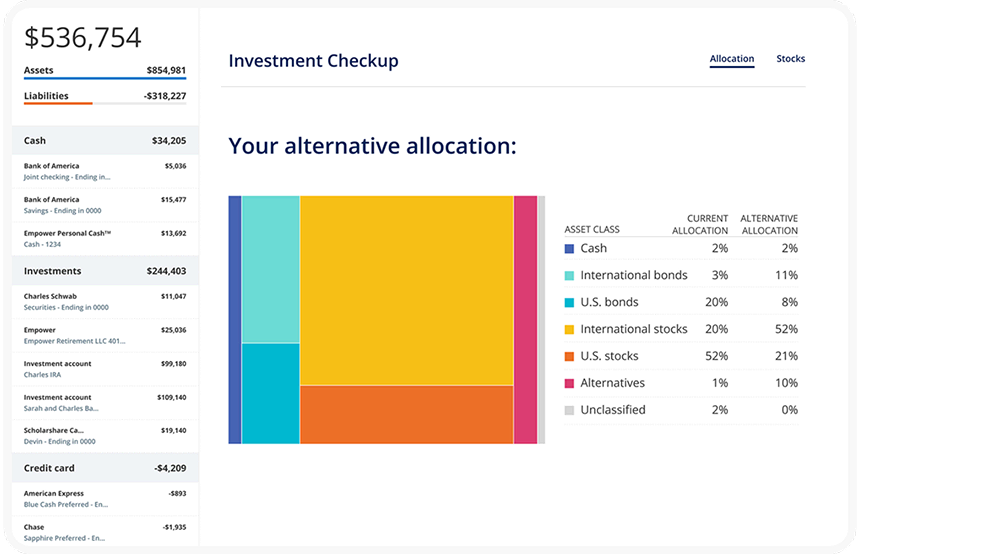
- Free financial tools: Empower’s free Personal Dashboard includes a host of useful tools, including a savings planner, retirement planner, financial calculators, and even a cost planner for your children’s education. But the tool that sets Empower apart is its Investment Checkup tool, which assesses portfolio risk, analyzes past performance, provides a target allocation for your portfolio, and lets you compare your portfolio to the S&P 500 and Empower’s “Smart Weighting” Recommendation.
- Fee-based wealth management services: Empower also offers several suites of advisory services depending on your investible assets. People with as little as $100,000 can get unlimited financial advice and retirement planning and a professionally managed portfolio. Clients with higher assets can access more services, including dedicated financial advisors, specialists in areas such as real estate and stock options, and even access to private equity.
Use our exclusive link to sign up for the Empower Personal Dashboard, whether that’s for the free tools or the advisory services. If you have $100,000 or more in investible assets, you’ll also be able to schedule a free initial 30-minute financial consultation with an Empower professional.
- Empower offers both a free set of portfolio, net worth, and cash flow tracking tools, as well as paid asset management service.
- Link Empower to your bank and investing accounts, credit cards, and more to see a single view of useful information and data, including your net worth.
- Empower Advisory Group offers a comprehensive wealth management service known as Personal Strategy. This managed account solution provides clients with discretionary investment management, personalized portfolio construction, and access to financial planning support. Accounts investing $100k to $250k receive unlimited advice and retirement planning help from financial advisors, as well as a professionally managed ETF portfolio with reviews upon request. Higher asset tiers offer access to dedicated advisors, estate planning, and tax specialists, plus additional investment options like access to private equity.**
- Special offer: If you have $100k+ in investible assets, sign up with our link to schedule a free initial 30-minute financial consultation with an Empower professional.
- Free portfolio tracker (Dashboard)
- Free net worth, cash flow, and investment reporting tools (Dashboard)
- Tax-loss harvesting (Personal Strategy)
- Dividend reinvestment (Personal Strategy)
- Automatic rebalancing (Personal Strategy)
- Low investment expense ratios (Personal Strategy)
- High number of investment accounts supported (Personal Strategy)
- Low $100k minimum for investment management (Personal Strategy) compared to traditional advisors.
- Moderately high investment management fee (0.89% AUM) compared to other online advisors (Personal Strategy)
- No dedicated advisor unless you have $250k+ in assets

Related: The 8 Best Vanguard Index Funds for Beginners
Mutual Funds vs. ETFs
Mutual funds and ETFs are similar vehicles that have a few key differences. But also confusing the conversation is that many people use the term “index funds” interchangeably with “exchange-traded funds (ETFs),” and “actively managed funds” with “mutual funds.”
While there’s a lot of overlap, they’re not the same thing. So, we’ll tackle the differences between mutual funds and ETFs, and explain why people are so quick to automatically equate them to index or actively managed products.
Mutual funds
When you invest in a mutual fund, you (or your broker) actually send money to the fund company, which in turn uses the cash to buy stocks or other investments. When you want to sell, the fund company will sell off a tiny piece of the securities the mutual fund owns and send you the proceeds. Money generally enters or exits the fund once per day.
Mutual funds are the traditional vehicles of choice for 401(k) plans or other situations when an investor is dollar-cost averaging, which means investing in regular installments. If you have a specific dollar amount to invest each month, whether it’s $100 or $10,000, a mutual fund will generally be able to accommodate you easier than an exchange-traded fund.
But the key here is that you don’t need a specific amount based on the price of a share. Once you meet the minimum initial investment (a certain dollar amount you must invest when you first buy the fund), you can generally invest just about any amount.
The thing is, most mutual funds are actively managed, which is why people conflate “mutual funds” and “actively managed funds.” But there are numerous index mutual funds.
The best Fidelity mutual funds tend to be some of the cheapest in the business in terms of fees, many of them indexed. And there are Fidelity index funds for virtually every stock market index you can imagine.
Exchange-traded funds (ETFs)
ETFs are quite similar to mutual funds, but their differences are significant … and make them superior in certain situations.
Like traditional index mutual funds, an ETF will hold a basket of stocks, bonds and other securities. These can be broad and benchmarked to a major index like the S&P 500, or they can be exceptionally narrow and focus on a specific sector or even a specific trading strategy. For the most part, anything that can be held in an exchange-traded fund can also be held in a mutual fund.
However, unlike mutual funds, ETFs trade on major exchanges—such as the New York Stock Exchange or Nasdaq—like a stock. If you want to buy shares, you don’t send the manager money; you just buy shares from another investor on the open market.
The need to buy shares can be problematic when dollar-cost averaging. As an example, let’s say you have exactly $100 to invest, but the shares of the ETF trade for $65. You can only buy one share, and you’re stuck with $35 in cash uninvested.
But ETFs have their own advantages. For one, they have intraday liquidity—that is, if you want to buy or sell in the middle of the trading day (or multiple times throughout the trading day), you can.
The second advantage is tax efficiency. In a traditional mutual fund, redemptions by investors can generate selling by the manager that creates taxable capital gains for the remaining investors who didn’t sell. This doesn’t happen with ETFs, as the manager isn’t forced to buy or sell anything when an investor sells their shares.
Like we said, many investors use “ETF” and “index fund” interchangeably. That’s because most exchange-traded funds are index funds—but not all. Some are actively managed.
As is the case with Fidelity index funds, Fidelity ETFs tend to have some of the lowest costs in the business.
Related: The 10 Best ETFs for Beginners
FAQs About Fidelity Index Funds

What are Fidelity ZERO Funds?
Fidelity ZERO Funds are a line of zero-minimum, zero-expense index funds launched by Fidelity in 2018. Currently, there are four Fidelity ZERO funds:
- Fidelity Zero International Index Fund (FZILX)
- Fidelity Zero Total Market Index Fund (FZROX)
- Fidelity Zero Extended Market Index (FZIPX)
- Fidelity Zero Large Cap Index Fund (FNILX)
The ZERO funds are true to their name: Investors literally pay nothing in management fees. But there are conditions. The Fidelity ZERO funds are only available in Fidelity brokerage accounts. That might not be a problem, as Fidelity brokerage accounts are generally well regarded and competitive with the other major online brokers. But if you do not already have a Fidelity account, you’d need to open one.
Fidelity ZERO Funds are, strictly speaking, index funds. But they are based on customized indexes that Fidelity has created in-house. The typical large-cap index fund tracks the S&P 500 or another recognized index, but they have to pay licensing fees to the index creator. Fidelity avoids the licensing fees by creating their own indexes, which allows them to pay the savings on in the form of zero fees.
The Fidelity indexes tend to be very similar to popular indexes such as the S&P 500, but they are not the same. So, if tracking a specific index is a priority for you, you should take that under advisement.
Featured Financial Products
Why does a fund’s expense ratio matter so much?
Every dollar you pay in expenses is a dollar that comes directly out of your returns. So, it is absolutely in your best interests to keep your expense ratios to an absolute minimum.
The expense ratio is the percentage of your investment lost each year to management fees, trading expenses and other fund expenses. Because index funds are passively managed and don’t have large staffs of portfolio managers and analysts to pay, they tend to have some of the lowest expense ratios of all mutual funds.
This matters because every dollar not lost to expenses is a dollar that is available to grow and compound. And over an investing lifetime, even a half a percent can have a huge impact. If you invest just $1,000 in a fund generating 5% per year after fees, over a 30-year horizon, it will grow to $4,116. However, if you invested $1,000 in the same fund, but it had an additional 50 basis points in fees (so it only generated 4.5% per year in returns), it would grow to only $3,584 over the same period.

What is the minimum investment amount on a Fidelity fund?
Every Fidelity fund has its own minimum investment amount specific to that fund. But Fidelity has been a trailblazer in making its funds available to beginning investors with ultra-low minimums, and many Fidelity funds have no minimum investment at all.
Part of our criteria in selecting the best Fidelity index funds was accessibility, and every fund selected here has a minimum investment of zero, meaning you can literally start your investment with any dollar amount.
Want to talk more about your financial goals or concerns? Our services include comprehensive financial planning, investment management, estate planning, taxes, and more! Schedule a call with Riley to discuss what you need, and what we can do for you.