

The air was let out of the inflation balloon in June, with consumer prices dropping by the fastest level in six years—easing some concerns that the Federal Reserve would soon raise its benchmark interest rate.
The U.S. Bureau of Labor Statistics said Tuesday that June’s consumer price index (CPI), which measures the change in prices on a variety of consumer goods and services, rose by a seasonally adjusted 3.5% year-over-year—well below estimates for 3.8% and a steep decline from May’s 4.2% headline figure (which was the hottest print since May 2023). On a month-over-month basis, prices actually declined by 0.4%, which was better than expectations for growth of 0.2% and the biggest decline in prices since April 2020.
“Core” CPI—a measure of inflation that excludes food and energy costs (factors that are more volatile than the other prices tracked by the Labor Department)—was also plenty softer than expected. Core inflation came in flat MoM and up 2.6% YoY versus expectations of 0.2% and 2.9% growth, respectively.
Related: Empower Personal Strategy Review: Wealth Management More People Can Afford
Stock markets bounced Tuesday morning, with Wall Street believing the report will stay the Fed’s hand at its next rate-setting meeting. But the reprieve on consumers might only be temporary.
“The well-behaved CPI print likely lowers pressure on the Fed to hike soon, but the reignition of hostilities in Iran means the prospect of hikes is far from over,” says Kay Haigh, global head and CIO of Fixed Income and Liquidity Solutions at Goldman Sachs Asset Management. “Concerns over energy supply through the Strait of Hormuz raises risks to the forward-looking inflation outlook, which could force the FOMC’s hand eventually. Although a path remains for rates to stay unchanged this year, the re-escalation of the conflict has narrowed it.”
Here’s a quick look at June’s key CPI figures:
- MoM CPI: +0.4% (estimate: +0.2%)
- YoY CPI: +3.5% (estimate: +3.8%)
- MoM Core CPI: Flat (estimate: +0.2%)
- YoY Core CPI: +2.6% (estimate: +2.9%)
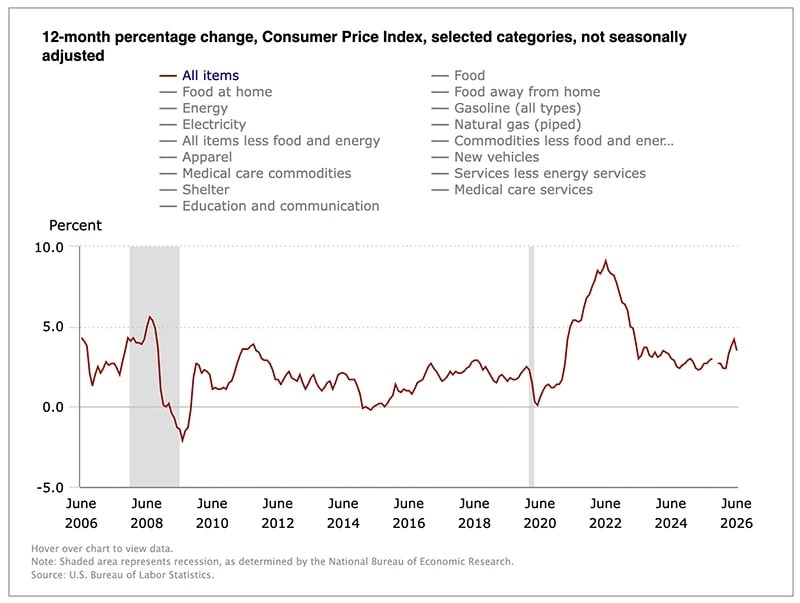
Energy prices led the all-items index lower, falling 5.7% year-over-year after rising by nearly 4% in each of the past two months and 11% in March. That included a sharp 9.7% drop in gasoline and 9.2% decline in fuel oil. From a utility perspective, electricity prices dropped 1%, though natural gas climbed by half a point.
“For three months the open question was whether the energy shock would seep into the rest of the basket. June answers it about as clearly as a single report can,” says Jason Pride, Chief of Investment Strategy & Research at Glenmede. “The Iran-driven spike at the pump, however painful, has not metastasized into a broader inflation episode, and the window in which that spillover would typically show up is now largely behind us.”
Related: 10 Best ‘Rebound’ Stocks to Buy for the Rest of 2026
Prices eased in several other categories. Used car and truck prices came down 0.2% month-over-month and are now down 1.8% over the past year. Medical care commodities fell by the same amount and are off 2.1% over the past 12 months. Transportation services and medical care services also saw slight price declines.
Need Help Picking Stocks? Consider These Top-Rated Services
|
Best Introductory Stock Picking Service

|
Data-Driven Stock Picking Service

|
Best Proprietary Ranking System

|
|
Primary Rating:
4.7
|
Primary Rating:
4.3
|
Primary Rating:
4.2
|
|
$99/yr. ($100 first-year savings)
|
$449/yr. ($50 discount)*
|
30-day free trial, then $249/yr.
|
Still, continuing price growth in other areas don’t have all experts convinced that inflation worries are behind us.
Food prices continued to rise, however. Both food at home and away from home were up by 0.2% month-over-month in June. The former has grown by 2.7% year-over-year, while the latter is up by 3.4%. Shelter prices continue to moderate, up 0.1%.
“The underlying inflation picture remains uncomfortable,” says Sonu Varghese, Chief Macro Strategist at Carson Group. “Software prices continue to rise amid AI-related capacity constraints, while persistent restaurant inflation suggests demand remains strong.”
Fed Seen as Far Less Likely to Raise Rates in July
The report immediately scaled back worries that the Federal Reserve would raise its target range for the federal funds rate at the conclusion of its next Federal Open Market Committee (FOMC) meeting, scheduled for July 27-28.
The CME FedWatch Tool, which uses trading in federal-funds futures to determine Wall Street’s expectations for future Federal Reserve actions, shows an 83% chance that the central bank will maintain its current 3.50%-to-3.75% range later this month, and just a 17% chance that it will announce a quarter-point hike. The probability of a stay is up from 58% yesterday and 89% a month ago.
“This is great news for [Chair] Kevin Warsh and the Fed,” says David Russell, Global Head of Market Strategy at TradeStation, an online brokerage firm. “Kevin Warsh is staking out a hawkish position in his testimony by strongly linking inflation with monetary policy. That implies rate hikes might be needed to get prices under control. He also noted few layoffs, which could support tighter policy.”
That said, expectations didn’t change much for the end of the year. Wall Street futures heavily imply at least one rate hike by the December FOMC meeting.
“[The CPI report] strengthens the case that the inflation impulse keeping policy on hold was largely a one-off, and it should give the committee more room to lean toward supporting the labor market as the year progresses,” Pride says. “The caveat sits in the oil market rather than the inflation data: crude has shown signs of turning higher again, and a fresh energy shock arriving just as the last one clears would test that thesis. For now, the direction of travel on underlying inflation is constructive, and the market may be underestimating the likelihood of a cut later this year.
Related: 2026 Second-Half Market Outlook: Stocks, Rates + More
What the Experts Think About June’s CPI Report
Here, we outline more thoughts from the experts on what last month’s CPI numbers mean for consumers, markets, the Federal Reserve’s future actions, and more:
Gargi Chaudhuri, Chief Investment and Portfolio Strategist, Americas, BlackRock
“We expect the Federal Reserve to leave interest rates unchanged at the July FOMC meeting. In our view, this inflation report does not provide evidence that would justify additional policy tightening. While policymakers continue to monitor inflation risks, particularly from energy prices, we believe the bar for further rate hikes remains high.
“The Federal Reserve continues to assess whether temporary supply shocks, particularly higher oil prices, begin to influence longer-term inflation expectations. While we do not expect higher energy prices to materially broaden inflation, we are watching closely to see whether they affect consumers’ expectations for future inflation. Beyond July, we expect the Fed to remain patient as it evaluates incoming inflation and labor market data. Policymakers will also continue assessing the findings from the five working groups launched by Chair Warsh, which could reshape the Fed’s communications framework and broader approach to monetary policy.”
Related: 3 Best Preferred Stock ETFs to Buy [High Income From ‘Hybrids’]
Josh Jamner, Senior Investment Strategy Analyst, ClearBridge Investments
“This print pours cold water on the case for rate hikes in the near-term and should lift risk assets including U.S. equities as rate hikes get priced out of the market and yields across the curve fall. Underneath the hood, inflation was fairly muted, with lower energy costs, softer shelter inflation, modest goods deflation, and tame services inflation. … Importantly, the components from today’s CPI release that flow into the Fed’s preferred PCE measure imply a modest print in the 0.1-0.2% range for core PCE.”
Get Elite Stock Analysis From Seeking Alpha
Among our favorite platforms for both data and picks is Seeking Alpha Premium, which gives you unlimited access to thousands of active authors who deliver stock analysis.
Seeking Alpha also provides you with stock research tools, real-time news updates, crowdsourced debates, and market data. Users can create their own portfolio of favorite stocks, see how they perform, and receive email alerts or push notifications about their investments.
Try out Seeking Alpha Premium free for seven days and get a discount on your first year’s subscription.
- Seeking Alpha Premium and Pro help you find profitable investing ideas, improve your portfolio, research stocks better and faster, track the news to find investing opportunities, and connects you to the world's largest investing community.
- A Premium subscription provides access to Seeking Alpha's stock and ETF ratings, including Seeking Alpha Quant Strong Buy recommendations, which have greatly outperformed the stock market over time.
- Premium also gives you access to Seeking Alpha's portfolio health check, which will analyze your portfolio's quality, risk level, and performance.
- Advanced and professional investors can sign up for Pro, where they'll get everything from Premium, as well as instant access to ideas from SA's top 15 analysts, the PRO Quant Portfolio (for active traders), short-selling ideas, and more.
- Special offer on Premium: New subscribers through our link receive a $30 discount off the price of Seeking Alpha Premium in their first year.*
- Special offer on Pro: New subscribers through our link receive one month of Pro for $89, then get $250 off their first full year's subscription.**
- Active community of engaged investors and analysts
- Stock screeners, quantitative tools for stock analysis
- Strong track record of market outperformance on stock ratings
- Minimal mutual fund coverage