
Energy costs continued to pinch Americans’ wallets in May, keeping consumer-price growth at three-year highs.
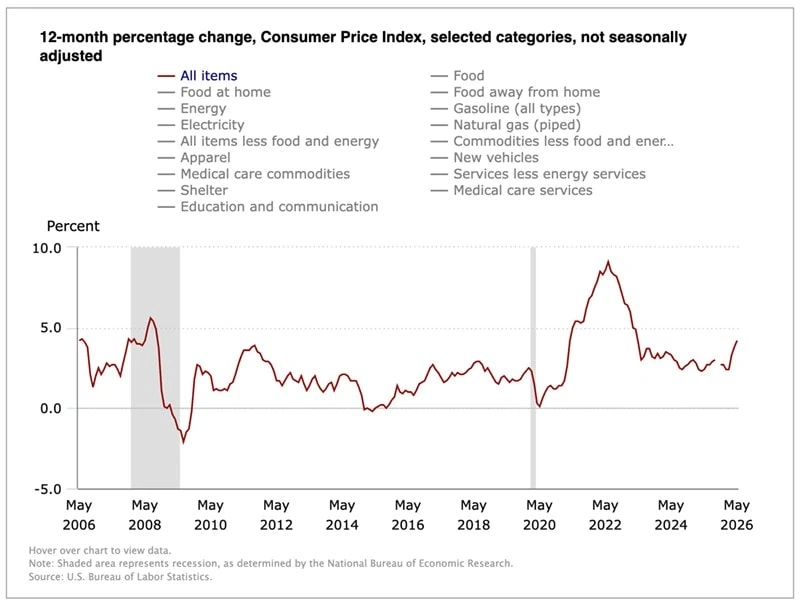
The U.S. Bureau of Labor Statistics said Wednesday that May’s consumer price index (CPI), which measures the change in prices on a variety of consumer goods and services, rose by a seasonally adjusted 0.5% month-over-month—a slightly slower rate than April’s 0.6% and in line with analysts’ estimates. The headline year-over-year reading remained elevated, with the 4.2% growth in consumer prices also meeting estimates but hotter than the prior month’s 3.8% and the highest such pace since May 2023.
“Core” CPI—a measure of inflation that excludes food and energy costs (factors that are more volatile than the other prices tracked by the Labor Department)—was a bit softer than expected on a month-over-month basis. Core inflation of 0.2% was both slower than April’s 0.4% rate and estimates for 0.3%. But on a year-over-year basis, a core CPI increase of 2.9% was in line with estimates and a hair quicker than April’s 2.8%.
Related: ‘Barnburner’ May Jobs Report Puts Fed Rate Hike in Play
With core measures suggesting more limited price increases and much of the upside coming from oil directly (energy) or indirectly (airfares), today’s release suggests that inflationary pressures stemming from the oil price shock have remained manageable for the U.S. economy so far,” says Josh Jamner, Senior Investment Strategy Analyst at ClearBridge Investments.
Here’s a quick look at May’s key CPI figures:
- MoM CPI: +0.5% (estimate: +0.5%)
- YoY CPI: +4.2% (estimate: +4.2%)
- MoM Core CPI: +0.2% (estimate: +0.3%)
- YoY Core CPI: +2.9% (estimate: +2.9%)
“While the recent spike in both headline and core inflation is meaningful and a headwind for the economy and more cyclical sectors, tailwinds from the AI investment cycle, potential benefits from the Big Beautiful Bill, and the lagged impact of Fed rate cuts are all still providing meaningful support,” says Tim Urbanowicz, Chief Investment Strategist, Innovator ETFs from Goldman Sachs Asset Management. “If the Iran conflict drags on and inflationary pressures continue to build, there could come a point where that balance shifts, but we don’t see that today.”
The continued closure of the Strait of Hormuz caused the energy index to rocket another 3.9% month-over-month in May—quicker than April’s 3.8% pace—and is now higher by more than 23% year-over-year. Gas prices are now 40% higher than they were a year ago, accelerating to 7% growth in May after rising 5.4% in April.
Related: 15 Best Long-Term Stocks to Buy and Hold Forever
Energy prices also bled into the airline fares index, which rose 2.7% last month.
Jason Pride, Chief of Investment Strategy and Research at Glenmede, notes that energy prices have compounded by roughly 20% over the March-through-May period—with the bulk of that coming from the initial Strait closure in March—and even though the monthly pace has decelerated significantly from that spike, it has remained persistently positive.
“The post-ceasefire oil price decline has not yet worked its way through to pump prices,” he adds. “Energy will continue to distort the headline picture at least through the June report.”
Higher costs for gas and fuel oil overshadowed easing inflation in other categories. Food-price growth slowed to just 0.2% MoM after increasing by 0.5% in April. Shelter costs, which are still up 3.4% year-over-year, decelerated from 0.6% monthly growth in April to just 0.3% in May. Utility costs hit the brakes, rising by just 0.4% MoM last month after jumping 1.6% in April.
Meanwhile, rising prices in a few categories actually sparked optimism about the economy.
For instance, prices for food away from home (+0.3% MoM) outpaced prices for food at home (+0.1%), which Jamner called a “sign of strength from the U.S. consumer given the discretionary nature of eating out.”
“Outside of energy, inflation was driven by higher airline and recreation costs,” adds Scott Helfstein, Head of Investment Strategy at Global X ETFs. “While that is frustrating for consumers, it is also a sign of a healthy economy. Airports and sporting events are packed. Wages continue to rise, though gains are slowing, and people continue to spend. That is a good formula.”
Related: Cerebras Systems (CBRS) Earns Raft of Buy Calls Post-IPO
Need Help Picking Stocks? Consider These Top-Rated Services
|
Best Introductory Stock Picking Service

|
Data-Driven Stock Picking Service

|
Best Proprietary Ranking System

|
|
Primary Rating:
4.7
|
Primary Rating:
4.3
|
Primary Rating:
4.2
|
|
$99/yr. ($100 first-year savings)
|
$449/yr. ($50 discount)*
|
30-day free trial, then $249/yr.
|
Market Still Eyes Rate Hike in 2026
The report had little immediate impact on the market’s expectations for interest rates.
The CME FedWatch Tool, which uses trading in federal-funds futures to determine Wall Street’s expectations for future Federal Reserve actions, shows a 98% chance that the target range for the federal funds rate will stay at its current 3.50%-to-3.75% range at the conclusion of the next Federal Open Market Committee (FOMC) meeting, scheduled for June 16-17. That’s virtually unchanged from yesterday. Meanwhile, the market is pricing in a nearly 70% chance of at least one rate hike by the end of 2026.
“The different signals from different inflation metrics will be on display this month,” says Andrew Hollenhorst, U.S. Chief Economist at Citi Research, who predicted a 0.22% MoM rise in core CPI but a much stronger 0.37% MoM jump in core personal consumption expenditures (PCE), which comes out later this month. “In our view, of the two CPI is currently the more accurate metric, in part because AI-linked prices are overrepresented in PCE. In contrast to the popular market narrative, we think underlying inflation is running around 2.5% and has been on a declining trend.”
Hollenhorst adds that core PCE looks more concerning because it overweights computer-memory prices, which have been boosted by artificial-intelligence demand, and because rising equity prices can impact portfolio management fees and boost the reading.
“These quirks of PCE methodology have little to do with the rate of change of the average prices consumers face on a daily basis (what most non-economists would recognize as ‘inflation’),” he says.
Related: iShares Target-Date ETFs: A Retirement Tool for All
What the Experts Think About May’s CPI Report
Here, we outline more thoughts from the experts on what last month’s CPI numbers mean for consumers, markets, the Federal Reserve’s future actions, and more:
Gargi Chaudhuri, Chief Investment and Portfolio Strategist, Americas, BlackRock
“The stronger-than-expected May employment report showed the U.S. economy adding 172,000 jobs. The report has increased market expectations for rate hikes and modestly increased the probability that rates remain elevated for longer.
“While the probability of additional tightening has increased at the margin, we believe the Fed will need to see further evidence that inflation pressures are broadening before considering another rate increase.”
Scott Helfstein, Head of Investment Strategy, Global X ETFs
“Despite some calls from Fed governors, there is no reason to start hiking rates. When inflation is driven by higher energy and housing costs based on supply side shocks, raising rates does not address the underlying issue, it just slows economic activity unnecessarily. What we need is more investment in housing and energy production, not less.”
Brad Conger, Chief Investment Officer, Hirtle & Co.
“Core prices were in line. The tentative conclusion is that energy is not bleeding into core items. Or at least the leakage is being offset by tariffs passing through. This news should pacify the hawks on the FOMC.”
Sonu Varghese, Chief Macro Strategist, Carson Group
“CPI confirms what we already knew: inflation is hot. Headline prices are up more than 4% year over year and running at an 8.2% annualized pace over the last three months. Worse, the heat isn’t confined to energy, as it’s showing up in food and services outside housing. That puts Warsh in a bind, as the cuts he was appointed to deliver will be hard to justify.”
Get Elite Stock Analysis From Seeking Alpha
Among our favorite platforms for both data and picks is Seeking Alpha Premium, which gives you unlimited access to thousands of active authors who deliver stock analysis.
Seeking Alpha also provides you with stock research tools, real-time news updates, crowdsourced debates, and market data. Users can create their own portfolio of favorite stocks, see how they perform, and receive email alerts or push notifications about their investments.
Try out Seeking Alpha Premium free for seven days and get a discount on your first year’s subscription.
- Seeking Alpha Premium and Pro help you find profitable investing ideas, improve your portfolio, research stocks better and faster, track the news to find investing opportunities, and connects you to the world's largest investing community.
- A Premium subscription provides access to Seeking Alpha's stock and ETF ratings, including Seeking Alpha Quant Strong Buy recommendations, which have greatly outperformed the stock market over time.
- Premium also gives you access to Seeking Alpha's portfolio health check, which will analyze your portfolio's quality, risk level, and performance.
- Advanced and professional investors can sign up for Pro, where they'll get everything from Premium, as well as instant access to ideas from SA's top 15 analysts, the PRO Quant Portfolio (for active traders), short-selling ideas, and more.
- Special offer on Premium: New subscribers through our link receive a $30 discount off the price of Seeking Alpha Premium in their first year.*
- Special offer on Pro: New subscribers through our link receive one month of Pro for $89, then get $250 off their first full year's subscription.**
- Active community of engaged investors and analysts
- Stock screeners, quantitative tools for stock analysis
- Strong track record of market outperformance on stock ratings
- Minimal mutual fund coverage