

Opening a child’s bank account with a debit card can be a big step for both a child and parents. So, it’s important to know what you are getting into before making your decision to move forward with your child’s first bank account and debit card.
This article will provide you options on where to open an account, help walk you through the considerations you might have when getting a bank account with a debit card, the features to look for and the steps involved in opening a child’s bank account with a debit card.
This should help you make an informed decision about whether or not this is right for your family.
Let’s jump right in.
Best Child Bank Accounts With Debit Cards
|
Best Debit Card for Kids

|
Kids Money App With Great Safety Features

|
Best Kids Debit Card From a Major Bank

|
Best Kids Debit Card for Customer Service

|
|
Primary Rating:
4.8
|
Primary Rating:
4.7
|
Primary Rating:
4.6
|
Primary Rating:
4.4
|
|
Core: $5.99/mo. Max: $10.98/mo. Infinity: $15.98/mo. Family Shield: $19.98/mo. (Each account supports up to 5 children.)
|
No subscription fees.
|
Free (no monthly fees).
|
Acorns Early Lite: Free 30-day trial, then $8/mo. Acorns Gold: $12/mo.
|
Are You Ready to Open a Bank Account and Debit Card for Your Kids?

If you feel ready to open a bank account with a debit card associated with the account, you’ll need to consider your available options. Have a look below at some useful debit cards for teens (or younger).
| App | Apple App Store Rating / "Best For" | Fees |
|---|---|---|
 Greenlight Greenlight | ☆ 4.8 / 5 High customer satisfaction and strong parental controls | Core: $5.99/mo. Max: $10.98/mo. Infinity: $15.98/mo. Family Shield: $19.98/mo. (All plans include cards for up to 5 children) |
 Cash App Families Managed Accounts (For Kids) Cash App Families Managed Accounts (For Kids) | ☆ 4.8 / 5 Excellent parental controls and no monthly fees. | No monthly fees |
 Chase First Banking Chase First Banking | ☆ 4.8 / 5 High customer satisfaction from a major bank card and no monthly fees | No subscription fees |
 Acorns Early Acorns Early | ☆ 4.7 / 5 Accessible customer service support | Acorns Early Lite: 30 days free, then $8/mo. Acorns Gold (Includes Acorns Early Invest): $12/mo. |
 Revolut <18 Revolut <18 | ☆ 4.8 / 5 Parent-paid bonuses | No monthly fees |
 Current Current | ☆ 4.8 / 5 Innovation and product features | Free (no monthly fees) |
 BusyKid BusyKid | ☆ 3.4 / 5 Teaching balanced financial approach via chores & allowance | $4/mo., billed annually (Supports up to 5 cards) |
 FamZoo FamZoo | ☆ 4.6 / 5 Financial literacy resources | Monthly: 1-month free trial, then $5.99/mo. Annually: 2-month free trial, then $59.90/yr. (16% discount) |
 Axos First Checking Axos First Checking | ☆ 4.7 / 5 Teens ready to learn about money management | Free (no monthly fees) |
| Note: Apple App Store Rating as of Sept. 29, 2026. | ||
1. Greenlight (Best-Rated Debit Card for Kids)
- Available: Sign up here
- Price: Core: $5.99/mo. Max: $10.98/mo. Infinity: $15.98/mo. Family Shield: $19.98/mo. (All plans include cards for up to 5 children)
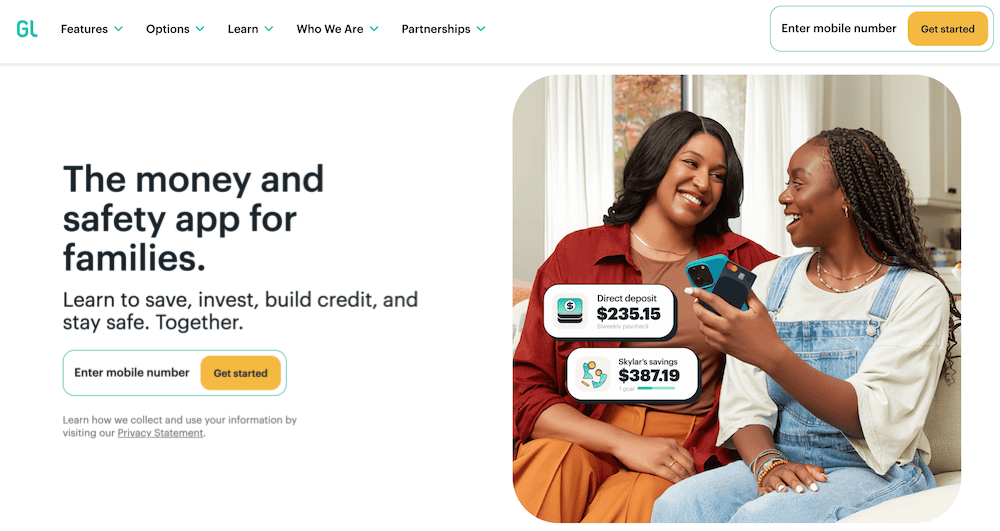
The Greenlight debit card allows kids to begin spending, but provides parents with peace of mind by giving them control over where their kids can spend money. Parents also can choose to receive alerts that tell them when, and how much, money is spent on the Greenlight debit card.
Greenlight works like a prepaid debit card, allowing you to transfer money onto the card for your child to pay for expenses at approved locations. You can choose how much money to load onto the card, and your child will be cleared to make approved purchases so long as a money balance backs up the card.
If your child asks for extra money to get added to the card, you can have them take a photo of the purchase they want to make and receive your approval. This gives you control and allows you to have discussions with your child about why a purchase might be a good or bad idea. And if your child has a job, they can add their own funds to the card via direct deposit.
Greenlight boasts numerous other features, too:
- Parents can open an investment account for kids to get their children investing in stocks and exchange-traded funds (ETFs) for the first time.
- Greenlight offers monthly savings rewards based on your tier, listed in the box below.
- Max, Infinity, and Family Shield families can also earn 1% cash back on their spending.
- You may also set up “Parent-Paid Interest” between you and your child, which allows you to foot the bill and pay interest on accounts for up to five kids.
Each monthly Greenlight subscription includes debit cards for up to five kids. Replacement cards cost $3.50 each but are free the first time. If you need to replace your card quickly, you can get express delivery for $24.99. The company also offers a personalized card, with your own photo or design, for $9.99.
Greenlight has no minimum age requirements for this card, but recommends starting at age 6 or older. Read more in our Greenlight card review or sign up today.
- Greenlight is a financial solution for kids that allows them to spend with a debit card, earn money on savings, and even invest their money.
- Greenlight offers flexible parental controls for each child and real-time notifications of each transaction. And it's the only debit card that lets you choose the exact stores where kids can spend on the card.
- Parents can use this app to teach kids how to invest with a brokerage account through Greenlight Max, Infinity, and Family Shield plans.
- Greenlight also provides educational materials such as "Level Up" lessons that simplify investing concepts, as well as videos about their favorite companies.
- Families can earn 2% (Core), 3% (Max), 5% (Infinity), or 6% (Family Shield) per annum on their average daily savings balance of up to $5,000 per family. Also, Max and Infinity families can earn 1% cash back on their monthly expenditures.
- Unlike many apps that simply provide features and controls, Greenlight is also designed to spark discussions with children about spending, investing, and more, fostering a better educational experience.
- Best-in-class parental controls (can prohibit specific stores)
- Can add brokerage account to invest in stocks
- Intuitive Parent + Kid apps
- Competitive cash back & interest rates
- Parent-Paid Interest
- High price points
- No cash reload options
- No parent / child lending
Related: 9 Best Allowance and Chore Apps for Kids [Easy Family Life]
2. Cash App Families (Managed Accounts for Kids)
- Available: Sign up here
- Price: Free* (no subscription fees)
Are your kids too young for Cash App Families’ teen card? No worries—parents can now help their children build good money habits through Cash App Families Managed Accounts.
Cash App managed accounts, designed for kids ages 6 to 12**, are a fully parent-managed money experience that’s designed to make learning about money fun, simple, and safe. There are no subscription fees, no minimum balance requirements, and no hidden charges.
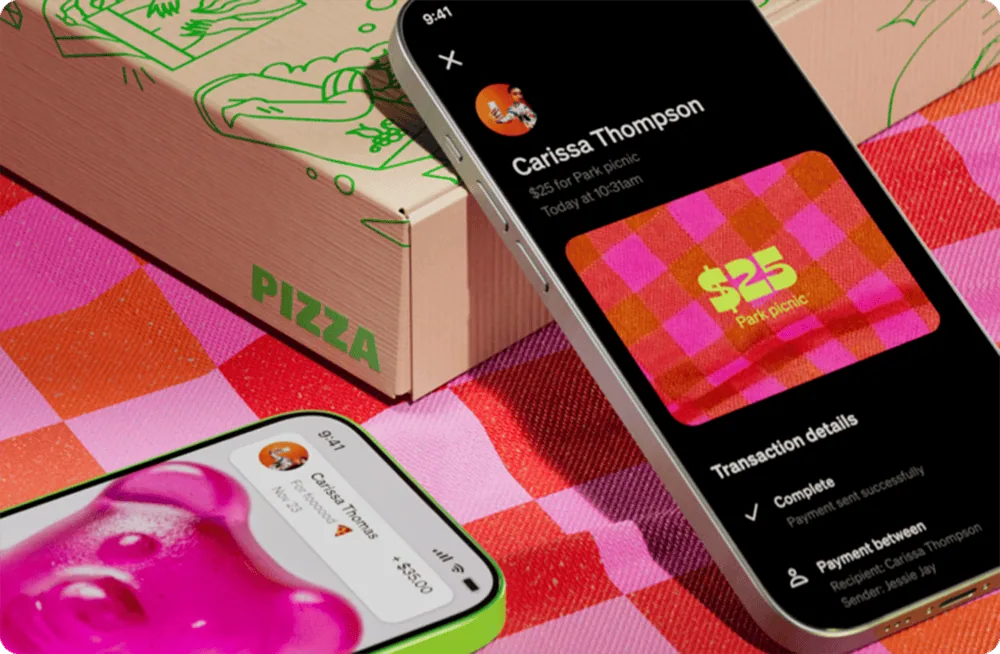
The app enables parents to teach their kids responsibility and consistency by setting up automatic recurring allowances, while kids can track their allowance, savings, and spending in one easy view. Kids don’t just store money with Cash App, either—they can watch it grow thanks to high yields on savings balances.¹ And when they’re ready, they can design their very own customizable Cash App Visa® Card, making their first financial tool feel truly their own with the assistance of their parents/guardians.
Parents, meanwhile, will enjoy the peace of mind that comes from a truly robust set of safety features and controls. All account access lives within your own Cash App, inside the Family Applet—your child never logs in independently. You set the rules, and you can change them anytime.
Your child’s profile is private by default—discoverable only by exact $cashtag or QR code, with no photo or avatar visible in search results. But you can add up to five trusted friends or family members to your child’s approved contact list, so only the people you choose can send them money. You can also set spending limits on their debit card, block specific merchants, and instantly lock or unlock their card with a single tap.
And Cash App’s industry-leading safety features extend fully to managed accounts. Advanced fraud and scam monitoring runs 24/7, automatically flagging or blocking unsafe spending categories and notifying you of any suspicious activity.
Parents/guardians must download Cash App (also free) to create the managed account. Use our link to learn more about or sign up with Cash App today.
- Cash App Families Managed Accounts are accounts designed for kids ages 6-12** to learn about, spend, and save money while being protected by a best-in-class suite of parental controls and security features.
- Kids can earn automatic recurring allowances or receive money from close friends and family.
- Kids can spend their money with a customizable Cash App Visa® Card*, or save it and earn a high 3.50% APY on any balance.¹
- Parental controls include setting debit card spending limits, merchant-specific blocking, and instant card lock/unlock.
- Safety features include real-time transaction alerts, a tightly managed contact list, and advanced 24/7 fraud and scam monitoring. Also, strangers can't find kids in Cash App search.
- Parents must sign up for Cash App first, which they can do via the link below.
- Free account and Cash App Visa® Card*
- High yield on children's savings balances¹
- Recurring allowance
- Robust parental controls
- Outstanding security features
- Customizable cards ($5+)
- FDIC insurance available on a pass-through basis (if certain conditions are met)***
- No investing feature
Related: 10 Best Prepaid Debit Cards for Teens & Kids [Reloadable]
3. Chase First Banking (Best Kids’ Debit Card From a Major Bank)
- Available: Sign up here
- Price: Free (no monthly fees)
Ready to teach your little ones about earning, saving, and spending money, but not quite sure if you have the time, patience, and/or expertise? Chase First BankingSM offers simple banking for both of you in one location—the Chase Mobile® App—for free.
Chase First BankingSM helps parents teach teens and kids about money by giving parents the control they want and kids the freedom they need to learn. Among the account’s many features?
- One of the best free debit cards for kids and teens—it works anywhere Visa is accepted, and can be used to withdraw money fee-free* from more than 14,000 Chase ATMs nationwide
- Savings goals that you can track via the Chase Mobile® App
- Parental controls, such as setting limits on where and how much they can spend and withdraw from ATMs
- Account alerts that let you know where your child is spending
- Recurring chores and allowance
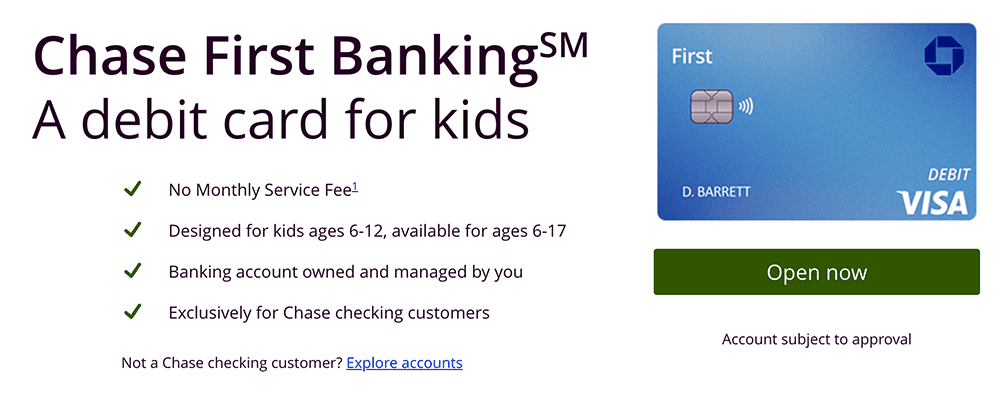
The account is designed with kids 6-12 in mind, and available for ages 6-17. To get started, you’ll first need to be a Chase customer with a qualifying Chase checking account. If you don’t already have one, consider opening a Chase Total Checking® or Chase Secure BankingSM account to qualify.
- Chase Total Checking® also grants access to thousands of branches and ATMs. You can pay $0 in monthly fees, subject to meeting certain conditions.** And you can collect a $400 new-customer bonus when you make total direct deposits of $1,000 or more within 90 days of coupon enrollment.
- Chase Secure BankingSM offers the same Chase ATMs and branch locations as well as a $125 sign-up bonus when you make stated qualifying activities and meet certain conditions.
Once you open a qualifying Chase Checking account, you may use our link to apply for a Chase First BankingSM account for your child.
- Chase First Banking is a free, just-for-kids banking account that teaches children and teens about their finances through the Chase Mobile® app and a Visa debit card.
- The account is designed with kids 6-12 in mind, and available for ages 6-17.
- Kids can use their debit card anywhere Visa is accepted, and withdraw money fee-free* from thousands of Chase ATMs.
- Parents can enjoy peace of mind by limiting how much and where their children can spend and withdraw money, and set up spending alerts.
- Parents can reward responsibility with allowance transfers, set to repeat on the schedule you choose.
- You must be a current Chase customer with a qualifying Chase checking account to sign up. If you don’t already have one, consider opening a Chase Total Checking or Chase Secure Banking account to qualify.
- Free account
- No monthly maintenance fees
- Chore and allowance functionality
- Parental controls on spend/ATM limit and location
- No paired investment account
- No interest
Related: 8 Best Free Debit Cards for Kids & Teens
4. Acorns Early (Best for Customer Service)
- Available: Acorns Early Lite | Acorns Gold
- Price: Acorns Early Lite: Free 30-day trial, then $8/mo. Acorns Early: $12/mo.
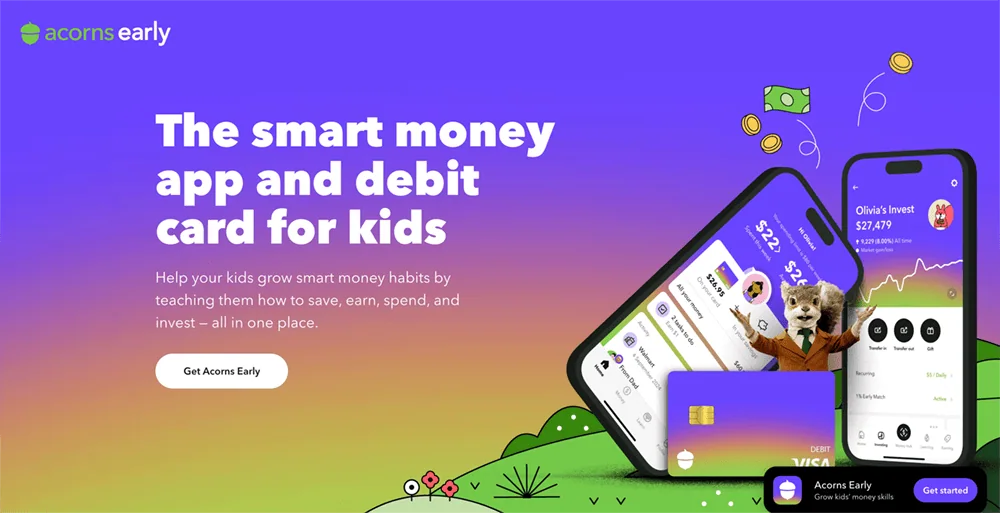
Many reviewers have long painted Acorns Early (formerly GoHenry) as just a way to spend. However, I see it as a real financial solution for minors—a debit card, yes, but also an app-based ecosphere that provides education and experience for the child, as well as ways for parents to keep their kids safe and teach them responsibility.
An Acorns Early account includes a smart money app, as well as Visa debit cards for up to four children. These debit cards can be used to spend anywhere Visa is accepted (so, millions of vendors online and in stores), as well as withdraw cash from ATMs. An Acorns Early account also allows kids to set savings goals, which they can fund manually or via autosave. And the app also hosts educational materials to help children and teens alike develop good money habits.
This FDIC-insured account also enjoys a variety of safety features, including chip and PIN protection, secure PIN recovery, and fraud protection. Acorns Early also offers parents additional peace of mind by providing a number of controls, including:
- Real-time spending notifications
- Card lock/unlock
- Savings goal lock/unlock
- Adjustable spending limits on a per-transaction and per-week basis
- Card category block/unblock for in-store purchases, online purchases, and ATM withdrawals
- Adjustable spending block/unblock at stores that sell age-restricted goods such as firearms and alcohol
Also, kids can only spend whatever money is available on the card because it’s a prepaid debit card. That means parents don’t have to worry about costly overdraft fees or their kids running up a debt.
Acorns Early also stands out to us as one of the best prepaid debit cards for kids because of its outstanding customer service, which it inherited from GoHenry. Acorns Early users enjoy seven-day-a-week phone service (9 a.m. to 8 p.m. ET Monday-Friday, 9 a.m. to 5 p.m. ET Saturday-Sunday), as well as 24/7 live chat support.
Acorns Early has no minimum age requirements but recommends starting at age 6 or older. Parents have two ways of signing up for Acorns Early:
- Sign up for Acorns Early Lite. This subscription level provides you with everything mentioned above.
- Sign up for Acorns Gold. Acorns Gold is the top Acorns subscription tier for adults, and it provides a wealth of banking, investing, and other features. However, it also includes a subscription to Acorns Early (again, good for up to four children), and it unlocks Acorns Early Invest: a UGMA/UTMA custodial account you can use to invest for your kids’ future.
Acorns frequently offers small bonuses for anyone who signs up with our links. You can check out current offers in the box below, or read more about this app in our Acorns Early review.
- Acorns Early is a debit card and financial app designed to provide education, experience, and confidence in saving, spending, and earning, to kids ages 6-18.
- Accounts come with a smart money app and up to 4 Visa debit cards, which allows your kids to spend in stores and online, and withdraw money from ATMs.
- Kids can also earn allowance, complete chores for money, set savings goals, even give to charity.
- Parents can rest easy knowing there are plenty of guardrails in place, including chip-and-PIN technology, fraud protection, and parental controls such as spending notifications, card locking, and adjustable spending limits.
- Acorns Early also provides educational resources tailored for kids of all ages, as well as sterling customer service (including everyday phone availability and 24/7 chat).
- All of the above is available via the Acorns Early Lite subscription.
- An Acorns Gold subscription delivers everything in Acorns Early Lite, as well as access to Acorns Early Invest (a UGMA/UTMA custodial account where you can save toward your kids' future and get a 1% match on up to $7,000 in contributions annually). Parents also enjoy banking and investing features such as an IRA with a 3% match for your first year, a high APY on emergency savings, Acorns' "Round-Ups," and more.
- Special offer (1): Get a free 30-day trial and $5 allowance when you sign up for Acorns Early Lite.
- Special offer (2): Get a $20 bonus investment when you sign up for Acorns Gold.
- Strong parental controls (including card-use controls and adjustable spending limits)
- Chores and allowance
- FDIC insurance
- Allows for ACH payments
- Convenient "Giftlinks" for non-accountholders to give money to kids' accounts
- Customizable cards (with fee)
- Must sign up for Acorns Gold to get investing
- No fee-free ATM network
Related: Acorns Early vs. Greenlight
5. Revolut <18 (No-Fee Prepaid Debit Card for Kids)
- Available: Sign up here
- Price: No monthly fees
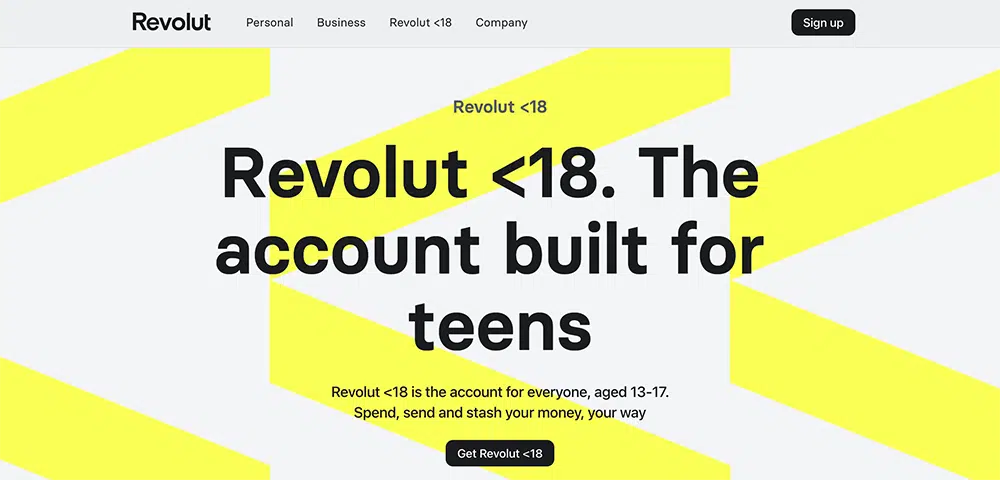
Revolut <18 is a prepaid debit card for kids designed to teach them money skills for life. Aimed at building healthy money habits from an early age, the unique, customizable card1 empowers parents to have full insight into their kids’ card activity through providing instant spending alerts and parental controls.
You can choose to freeze the card, as well as set controls on how they use the cards online and with contactless payments through your Revolut app. You can also set spending limits on how much your child can use with the prepaid card.
Parents use the card and accompanying app to teach kids about earning, budgeting, saving and even investing money (depending on the plan chosen). You can also use the card to manage chores and allowance, set savings goals as a family, and help your children manage their money.
And if your child did something deserving of a reward? You can send parent-paid bonuses when they complete specific tasks. Simply add money to their digitized piggy bank through the app. You can send and receive money in seconds through Revolut’s payments feature, which allows fast transfers between account holders and also global transfers at transparent rates.
You must have a personal Revolut account before you can open a Revolut <18 account for your children. You can add up to five Revolut <18 accounts per parent account.
To learn more about Revolut <18, visit their site and open an account for yourself and your child.
- Revolut <18 is a prepaid debit card for kids designed to assist parents teach kids ages 6-17 about money. Families can handle chores and allowance, create budgets, set parental controls and more.
- Revolut <18 comes with unique, customizable cards* that parents can use to set up tasks and goals to work on together as a family.
- Prepaid debit card for teens
- Parental controls
- Round-ups
- Chore and allowance management
- Customizable designs (fees apply)
- Children can't load funds, only parents can
- Parents need to have a personal Revolut account

6. Current (Great No-Monthly-Fee Teen Card)
- Available: Sign up here
- Price: Free (no monthly fees)
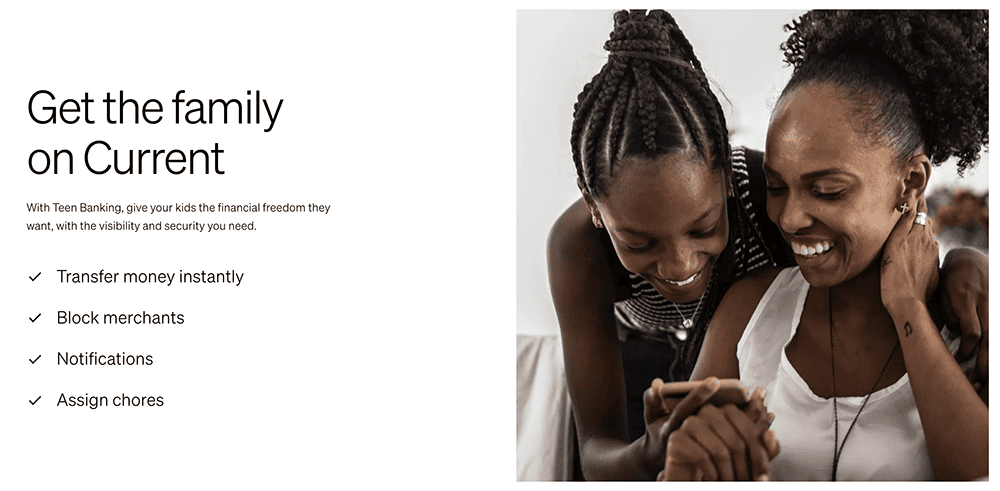
Current is a banking app designed for families; it offers both parent and teen accounts, with the latter acting like prepaid debit cards that parents load for their children. The Current app allows you to track your teen’s spending in real-time, set limits on how much your children can spend, and even block specific merchants on its Visa-enabled debit cards. You also get the peace of mind that comes with knowing your children’s money is safe because it’s not cash—no temptations, just a tool parents can use to help teach teens financial responsibility.
Among Current’s features:
- No minimum required balances, no fees on transfers to other Current accounts, and no hidden fees.
- Create Savings Pods, or Giving Pods, that allow you to save up for various goals.
- Round-Ups allow you to round up purchases to the nearest dollar amount and store the difference in Savings or Giving Pods.
- Buy and sell 27 different cryptocurrencies with zero trading fees.
Teens will love easy allowance deposits, a card they can use in stores or online, instant gas hold removals when buying gas, and access to more than 40,000 fee-free Allpoint ATMs nationwide. They’ll also have the opportunity to learn about financial responsibility and financial independence through Current’s Budgets feature, which allows them to track their spending and even receive alerts when they get too close to (or exceed) a predetermined limit.
The product has no specifically stated minimum age requirement, but the marketing suggests teens are the target audience. However, you might be able to open an account for a younger child.
Read more in our Current review.
- Current is a financial technology platform that lets teens enjoy not just traditional banking basics, but numerous features meant to simplify spending, streamline saving, and set them on the path toward more organized finances.
- Teens can spend with the Current Visa debit card, which allows them to purchase in-store and online, as well as withdraw money fee-free from more than 40,000 in-network Allpoint ATMs.
- Current Teen Accounts also come with Savings Pods, which earn 0.25% APY and allow you to round up purchases (overages are funneled into your savings). Keep a qualifying direct deposit of $200 or more in your account, and you'll earn a full boosted rate of up to 4% annually.
- Parents can monitor their kids' spending, adjust maximum ATM withdrawal and spending limits, and even toggle spending categories (and the Current debit card itself) on and off.
- Parents can also automate allowance payments, pay for chores, instantly transfer money to their teens, and more.
- Free account (no monthly maintenance fees)
- Good parental controls
- Fee-free ATMs
- Cash reloads
- Gas hold deposits
- 24/7 email and live-chat support
- No direct deposit
- No paired investment account
- No card customization

Related: 5 Best Credit Cards for Teens [Build Credit in 2026]
7. FamZoo (Best for Financial Education)
- Available: Sign up here
- Price: Monthly: 1-month free trial, then $5.99/mo. Annually: 2-month free trial, then $59.90/yr. (16% discount)
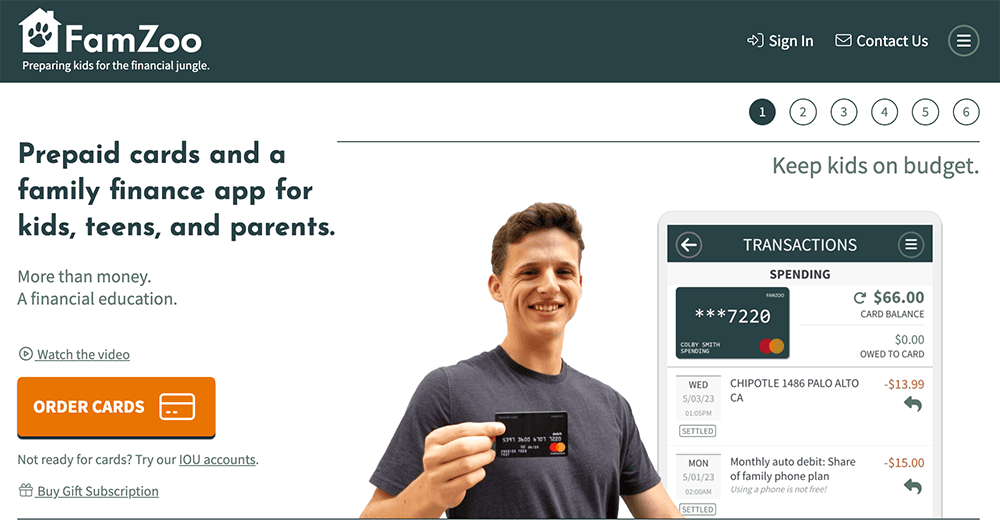
FamZoo is another service for parents interested in opening a prepaid debit card to manage their children’s spending.
FamZoo rates as our top education choice because of both its robust financial education library, and functions that have financial literacy in mind. For instance, its chore features include payment checklists that teach kids the value of a dollar by tying chores and odd jobs to rewards and even penalties. You can also teach younger children the basics of money through the automated allowance feature, which lets you set a fixed amount or even automatically raise it as they age.
Spending, Saving, and Giving accounts separate funds into different purposes. With “Parent-Paid Interest,” you can teach your kids the power of compound interest over time. Other features include direct deposit, savings goal tracking, and FDIC insurance.
Parents can fund a FamZoo account through numerous routes, including bank transfers, Direct Deposit, even cash. Typically, parents will load their primary funding card, then they will transfer those funds onto their kids’ cards. But you do have the option of directly funding kids’ cards.
There are plenty of safety features, too. And there’s no risk of having your bank account information stolen from FamZoo—because FamZoo never asks for it. Adults can monitor transactions, you can temporarily lock and unlock cards, and you can set up real-time alerts for card activity and remaining balances.
- FamZoo is the prepaid debit card used by families to teach children good financial habits from an early age.
- Many of the app's functions also have financial literacy in mind, including Parent-Paid Interest, parental loans, and reimbursements.
- Robust allowance and chore functions include features such as automatic allowance, payment checklists, even chore penalties.
- FamZoo lets you fund your account in a variety of ways, including bank account, debit card, payment app, digital wallet, and cash.
- Robust, customizable allowance and chores functions.
- Prepaid card without overdraft fees
- Highly customizable allowance and chores functions
- Strong financial education resource library
- Parent-paid interest
- No paired investment account
- Weak parental controls

Related: Greenlight vs. FamZoo
8. Axos First Checking (Best Free Debit Card for Teens at an Online-Only Bank)
- Available: Sign up here
- Price: Free (no monthly fees)
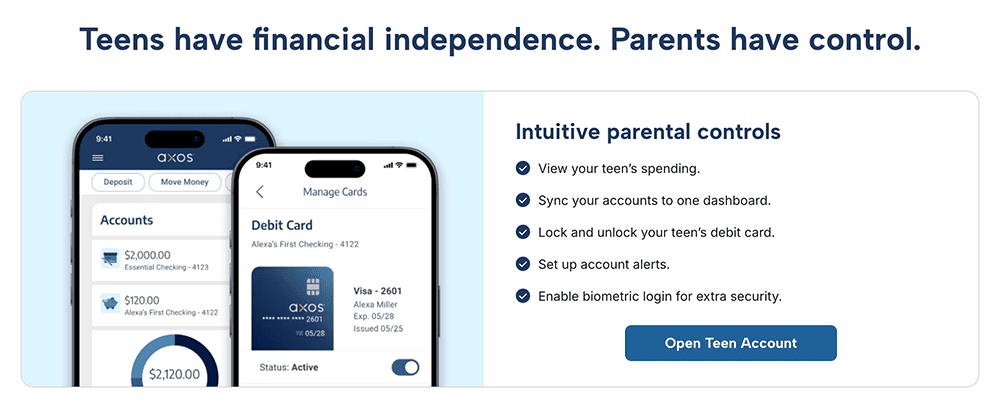
Axos First Checking is a free joint bank account for teens and adults offered by Axos Bank—an online-only bank with a focus on technology-driven finance.
First Checking offers teens and their parents (or other adult owners of the account) a free debit card, peer-to-peer transfers, direct deposit, bill pay, extensive security features, even interest payments.
The Axos First Checking account comes with a debit card—you can choose either Visa or Mastercard—that you can use to spend in store and online, as well as to withdraw cash. While Axos Bank doesn’t have its own ATM system, Axos offers fee-free access to 91,000 ATMs nationwide, and it reimburses up to $12 in third-party ATM fees every month.
If you’re worried that your (or your teen’s) card is lost or stolen? You can lock and unlock the card from your Axos account. And the card limits cash withdrawals to $100 daily and debit transactions to $500 daily.
Axos First Checking charges zero monthly maintenance fees, overdraft fees, and non-sufficient fund fees. It’s designed for teens between ages 13 and 17 (up to 18 years old in Alabama). And once your teen reaches adulthood, it’s easy to convert to another Axos checking account, giving the newly minted adult full control.
Read more in our Axos First Checking Account review.
- Axos Bank First Checking is a joint checking account targeted for teenagers ages 13-17 and their parents.
- Account holders get a Visa or Mastercard debit card that can be used to spend online or in person, or to withdraw cash at any ATM. (Axos provides up to $12 in monthly domestic ATM fee reimbursements.)
- No monthly maintenance, overdraft, or non-sufficient fund fees.
- The debit card's security features include account alerts, card locking, and daily transaction alerts of $100 (cash) and $500 (debit).
- Currently, you can earn up to 0.10% APY on any balance.
- Free (no monthly maintenance fees)
- ATM fee reimbursements (up to $12 per month)
- Converts to adult checking account after minor reaches age of majority
- No paired investment account
- No robust financial literacy resources

Related: 10 Best Money Apps for Teens Under 18 [Invest, Pay + More]
9. BusyKid (Prepaid Visa Debit Card for Kids)
- Available: Sign up here
- Price: $4/mo. billed annually. (Up to 5 cards)
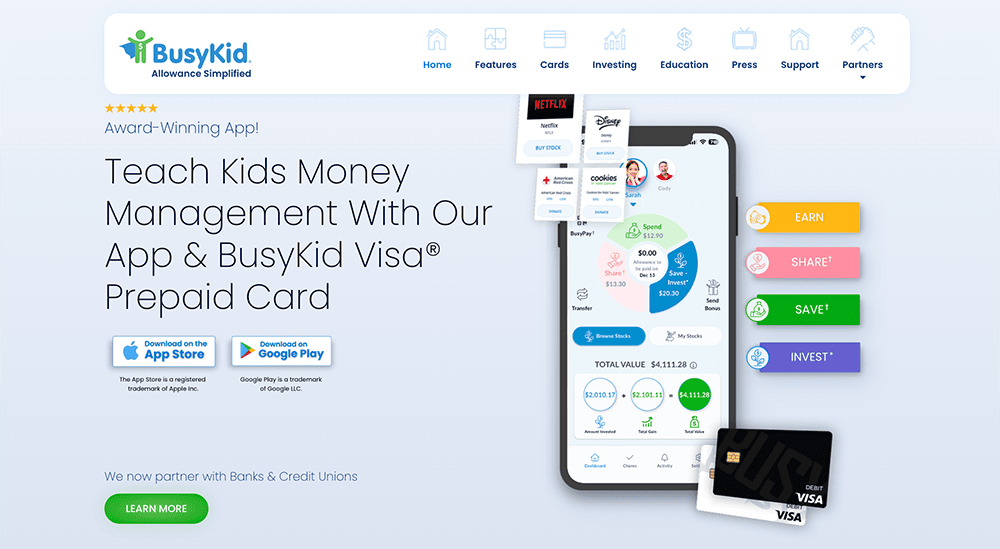
If you’re looking for prepaid debit cards for kids that also teach your children about money, lets you pay them allowance, and allows them to spend, consider the award-winning BusyKid app and the connected BusyKid Visa Spend Card.
BusyKid started as an easy-to-use, interactive chore app for kids, but has since added a prepaid debit card that allows your children to spend their money in stores and online. Your children can earn real money by completing chores and other tasks around the house, then use the app to learn valuable financial skills, such as budgeting, saving, and even giving back.
Parents can pay allowance on an ad hoc basis, or they can set up Auto-Allowance. When parents add to their children’s accounts, that money can be split between Save, Share, and Spend:
- Save: Parents can automatically allocate money toward a savings basket; however, parents can also match any money their children elect to save.
- Donate: Children can choose which charities they would like to give money to, and parents must approve before the cash is transferred.
- Spend: When they’re ready for independence, BusyKid has a Visa Spend Card so kids are never without cash in hand.
Also, with BusyKid, the parent isn’t the only person who can add money to child accounts. With a share of the QR code, grandparents, aunts, uncles, other family members, and even friends can add money—from birthday presents to paying for chores–for a $1 fee (plus any credit card or bank transaction costs).
Finally, BusyKid also allows children to invest their earnings through the app. Doing so requires setting up a separate Apex Clearing account. Children can choose to invest in hundreds of stocks and ETFs with as little as $10.
In addition to the $4 monthly subscription, BusyKid charges other fees, including 50¢ per declined transaction, $5 for a card reissue, and a $5 monthly fee for paper statements.
- BusyKid is an award-winning, parent-approved app that educates kids about money.
- Parents can pay allowance on an ad hoc basis, or they can set up Auto-Allowance.
- Parents can split allowance money across Save (and even match money in the Save category), Spend (which kids can access with their Visa Spend Card), and Donate (children can choose charities to donate to; parents must approve).
- Parents can set up a separate Apex Clearing brokerage account to allow their children to invest earnings through BusyKid, with as little as $10.
- Feature-heavy allowance function
- Offers investment functionality
- Combines several kid-focused financial needs in one app
- Charges a fee
- Lower customer user ratings than competitors

What is a Child Bank Account With Debit Card?

Today, parents have to keep pace with numerous priorities previous parents couldn’t even imagine. Concerns like social media, cybersecurity, buying stuff online, easy access to information and much more.
With finances, parents of yesterday really only needed to concern themselves with hard currency, or dollars and bills. I remember my parents writing me a check to bring to school each month to pay for my school lunches.
Now? You can just Venmo the payment or submit it through an online portal in most instances.
While checks might still suffice in some areas, many places have moved onward with technological advancement. With how things progress, it seems only more likely this digital transformation will continue, not reverse. Therefore, as digital banking through an online portal and mobile app interface become the norm for how we buy and sell goods, get paid, transfer money and more, kids need to keep up with the times or risk getting left behind. That means needing to consider bank accounts with a debit card to make online purchases or keep track of spending activity.
Parents need to be laser-focused on making sure their kids understand money, as well as how to use it.
Does a Child Need a Checking Account to Get a Debit Card?

In today’s world, it’s hard to get by as a kid without some form of digital banking product like a debit card or credit card.
Having a bank account with a linked card can help parents manage their kids’ finances while also giving them the freedom to make some of their own money decisions—albeit with guardrails installed by parents and enabled by fintech apps.
While cash is still king, that only works for face-to-face transactions. Many of our needs now can be met online and that requires plastic of some sort, namely in the form of a debit card or credit card.
With new apps, though, not all kids need a checking account to get a debit card. Some apps like Greenlight, BusyKid, Acorns Early and more act as prepaid debit cards which attach to an app and ultimately to a bank account of your choosing to control how you transfer money to and from the card.
This can be from performing chores for an allowance, receiving gift money, or even working a job and having money come through direct deposit.
Related: Allowance for Kids: How Much to Give [Age-Appropriate Amount]
What Age Can a Child Have Bank Accounts With a Card?

Bank accounts with a card can serve as a great entry way for kids into the financial world. They offer a chance to manage money while also falling under control of a parent or legal guardian since they’re technically on the account as a joint account holder.
Prepaid debit cards work just the same. They only allow you to spend the balance held on the card while also making it easier to transfer allowance earned through performing chores or just as part of a set payment schedule.
Getting kids started early with a prepaid kids’ debit card can help them get a head start on navigating the financial system as they get older, providing them familiarity with the different financial products and institutions. Further, these can help to guide them about how to think about managing their money digitally as opposed to physically, though handling physical cash early on can lead to a more concrete understanding of money for later.
Once kids have mastered how physical money works and the concepts behind it, moving to a digital-based prepaid debit card might serve as a good next step. This holds especially true since physical cash can’t work as effectively as plastic when ordering items online—something that’s become increasingly the default method for buying goods and services these days.
Most prepaid debit cards require the child to be 18 or older (or, sometimes even 16 or older). Though, you can also get around this situation through the use of adding your child as an authorized user on your existing prepaid debit card. This provides your child access to a prepaid debit card under your control, allowing you to monitor card activity as well as set spending limits.
When conducting your own due diligence, some factors you’ll want to consider certain features.
Related: 5 Best Credit Cards for Teens [Build Credit in 2026]
What Features Should I Look for in a Kid’s Debit Card?
1. Monthly Service Fees

Many bank accounts with debit cards for kids have account subscription fees you pay to open and maintain an account with this banking provider.
This is a common way for banks to earn money. These monthly or annual fees are commonplace given the low minimum deposit and minimum balance requirement rules established by these mobile banking providers.
Banks, credit unions and other lenders typically make money by taking the deposits held on account and lending them to borrowers. They charge an interest rate to the borrower at a higher rate than they borrow from the depositor. This difference, called the net interest margin, accounts for the lion’s share of bank earnings.
However, many banks have also gone after non-interest income in the form of fees or services. Items like overdraft fees, account fees, account minimum balance violation fees and much more.
Because most kids will have low account balances and still require automated financial assistance for their needs, many debit cards for teens choose to charge fees as an avenue for earning income. Thankfully, many of them offer value-added services above and beyond what many traditional banks have, making them worth more to a parent’s peace of mind.
Having parental controls, setting spending limits, maintaining shared mobile app access and more provide parents with an attractive value proposition.
2. Financial Literacy Resources

You’ll want apps that can teach, inform and grow your child’s understanding of finances. That means coming with tools for smarter spending.
Life gets busy and keeping track of your finances can be time-consuming. You don’t always have to see where and how you spend your money. That’s why many of these apps come with information to highlight spending insights based on your history, budgeting tools to manage your money, saving categories and goals and more.
These all help with managing money, developing a sense of ownership and understanding with finances for kids. Many also come with information through financial literacy resources through videos, articles, tutorials and explainers.
Make sure you review the content covered and navigate through the available libraries of resources to select the most important topics to cover.
3. Parental Controls

Parental controls are one of the key features that a debit card for teens should have. This is easy to set up and can be suited to any parent’s needs by being able to choose what notifications they want, set spending limits, determine which merchants kids can visit and more.
Different transactions need different levels of monitoring, so parental controls allow customization which makes it easier on parents who want a specific view into their kids’ spending activity. You won’t get these on a free debit card.
Parental controls also allow automated allowance payments, setting chores to complete, notifications for all purchases online and off and seeing spending reports.
These parental controls differentiate between a traditional prepaid card and a card offered by a traditional bank.
4. Savings Account Option
The best debit cards don’t just about teach kids about money and develop financial responsibility. They’re also a savings account in disguise, since the money gets drawn from the linked checking account on the card itself and all transactions go through it.
Learning to manage this account can teach kids how to save and budget their money in the short-term but also toward longer-term goals.
5. Online Banking / Mobile Banking App
When looking for a bank account and debit card, having direct access to your account serves as a vital connection to you and your money.
The advantages of having an accessible online banking portal and paired mobile banking app include:
- Financial responsibility. Teaching kids about financial responsibility and giving them their first taste of managing money like adults do: digitally
- Online access. Online banking, mobile app and online access for parents
- Enables saving. Mature teenagers’ checking account allows teens to save for a car, college or other long term goals.
- Avoids having cash. Allows savings without having to keep cash in the house
- Account Security. Security over your account balance and who has access
- Real-time monitoring of account activity. (e.g., checking a child’s spending, cash withdrawals, mobile check deposits, ATM fees, minimum daily balance, real time notifications, etc.)
- Convenience. Have instant oversight on multiple accounts (sometimes even up to five cards) all in one place.
- Timesaving. Instead of waiting in line at a bank or credit union, you can see everything on your mobile app or through the online portal.
- Banking on the go. Likewise, do all your banking needs on your phone (e.g., deposit checks, set up recurring transfers, spend money online, monitor your monthly service fee, etc.)
- Find bank and ATM locations. Most mobile app options from banks also offer convenient bank location features, allowing you to find a bank or member ATM if you need to make ATM withdrawals or stop into the bank or credit union for something
6. Set Spending Limits

When you sign up for a credit card as an adult, chances are your spending limits will be set relatively high. You may start with a $500 credit limit in the beginning but can quickly work your way up to a balance of $5,000 or more if you build a good credit score and history.
For kids, however, it might not make sense to give them that much freedom during their early years before they’ve had a chance to develop strong money skills.
Parents can set spending limits by the day, week or month. For example, parents can set limits of $25 per day for children to spend on things they want and need.
Some people have acted better with cash while others might be more comfortable using cards. Cash provides a spending limit that may help them avoid impulse purchases. Thankfully, with the spending limits parents can set on these cards, you’ve installed a cash-based mentality in a cashless society.
7. Overdraft Protection
Fees for overdraft can be avoided when banks decline charges that would overdraw the account.
One of the best features to look for when choosing a bank account is overdraft fee protection, which can come with prepaid cards or linked debit cards. This can block purchases from going through, automatically transfer money from another account to cover this purchase or provide a line of credit if you’re short on cash.
In the past, kids were not allowed their own debit card or credit card unless they met certain requirements. With mobile apps that allow parents to take control of the card, children can’t spend more than a predetermined amount in any period of time or location. That means not having to pay for overdrafts: if the debit card for teens won’t allow spending above a preset limit (such as the remaining account balance), children won’t have the ability to buy something that triggers a fee.
Another method for avoiding overdraft fees comes from use of prepaid debit cards for teens. Much like a debit card with spending limits set above the account balance, prepaid debit cards don’t allow you to spend what you don’t have loaded on the card.
Both types of cards place guardrails on overdraft fees, protecting children (and yourself) from costly fees and other banking account issues.
8. Age Restrictions and Limits

Some financial products limit access by requiring users to be a certain age. Banking apps with debit cards like Acorns Early provide access to kids as young as 6 while the American Express doesn’t offer cards to kids below 18.
Likewise, Greenlight and FamZoo have no age restrictions on who can have a debit card. You can be any age minor: a young child, a teen or even a teen entering college. Check with your banking institution to learn about what rules they place on age restrictions and limits.
9. Age Transfer
Because these banking products target minors, that inevitably means the account will need to phase out or evolve into something else owned by an adult.
Fortunately, many bank accounts for teens will likely convert into the bank’s adult version of the account. For example, if you have a checking account for teens, this account would convert to a regular checking account available to anyone the age of majority.
However, depending on your prepaid card provider, your account may not convert into an adult equivalent as one may not exist. In this case, you can likely use your card until it expires.
Consult the provider for more information and inquire about any product development which might allow you to transition to a new adult product or if they can refer you to a banking partner.
10. Minimum Deposit
Likely, many teen savings accounts and teen checking accounts for kids won’t require a sizable minimum deposit to open a child’s account.
Options like Greenlight’s debit card, BusyKid, and many others have no minimum deposit requirement, allowing you to open the account with any amount you wish. Likewise, many other teen checking account options avoid requiring a minimum deposit or maintaining a minimum daily balance.
Teen savings accounts held at a bank or credit union or through a joint account holder arrangement might have different rules and you should be mindful of these terms before opening an account.
Be sure to check your monthly statement cycle for any monthly fees that might get triggered through failing to meet any account minimums.
Related Child Bank Account and Debit Card Questions
What Happens to My Child’s Card When Turning 18?
Because these banking products target minors, that inevitably means the account will need to phase out or evolve into something else owned by an adult. Fortunately, many bank accounts for teens will likely convert into the bank’s adult version of the account. For example, if you have a checking account for teens, this account would convert to a regular checking account available to anyone the age of majority.
However, depending on your prepaid card provider, your account may not convert into an adult equivalent as one may not exist. In this case, you can likely use your card until it expires.
Consult the provider for more information and inquire about any product development which might allow you to transition to a new adult product or if they can refer you to a banking partner.
What are Kids’ Bank Cards?
Kids’ bank cards are debit cards which allow kids to spend money at retailers, make deposits and withdrawals at participating ATMs, and avoid carrying cash but still having money in their pocket.
One type of bank card is a debit card attached to a bank account. This works by debiting against the cash balance each time the card gets used for a purchase. Likewise, you can also have a prepaid debit card which loads a balance onto a card and has funds deplete as you spend them (or increase as you reload the card).
The principle behind both remains the same: have a balance backing the available spending limit of the card. The difference comes from having a balance held directly on the card or through a bank account backing the card.
How Do I Get a Kids Bank Account?
Getting a kids bank account is a simple process. It involves conducting a search of available products and offerings on the market, determining which checking account and/or savings account make the most sense for your needs, and then submitting an application to the company. From there, you need to provide necessary documentation substantiating your identity, citizenship and proof of residence. Afterward, the company will walk you through the account set up to open your deposit accounts with a kid’s debit card, prompt you to activate your card, transfer funds and begin using the account.
For more details on how to open a bank account for a minor, we have a resource which walks you through how to open these FDIC insured financial products. Also, consult this guide on debit card age requirements and also this primer on how prepaid debit cards work for these associated products on your kid’s account.
Can My Kid Have a Bank Account?

If you want my child to sign up for a card for a bank account with debit card, you will need to open a joint account and serve as a joint account holder with your child. However, the rules do vary with different banks, credit unions and mobile app options which cater toward offering accounts for kids.
Some options only allow a legal guardian to list themselves as the joint account holder while others won’t allow minors to have a debit card under their own name until the age of 16 or even 18. Others still allow kids of any age to have a kids savings account, kid’s checking account or kid’s debit card. It makes sense to start first with your own banking institution to learn about their options.
But be warned: Many established banks and credit unions might not offer the level of parental controls you want for your kid’s debit card, checking account or other deposit accounts (i.e., savings accounts).
Even if you can get one from your current bank, you don’t want to just hand your child a debit card. You might want more insight and control over their spending so you can introduce good money habits. Such options include having a joint prepaid debit card with your child, allowing you both to manage the money jointly and agree on what the card can be used for. These cards give children the control they seek over their own cash but also allow parents to monitor the spending and offer useful guidance when needed.
Disclosures
Cash App Families
Cash App is a financial services platform, not a bank. Banking services provided by Cash App’s bank partner(s). Prepaid debit cards issued by Sutton Bank, Member FDIC. Cash App Visa® Debit Flex Cards issued by Sutton Bank, Member FDIC, and The Bancorp Bank, N.A., pursuant to a license from Visa U.S.A. Inc. See terms and conditions for the Sutton prepaid card, Sutton debit flex card, and Bancorp debit flex card. Savings provided by Cash App, a Block, Inc. brand.
* Card use fees apply. Free Cash App Cards come in black, white, pink, or glow-in-the-dark.
** Parents and legal guardians can open a managed account for kids 6-12. To view the eligibility requirements for sponsoring a teen or child, please visit the Sponsored Accounts section of the Cash App Terms of Service.
*** With a Cash App Card, your money is eligible for FDIC pass-through insurance through Wells Fargo Bank, N.A., Sutton Bank, and/or The Bancorp Bank, N.A., Members FDIC, for up to $250,000 per customer when aggregated with all other deposits held in the same legal capacity at each bank, if certain conditions are met. See the Cash App Terms of Service.
Cash App is a financial services platform, and not an FDIC-insured bank. Prepaid debit cards issued by Sutton Bank, Member FDIC. Cash App Visa® Debit Flex Cards issued by Sutton Bank, Member FDIC, and The Bancorp Bank, N.A., pursuant to a license from Visa U.S.A. Inc.
1 Cash App will pass through a portion of the interest paid on your savings balance held in an account for the benefit of Cash App customers at Wells Fargo Bank, N.A., Member FDIC. To earn interest on your Cash App savings balance, you need to have sponsor approval. Exceptions may apply. Savings yield rate is subject to change.
Revolut <18
1 Customized cards may require fees.