


The financial transition from a person’s teenage years to adulthood is a lot more gradual than you realize. Teens start taking on costs (like a car payment or a cell phone bill), get jobs, even start looking for loans (for college) … all before they ever become legal adults.
For a long time, though, teens never gradually started investing—they waited until their late 20s or 30s to finally take the plunge. But that’s changing, and so too are trading accounts, some of which now have minors specifically in mind.
Consider these findings from Fidelity’s 2023 Teens and Money study:
- 23% of teens say they’re already investing
- 91% of those who don’t say they plan on investing at some point
- 75% of those who don’t say they plan on starting before they graduate college
That’s a big change from when many of us were teens and didn’t think twice about stocks, bonds, or Wall Street. And if you ask me, that’s awfully encouraging.
Parents who want to nurture this interest might still be hesitant, though. After all, do you want to put your child behind the wheel of your average brokerage account and say “have at it, kid”? Heck no. Most regular brokerage accounts are too complex (and frankly too boring) for young minds just starting to learn the ropes.
But today, I’m going to talk about some options that specifically have kids in mind. Read on as I explore the pros and cons of some of the best trading accounts for minors—accounts that go above and beyond just letting families buy and sell, and instead offer parental controls, educational resources, and even package together other important financial tools like savings accounts and debit cards.
Read on to decide which trading account is the best fit for both you and your kid. The sooner you get started, the sooner your child or teen can grow not just their money, but their financial knowhow.
Trading Accounts for Minors—Our Top Picks
|
Best Paid Investing + Prepaid Card for Kids

|
Feature-Rich Teen App + Debit Card

|
Kids' Investing, Spending, Saving + More

|
|
Primary Rating:
4.8
|
Primary Rating:
4.7
|
Primary Rating:
4.0
|
|
Max: $10.98/mo. Infinity: $15.98/mo. Family Shield: $19.98/mo. (All plans include cards for up to 5 children)
|
No subscription fees.
|
$4/mo. billed annually. (Up to 5 cards.)
|
How Old Do You Have to Be to Buy Stocks?

To buy stocks completely on your own, you must be a legal adult. However, minors can invest in stocks, mutual funds, and other investments with the help of a trusted adult.
A minor can start investing at any age through a custodial account or joint brokerage account.
How Do You Open a Brokerage Account for a Minor?

It’s easy to open a brokerage account for a child. In the past, the type of custodial account you could open for a child depended on the state. Some states offered Uniform Gifts to Minors Act (UGMA) accounts and others offered Uniform Transfers to Minors Act (UTMA) accounts. (If you’re curious, here’s the difference between UTMA and UGMA.) Now, anyone in one of the 50 U.S. states or the District of Columbia automatically uses UTMA accounts.
You don’t need to be a parent to open a custodial account for a minor, by the way. You might be a grandparent, aunt, or other relative.
To open an account, you will need personal information, such as the child’s Social Security number. After the account is open, you can fund it and choose investments, such as stocks, exchange-traded funds (ETFs), or mutual funds, just like you would for a traditional brokerage account
It’s simple for a parent to open a joint brokerage account for their child as well. You just need personal information for both parties. A joint brokerage account isn’t limited to two people, so both parents are allowed on the account.
Remember: With a custodial account, the minor owns the assets, but the parent or trusted adult manages the account until the minor reaches the age of majority. With a joint brokerage account, both the minor and the adult jointly own the assets.
Related: What Is a UGMA Account? [Can You Open One in 2024?]
Best Trading Accounts for Minors
1. Greenlight (Best Overall Account)
- Available: Sign up here
- Price: Max: $10.98/mo. Infinity: $15.98/mo. Family Shield: $19.98/mo. (All plans include cards for up to 5 children)
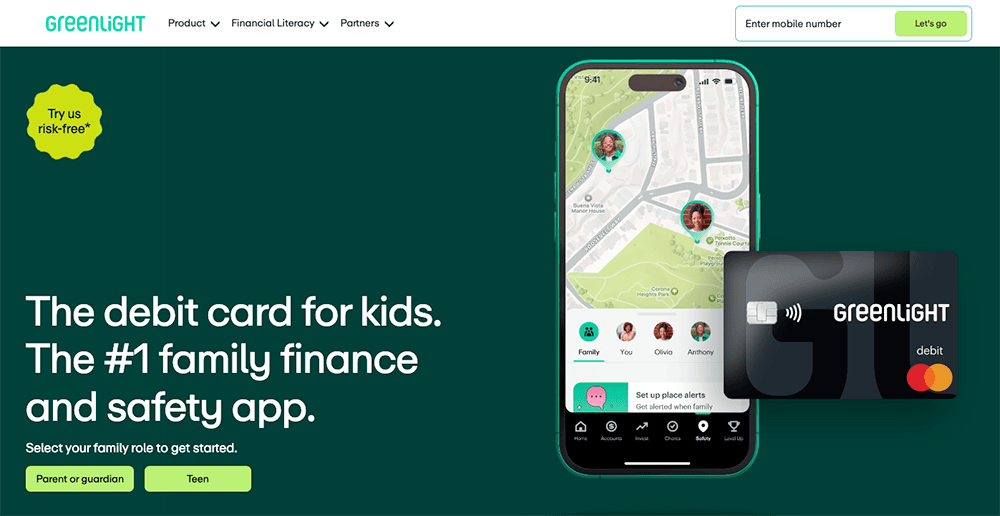
Greenlight is a premier kids’ financial app that teaches minors the ins and outs of saving, spending, and financial responsibility—and with a Max, Infinity, or Family Shield plan, they can start to invest, too!
Greenlight’s investing app will help your kid learn the basics of investing, how to invest in stocks, how exchange-traded funds (ETFs) work, and more—that’s real-life lessons made with real money and real investments, all with your direct involvement and supervision. Better still, the app doubles as a savings account and a banking app for kids and teens, too.
With Greenlight Investing, your child can:
- Buy kid-friendly stocks they admire
- Start investing with as little as $1 thanks to fractional shares
- Spread out their risk with the best ETFs
- Buy and sell without paying commissions
Parents can enjoy peace of mind knowing that Greenlight’s popular guardrails extend to its investing offering, too. While teens have access to more than 4,000 stocks and ETFs, parents must approve every trade directly in the app before it can be completed.
And, of course, you get everything else that comes along with Greenlight. That includes a prepaid debit card with strong parental controls, mobile payments, ATM access, instant money transfers, savings, and even cash-back rewards.
Read more in our Greenlight Card review, check out plan pricing below, or sign up for Greenlight Max, Infinity, or Family Shield today.
- Greenlight is a financial solution for kids that allows them to spend with a debit card, earn money on savings, and even invest their money.
- Parents can use this app to teach kids how to invest with a brokerage account through Greenlight Max, Infinity, and Family Shield plans.
- Greenlight offers flexible parental controls for each child and real-time notifications of each transaction. And it's the only debit card that lets you choose the exact stores where kids can spend on the card.
- Greenlight also provides educational materials such as "Level Up" lessons that simplify investing concepts, as well as videos about their favorite companies.
- Families can earn 2% (Core), 3% (Max), 5% (Infinity), or 6% (Family Shield) per annum on their average daily savings balance of up to $5,000 per family. Also, Max and Infinity families can earn 1% cash back on their monthly expenditures.
- Unlike many apps that simply provide features and controls, Greenlight is also designed to spark discussions with children about spending, investing, and more, fostering a better educational experience.
- Best-in-class parental controls (can prohibit specific stores)
- Can add brokerage account to invest in stocks
- Intuitive Parent and Kid apps
- Competitive cash back and interest rates
- High price points
- No cash reload options
- No parent / child lending

Related: 8 Best Greenlight Alternatives [Cards for Kids & Teens]
2. Cash App Families (Cash App’s Debit Card for Teens)
- Available: Sign up here
- Price: Free* (no subscription fees)
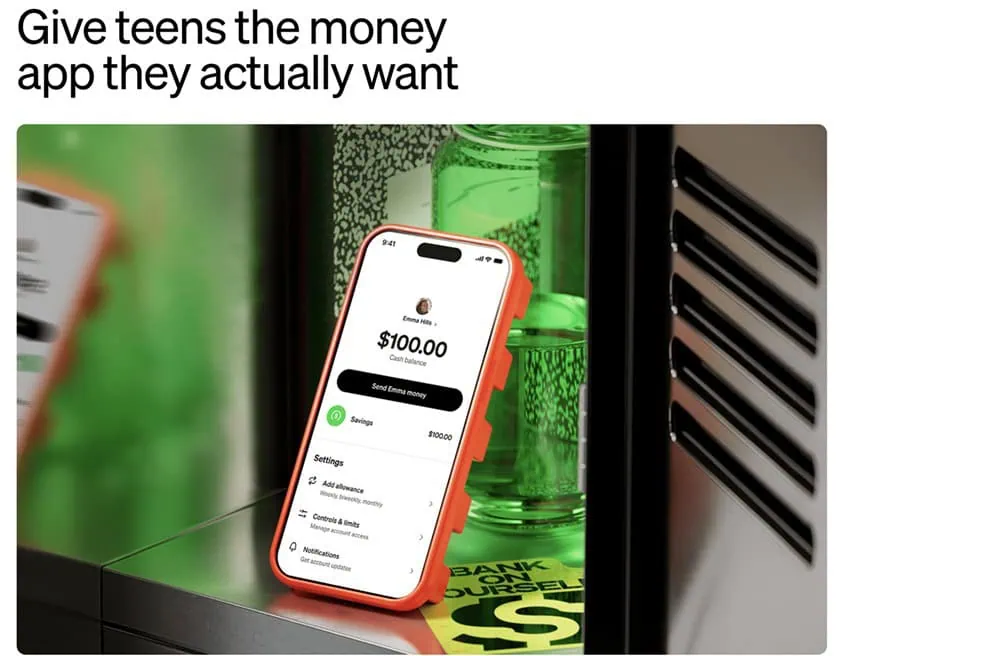
Does your teen need to start learning smart saving, spending, and even investing habits? Cash App Families can accomplish all three—with no subscription fees—putting the power of Cash App into your teen’s hands while keeping their financial safety firmly in yours.
Teens get an account with a designable Cash App Visa® Card, which they can use to spend money where Visa is accepted. Meanwhile, access to Cash App allows them to save money toward specific goals, send money to friends, accept offers for instant discounts at their favorite places, earn high interest on savings³, and check out securely in stores and online by using a QR code.
If your teen direct-deposits $300 or more each month, they’ll also unlock a bevy of other features, including getting paid two days earlier, no ATM fees¹ when withdrawing from more than 40,000 in-network ATMs, and one waived out-of-network ATM withdrawal per month.
Cash App Families even has an investing feature with fractional shares, allowing kids to purchase as little as $1’s worth of stocks and Bitcoin (parent permission is required).²
Meanwhile, parents/guardians who sponsor the teen** enjoy some of the best oversight features among teen debit cards. You can monitor your teen’s activity from your own Cash App or receive real-time transaction alerts for their payments and purchases. You control which features—stocks, Bitcoin², sending money, the Cash App Visa® Card—your teen can access, and certain spending categories are auto-blocked for teens. Parents can also send money for allowance whenever they want, and built-in tools allow parents and teens to budget and save together.
Parents/guardians must download Cash App (also free), then invite their teen to create a sponsored account. Cash App Families can be used by teens ages 13-17. Use our link to learn more about or sign up with Cash App today.
- Cash App Families is a money app and debit card that helps teens ages 13-17** learn about, spend, save, and invest money while under the protection of a large suite of parental oversight tools.
- Teens get a customizable Cash App Visa® Card*, can make and receive instant person-to-person payments, can fund their account with direct deposit, and can even buy as little as $1's worth of stocks and Bitcoin.²
- Your teen can earn 3.50% interest on savings. No account minimums.³
- Pay your kids an allowance, and use Cash App's tools to save and budget together.
- Safety features such as real-time transaction alerts, account monitoring (from the parent's Cash App), alerts for teen payments to new contacts, contact blocking, feature control, and payments control. Also, Cash App auto-blocks certain spending categories to teens, and strangers can't find teens in Cash App search.
- Features such as two-day early payment, free in-network ATM withdrawals, and a monthly reimbursement for an out-of-network ATM withdrawal are unlocked when $300+ is direct-deposited each month.¹
- Free account and Cash App Visa® Card*
- Excellent parental controls (including feature lock and real-time transaction alerts)
- Stock and Bitcoin investing²
- Fractional shares²
- Allowance feature
- Customizable cards ($5+)
- FDIC insurance available on a pass-through basis (if certain conditions are met)***
- Certain benefits, such as free in-network ATM withdrawals¹, require direct deposit of at least $300 monthly
Related: 9 Best Debit Cards for Teens [Reviewed by a CPA + Father]
3. BusyKid (Investing + Visa Prepaid Debit Card)
- Available: Sign up here
- Price: $4/mo. billed annually. (Up to 5 cards)
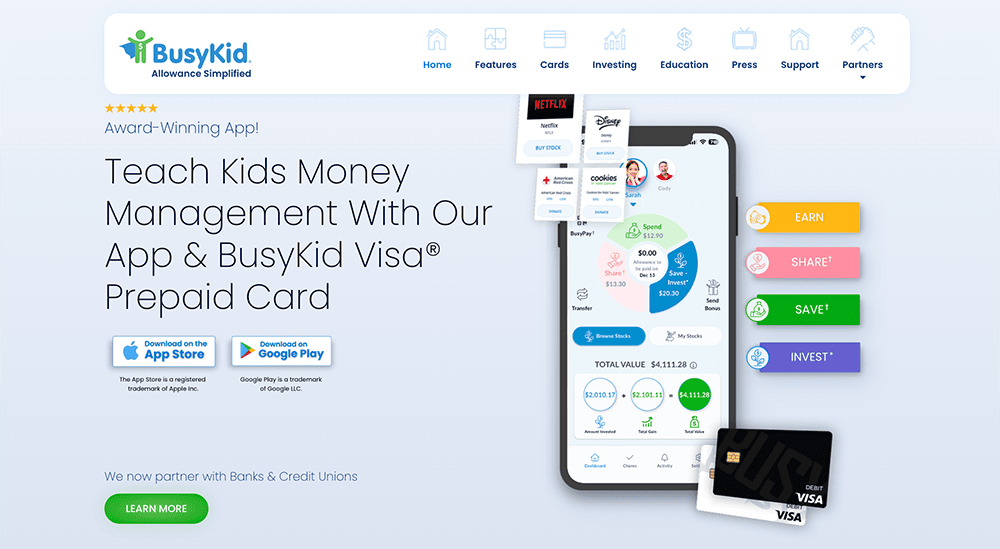
If you’re looking for prepaid debit cards for kids that also teaches your children about money, lets you pay them allowance, allows them to spend, and gets them into investing, consider the award-winning BusyKid app and the connected BusyKid Visa Spend Card.
BusyKid also allows children to invest their earnings through the app. Doing so requires setting up a separate Apex Clearing account. Children can choose from hundreds of stocks and ETFs and invest commission-free with as little as $10!
BusyKid started as an easy-to-use, interactive chore app for kids, but has since added a prepaid debit card that allows your children to spend their money in stores and online. Your children can earn real money by completing chores and other tasks around the house, then use the app to learn valuable financial skills, such as budgeting, saving, and even giving back.
Parents can pay allowance on an ad hoc basis, or they can set up Auto-Allowance. When parents add to their children’s accounts, that money can be split between Save, Share, and Spend:
- Save: Parents can automatically allocate money toward a savings basket; however, parents can also match any money their children elect to save.
- Donate: Children can choose which charities they would like to give money to, and parents must approve before the cash is transferred.
- Spend: When they’re ready for independence, BusyKid has a Visa Spend Card so kids are never without cash in hand.
Also, with BusyKid, the parent isn’t the only person who can add money to child accounts. With a share of the QR code, grandparents, aunts, uncles, other family members, and even friends can add money—from birthday presents to paying for chores–for a $1 fee (plus any credit card or bank transaction costs).
In addition to the $48 annual subscription, BusyKid charges other fees, including a $1.50 ATM fee, 50 cents per declined transaction, $5 for a card reissue, and a $5 monthly fee for paper statements.
- BusyKid is an award-winning, parent-approved app that educates kids about money.
- Parents can pay allowance on an ad hoc basis, or they can set up Auto-Allowance.
- Parents can split allowance money across Save (and even match money in the Save category), Spend (which kids can access with their Visa Spend Card), and Donate (children can choose charities to donate to; parents must approve).
- Parents can set up a separate Apex Clearing brokerage account to allow their children to invest earnings through BusyKid, with as little as $10.
- Feature-heavy allowance function
- Offers investment functionality
- Combines several kid-focused financial needs in one app
- Charges a fee
- Lower customer user ratings than competitors
Related: 9 Best Allowance and Chore Apps for Kids [Easier Family Life]
Trading Accounts for Minors: FAQs

Can I open a trading account for a minor?
Yes, as previously mentioned, you can open an investment account for a minor.
Anyone can open a custodial account for an important child in their life. For educational savings, anyone can also open a 529 plan or Coverdell education savings account (ESA) for a child. For the former, the child owns the assets in the account and for the latter the adult owns them.
Parents can also open joint brokerage accounts with their children and have joint ownership over assets.
Can a minor have a retirement account?
Yes, a minor can have a retirement account if they have earned income. For example, if a teenager has a part-time job, a parent could set up a custodial IRA.
A custodial IRA, particularly a custodial Roth IRA, is an excellent account for a minor because, as a retirement account, it has tax benefits. During retirement, tax-free withdrawals can be taken from the account, even when withdrawing earnings.
However, these accounts have contribution limits. Just like an adult’s Roth IRA, the contributions can’t exceed annual contribution limits or the child’s amount of earned income that year. The 2026 IRA contribution limit for minors is $7,500.
Parents can contribute to the account as long as their contributions don’t exceed the limits. Once the money is in the account, it belongs to the child and the parent cannot take it back.
Do custodial accounts affect financial aid eligibility?
Yes, the money in a custodial account can affect financial aid eligibility. The account assets belong to the minor, so financial aid formulas consider 20% of the money available for education costs.
Those opening investment accounts specifically for higher education, but expect to still need financial aid, should consider instead using 529 plans or Coverdell education savings accounts. The assets in these investment accounts belong to the parents, so only 5.64% counts towards the expected family contribution.
These accounts allow tax-free withdrawals as long as the money is being spent on qualified education expenses.
How are earnings in a custodial account taxed?
Custodial brokerage account earnings are considered taxable income and are subject to “kiddie tax” rules. There are three phases to the kiddie tax and if the earnings are low enough you don’t have to pay taxes that year.
For 2026, the breakdown for custodial account taxes is as follows:
- The first $0 to $1,350 of unearned income is tax-free
- The next $1,351 to $2,700 is taxed at the child’s rate
- Any amount over $2,700 is taxed at the parents’ rate
These rules don’t apply to custodial IRAs.
Related: 14 Best Investing Research & Stock Analysis Websites [2026]
What types of assets can you hold in a custodial account?
Custodial accounts can hold a wide range of assets. These accounts can hold popular stock market investments, such as stocks, bonds, exchange-traded funds, and mutual funds. Additionally, a custodial account can include real estate, life insurance policies, fine art, and much more.
There are some limitations, though. You cannot trade on margin in a custodial account or trade derivatives, futures, or other highly speculative investments.
Who owns the assets in a custodial account?
The beneficiary, which is the minor, owns all of the assets in a custodial brokerage account. While the custodian manages the account, they don’t actually own the assets.
Adults are allowed to make withdrawals from custodial accounts at any time, but the money withdrawn must be used in a way that directly benefits the minor. Parents cannot withdraw money to spend on themselves.
Once the beneficiary reaches the age of majority, which varies by state, she takes control of the custodial account.
Do parents pay a gift tax for custodial account contributions?
Custodial accounts (except for custodial IRAs) have no contribution limits.
However, when parents add money to custodial accounts, it counts towards gift contribution limits. For 2026, the annual federal gift tax exclusion is $17,000 for an individual or $34,000 per married couple ($18,000 and $36,000 in 2024).
If parents exceed that limit with contributions to custodial accounts, they need to fill out an IRS form so they can deduct the excess money from their lifetime gift tax exemption limits. As of 2023, the lifetime limit is $12.92 million ($13.61 million in 2024). Unless you expect to surpass the lifetime limit, you shouldn’t face any issues.
Read More on Young and the Invested
- Best Investing Apps for Teens Under 18 [Stock Trading Apps]
- 10 Best Money Apps for Teens Under 18 [Invest, Pay + More]
- 26 Best Online Jobs for Teens [Make Money at Home]
Disclosures
Cash App Families
Cash App is a financial services platform, not a bank. Banking services provided by Cash App’s bank partner(s). Prepaid debit cards issued by Sutton Bank, Member FDIC. Cash App Visa® Debit Flex Cards issued by Sutton Bank, Member FDIC, and The Bancorp Bank, N.A., pursuant to a license from Visa U.S.A. Inc. Offers, Instant Discounts, Savings, and Direct Deposit provided by Cash App, a Block, Inc. brand. Offers may not be affiliated with third party merchants.
* Card use fees apply. Free Cash App Cards come in black, white, pink, or glow-in-the-dark.
** Teens 13 to 17 can use Cash App with sponsorship by an eligible parent or guardian. To view the eligibility requirements for sponsoring a teen, please visit the Sponsored Accounts section of the Cash App Terms of Service.
*** Parents and legal guardians can open a managed account for kids 6-12. To view the eligibility requirements for sponsoring a teen or child, please visit the Sponsored Accounts section of the Cash App Terms of Service.
**** With a Cash App Card, your money is eligible for FDIC pass-through insurance through Wells Fargo Bank, N.A., Sutton Bank, and/or The Bancorp Bank, N.A., Members FDIC, for up to $250,000 per customer when aggregated with all other deposits held in the same legal capacity at each bank, if certain conditions are met. See the Cash App Terms of Service.
Cash App is a financial services platform, and not an FDIC-insured bank. Prepaid debit cards issued by Sutton Bank, Member FDIC. Cash App Visa® Debit Flex Cards issued by Sutton Bank, Member FDIC, and The Bancorp Bank, N.A., pursuant to a license from Visa U.S.A. Inc..
1 Cash App reimburses ATM fees for all in-network withdrawals when you deposit at least $300 monthly of Qualifying Deposits into Cash App, or spend $500 or more in Qualifying Purchases using your Cash App Card or Cash App Pay in a calendar month. Service fees may apply. See terms https://cash.app/legal/us/en-us/tos) for more details.
2 Brokerage services provided by Cash App Investing LLC, member FINRA/SIPC, subsidiary of Block, Inc. Bitcoin services provided by Block, Inc. Bitcoin services are not licensable activity in all U.S. states and territories. Block, Inc. operates in New York as Block of Delaware and is licensed to engage in virtual currency business activity by the New York State Department of Financial Services. Investing and bitcoin are non-deposit, non-bank products that are not FDIC insured and involve risk, including monetary loss. Cash App Investing does not trade bitcoin and Block, Inc. is not a member of FINRA or SIPC. For additional information, see the Bitcoin and Cash App Investing disclosures. Additional fees for securities may apply such as regulatory fees and fees to transfer securities externally. Please see our House Rules for more information. Fractional shares investing may involve additional risks such as non-transferability. For additional information regarding the unique risks and limitations of fractional shares, please see your Investing Customer Account Agreement.
3 Cash App will pass through a portion of the interest paid on your savings balance held in an account for the benefit of Cash App customers at Wells Fargo Bank, N.A., Member FDIC. To earn interest on your Cash App savings balance, you need to have sponsor approval. Exceptions may apply. Savings yield rate is subject to change.