
America’s employment situation tapped the brakes in June, with job growth last month coming in at roughly half of what economists expected, slightly tempering expectations that the Federal Reserve will raise its benchmark interest rate before 2026 is over.
The Labor Department reported Thursday that nonfarm payrolls (NFP) grew by 57,000 in June, which was well below Dow Jones-polled economists’ expectations for 115,000 jobs created. The prior two months were revised lower, too. May saw 129,000 jobs created (down from 172,000), while April’s payrolls came in at 148,000 (from 179,000).
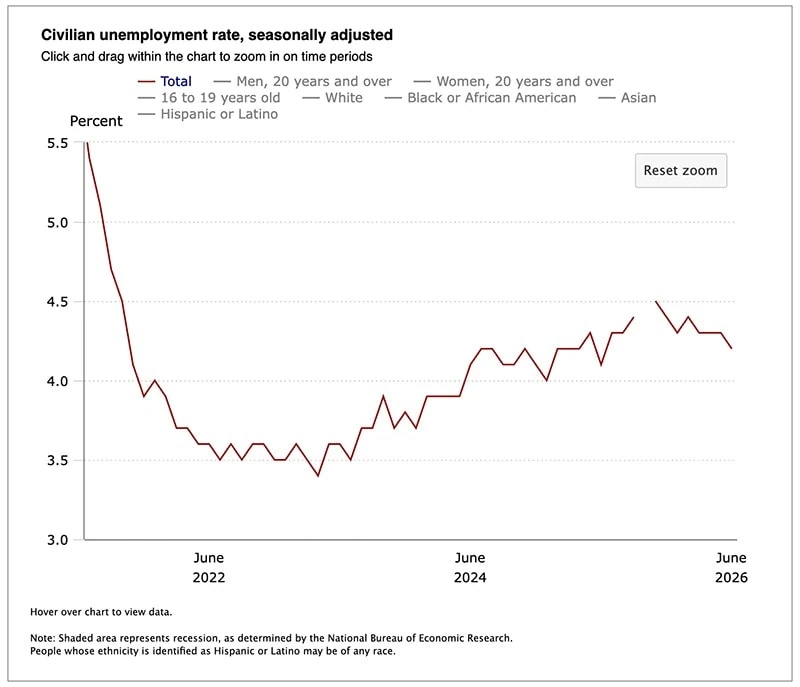
The unemployment rate slipped to 4.2% against expectations for 4.3%, however and has remained below 4.5% since October 2021. But Jason Pride, Chief of Investment Strategy & Research at Glenmede, says the improvement reads better than the underlying detail.
“The number of unemployed people did fall by 213k, a genuine positive, but a 0.3% drop in the labor force participation rate flattered the result,” he says. “A jobless rate edging lower partly because people stepped out of the workforce is a softer signal than one driven by hiring.”
Average hourly earnings grew by 0.3% month-over-month, to $37.64. That comes out to 3.5% year-over-year growth, which was in line with estimates.
June’s weak nonfarm payrolls data came a day after the release of a disappointing ADP private payrolls report showing 98,000 jobs created last month, which was slower than May’s 122,000 and missing expectations for 111,000.
Related: Wedbush Launches SpaceX (SPCX) Coverage at Outperform
“Softer labor market data over the next several months is a key driver of our view that the Fed will return to cutting policy rates later this year,” says Andrew Hollenhorst, US Chief Economist at Citi Research. “[Federal Reserve chair Kevin] Warsh maintained his strict no-guidance approach in public comments yesterday in Sintra,” referring to the European Central Bank’s economic conference in Portugal.
Here’s a brief look at the June jobs report’s most pertinent details:
| Reported | Estimated | Previously | |
|---|---|---|---|
| June payrolls | +57,000 | +115,000 | +129,000 (May) |
| June unemployment | 4.2% | 4.3% | 4.3% (May) |
| June hourly earnings (YoY) | +3.5% | +3.5% | +3.4% (May) |
| May payrolls (revised) | +129,000 | N/A | +172,000 |
| April payrolls (revised) | +148,000 | N/A | +179,000 |
| Source: U.S. Bureau of Labor Statistics. | |||
Employment trends were strongest in professional and business services (+36,000) and social assistance (+25,000). The healthcare industry added 22,000 jobs too, though that’s quite a bit slower than its prior 12-month average of 38,000. Seasonal weakness showed in leisure and hospitality employment, which actually declined by 61,000 in June and has shown almost no net change so far in 2026.
“Although the headline jobs number missed and there were negative revisions to prior months, the labor market continued to broaden with an increase of 376,000 jobs outside of the healthcare sector in the first half of the year—a stark contrast to the -271,000 figure recorded for all of 2025,” says Jeff Schulze, Head of Economic and Market Strategy at ClearBridge Investments.
Jerry Tempelman, former senior analyst at the NY Fed and VP of Economic and Fixed Income Research at Mutual of America Capital Management, says that while net job creation disappointed, the report follows three consecutive months of solid jobs growth, and the unemployment rate is low by historical comparison.
“Geopolitical and inflationary headwinds have had only a minimal effect on slowing or preventing hiring to this point, and payroll growth has already surpassed last year’s pace,” he says. “Despite a weaker-than-expected jobs report this month, the labor market remains resilient.”
Do you want to get serious about saving and planning for retirement? Sign up for Retire With Riley, Young and the Invested’s free retirement planning newsletter.
Wall Street Ratchets Back Rate-Hike Expectations … A Little
The markets had been growing convinced that the Federal Reserve would not only raise interest rates at some point in 2026, but that it might do so next month. That confidence faltered somewhat after Thursday’s report.
Ahead of the release, the CME FedWatch Tool, which uses Fed funds futures prices to track the probability of a change to the federal funds rate, showed a 70% chance that the current 3.50%-3.75% range would stand at the next Federal Open Market Committee (FOMC) meeting, scheduled for July 28-29. Meanwhile, odds for a quarter-point rate stood near 30%. Following June’s jobs data, the odds for a July “stay” grew to 84%.
That said, the markets are still largely pricing in at least one rate hike by the end of 2026, with 43% looking for rates at 3.75% to 4.00% by December’s meeting.
“Ongoing labor market stability likely leaves the FOMC focusing on upcoming inflation data to determine its appetite for tightening policy,” says Kay Haigh, global head and CIO of Fixed Income and Liquidity Solutions at Goldman Sachs Asset Management. “We still see a path for the Fed to stay on hold for the rest of the year, however any further upside surprises to inflation could convince the committee to hike sooner rather than later.”
Related: The 10 Best-Rated Dividend Aristocrats Right Now
Need Help Picking Stocks? Consider These Top-Rated Services
|
Best Introductory Stock Picking Service

|
Data-Driven Stock Picking Service

|
Best Proprietary Ranking System

|
|
Primary Rating:
4.7
|
Primary Rating:
4.3
|
Primary Rating:
4.2
|
|
$99/yr. ($100 first-year savings)
|
$449/yr. ($50 discount)*
|
30-day free trial, then $249/yr.
|
More Expert Reactions to June’s Jobs Report
Here’s what other strategists, financial managers, and experts had to say about last month’s employment situation:
Sonu Varghese, Chief Macro Strategist, Carson Group
“Monthly payrolls remain volatile, but the big picture is that the labor market is fairly solid. The economy’s created an average of 111,000 jobs per month over the last three months, and the unemployment rate has fallen to 4.2% (the lowest in a year). While this sets the Fed up to squarely focus on their inflation mandate, we still don’t think we’re going to see rate hikes this year as a majority of Fed members wait for inflationary pressures to pass.”
Related: The 10 Best Fidelity ETFs You Can Buy [Invest Tactically]
Bradford Smith, Portfolio Manager, Janus Henderson Investors
“This is the weakest print since February and comes after the barnburner of a print last month. Also unexpected was the decline in the unemployment rate to 4.2%, which is surprising given the jobs miss, but explained by a further decline in the participation rate by 0.3% to 61.4%. Prior-month revisions lower also make the job outlook less sanguine from previous understandings.
“As we are learning how the Fed reaction function will form under Warsh, this print takes some of the pressure off of the inflation fighting institution to hike near term. That said, Warsh commented at his first presser that jobs data only becomes meaningful after the third revision and by then becomes ‘echoes of history.’ With oil price inflation moderating, some softness on the jobs front likely keeps the Fed on hold at least for the next meeting.”
Brad Conger, Chief Investment Officer, Hirtle & Co.
“June nonfarm payrolls were weaker than expected. Hospitality employment went sharply negative, confirming anecdotal evidence from hoteliers that the World Cup boost was proving to be a fool’s paradise. The bigger takeaway is that Warsh/Bessent are going to muddy the waters just enough so that the sharks occasionally eat each other. One-way tickets are getting more expensive. We are modestly long duration in view of attractive real yields.”