
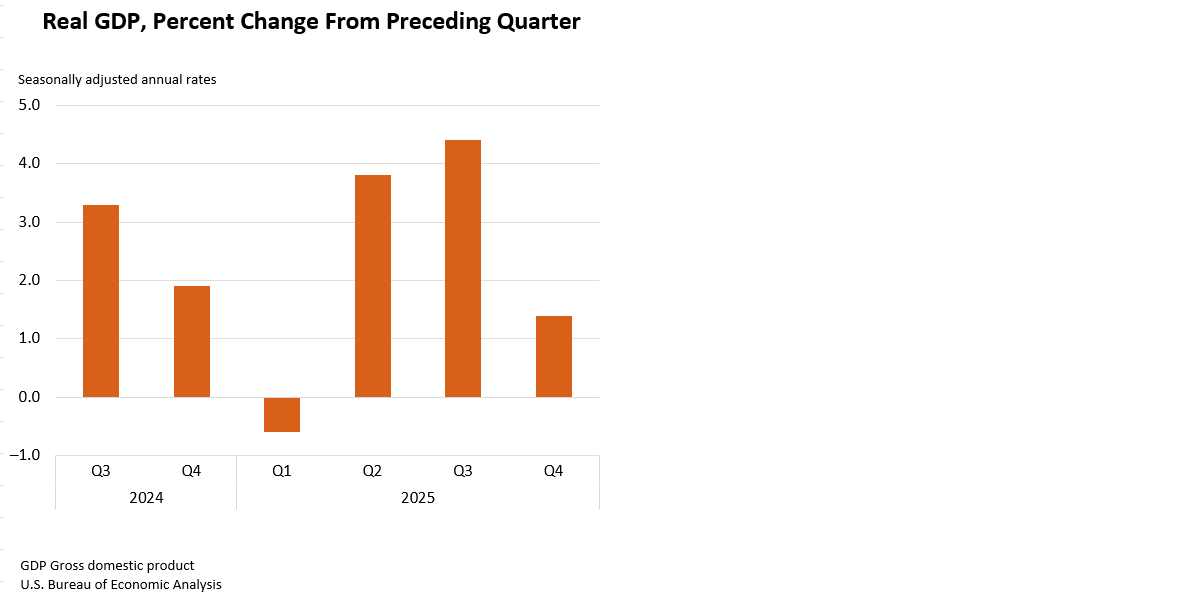
A Friday report from the Commerce Department showed that U.S. gross domestic product slowed well beyond estimates in the final quarter of 2025, capping the slowest annual growth in GDP since COVID.
The Bureau of Economic Analysis (BEA) said that in its advance estimate for the fourth quarter, GDP across the final three months of 2025 expanded at a seasonally adjusted 1.4% pace. That was well behind expectations for 2.5% GDP growth, and a considerable slowdown from the third quarter’s 4.4% rate of improvement.
“A disappointing, and noisy, 1.4% growth rate for Q4 GDP contributed to full year 2025 growth at 2.2%,” says Adam Hetts, Global Head of Multi-Asset and Portfolio Manager at Janus Henderson Investors. “The government shutdown was a large contributor depressing growth to a level that is over 1% lower than Q4 expectations, although the reopening will serve as a rebound mechanism for Q1 GDP.”
The 12 Best Budgeting Apps We’ve Reviewed
That 2.2% annual pace for 2025, which was severely hampered by the government shutdown, was down from 2024’s 2.8% and the lowest since 2020.
The greatest contribution in real GDP during Q4 was consumer spending, which added 1.6 percentage points to growth, while private domestic investment added another 66 basis points. (A basis point is one one-hundredth of a percentage point.) “We focus on real final sales to domestic purchasers, which strips out inventories and trade, as the cleanest measure of activity,” says Brad Conger, Chief Investment Officer at Hirtle Callaghan. “The Q4 reading of 2.4% decelerated from Q3’s 2.9% and shows an economy that is catching its breath on an upward haul.”
The biggest weight on GDP was government spending and investment, which reduced growth by 90 basis points.
In the meanwhile, the core personal consumption expenditures price index—the Federal Reserve’s preferred gauge of inflation, which backs out food and energy costs—kept close to recent levels, up 3% in December. That was in line with expectations, while headline PCE growth of 2.9% was 10 basis points ahead of estimates.
Month-over-month, headline and core PCE were up 0.4%, ahead of forecasts for 0.3%.
Financial Caregiving: How to Manage a Loved One’s Finances
“Inflation pressures are likely to reaccelerate modestly in the first half of the year, potentially moving back above 3% as tariff pass-through and wage growth filter through to prices,” says Steve Rick, Chief Economist at TruStage. “That keeps the Federal Reserve on a cautious path. Even with softer growth data, we still expect about 50 basis points in total rate cuts during 2026 as policymakers move gradually toward a neutral policy stance.”
Wall Street agrees. Following Friday’s GDP report, the CME FedWatch Tool, which uses trading in federal-funds futures to determine the market’s expectations for future Federal Reserve actions, showed little change from the day prior. Futures still indicate a 94% chance the Fed will keep the range on its benchmark interest rate set at 3.50% to 3.75% at the next Federal Open Market Committee (FOMC) meeting, scheduled for March 17-18.
Do you want to get serious about saving and planning for retirement? Sign up for Retire With Riley, Young and the Invested’s free retirement planning newsletter.
Additional Insights on Q4 GDP
A look at what other economists and market strategists have to say about America’s fourth-quarter GDP reading:
Scott Helfstein, Head of Investment Strategy, Global X ETFs
“There are definitely some conflicting signals still flashing out there. For example, quarterly GDP growth was sluggish, but corporate revenue growth for the quarter was phenomenally strong. One reading inflation shows that prices are still accelerating and another shows the Fed is basically at target. We continue to take a constructive view on equities and risk assets.
The economic data was mixed. Quarterly GDP growth was disappointing, but nominal year-over-year growth was still a half point better than forecasts and better than last quarter. Meanwhile, the PCE inflation report reflects price increases in December, but the January consumer inflation is already moderating.”
Helpful Teenage Money Management + Financial Planning Apps
Michael Reynolds, Vice President of Investment Strategy, Glenmede
“Glenmede estimates that the longest government shutdown in U.S. history likely held back economic growth by up to 1.5% in Q4, but this was a temporary headwind that is likely to reverse over the next few quarters. These impacts are not purely confined to the government spending line item in today’s GDP report, which only covers the portion of direct federal spending that was delayed during the shutdown. The rest of the impact shows up in the light print on household goods spending since government employees and transfer recipients faced temporarily lower spending power due to delayed paychecks and SNAP benefits, which may have depressed consumption.”
Sonu Varghese, Chief Macro Strategist, Carson Group
“Economic growth eased in Q4, but that was mostly because of the shutdown, and we should see a rebound in Q1 2026. Overall growth in 2025 pulled back to trend after a couple of hot years in 2023-2024, in part thanks to a big boost from AI-related investment. Inflation also ran hotter in 2025, with a pickup in the Fed’s preferred inflation metric (core personal consumption expenditures index) at the end of the year. That’s going to keep the Fed on the sidelines for longer.”
Want to talk more about your financial goals or concerns? Our services include comprehensive financial planning, investment management, estate planning, taxes, and more! Schedule a call with Riley to discuss what you need, and what we can do for you.