

If you’re raising a teenager, the most important thing to remember is that their financial future will be greatly influenced by how they manage their money today. That’s a challenge to overcome—financial responsibility historically hasn’t been a top priority for teenagers.
Teenagers can have rapidly changing priorities for how they spend their time, and inevitably, how they spend their money. They face inherently different situations than kids or adults and carry different responsibilities.
Typically, the first time money management for many teenagers comes up is right around when a teen’s income from a job comes into the picture—and with that, the ability to make some of their own choices on how to spend it. But depending on their responsibilities, it might be better if they don’t spend all of their income—it might be best to have them shoulder a couple small adult expenses to teach them money management from an early age.
This should build sustainable expectations for what life will be like after school, when they must begin to make their own financial decisions.
Your aim should be to teach your teens how to think about their financial goals, and to understand how saving and spending now can help achieve them. It won’t be easy for them to keep the long term in mind, but we’ll teach you several financial planning and advice tips for teenagers that will compound over time.
Read on as we discuss some of the different ways you can teach your teenager to save and spend wisely, building habits that will ensure them a secure financial future!
Table of Contents
Helpful Teen Money Management Apps—Our Top Picks
|
Best Debit Card for Kids

|
Feature-Rich Teen App + Debit Card

|
Best Kids Debit Card for Customer Service

|
Free Debit Card for Kids

|
|
Primary Rating:
4.8
|
Primary Rating:
4.7
|
Primary Rating:
4.4
|
Primary Rating:
3.9
|
|
Core: $5.99/mo. Max: $10.98/mo. Infinity: $15.98/mo. Family Shield: $19.98/mo. (Each account supports up to 5 children.)
|
No subscription fees.
|
Acorns Early Lite: Free 30-day trial, then $8/mo. Acorns Gold: $12/mo.
|
No monthly subscription fees.*
|
What Is Money Management?

Money management is a series of decisions you make about how to spend, save, invest and generally use money. It’s also a way of thinking about your future finances.
It can be as simple as:
- Deciding to put aside $20 every week from now on to reach teenage investing goals
But it could also involve major life decisions like:
- Choosing between attending an expensive four-year college versus a cheaper two-year community school
- Buying a home instead of renting
- Choosing to buy a car versus riding public transportation
Money management involves understanding the value of money, how to earn it and what you want in life—then making decisions that will help you get to where you want to go.
Why is Teenage Money Management Different?

Clear goal-setting and follow-up are always top priorities for anyone trying to be responsible with their money. But they’re both more challenging when it comes to teenage money management.
Teenagers often go through emotional, psychological and financial changes. As a result, they can make impulsive decisions about the timing of their goals, how they reach them and even whether they still care about them.
One way to help your teen stick with and achieve their goals is to break them down into categories, which makes them more digestible. For example, goals for teenagers might include:
- Saving money: It’s probably not realistic for a teenager to save up $20,000 by age 18 or even 25. However, convincing them to save just one dollar per day early on can make a big difference in their saving habits as the years roll by.
- Spending money: Money management for teenagers is all about balancing wants and needs. If they spend too much on what they want, they won’t be able to afford their needs. Thus, it’s important to help your teen align their spending with their goals.
- Investing money: It might be tempting to skip this step, as it’s more difficult and often involves much longer-term goals that are difficult for a teen to commit to. But teaching your teenager the first step on how to invest money is a vital step toward money-management success. Consider helping your teenager open a brokerage account of their own. Many free stock investing apps have slashed barriers to entry to almost nothing, making it easier for teenagers to learn how to invest money than ever before.
- Giving money: Teenagers can start giving back by donating to their favorite charities or volunteering in some capacity every month. Select a charity that aligns with their interests and ensure they give a fixed amount each month or year.
Financial goals are achieved by saving up until the cost of something can be purchased in one lump sum. Consider setting three goals:
- A short-term goal for a specific purchase
- A medium-term goal for a purchase they intend to make in the coming two to three years
- A long-term goal such as contributing to a retirement account (if they have a job) or a college fund
It’s also important to establish clear steps on how you will achieve them. This helps with teenage money management because it makes the goal achievable, which in turn will better motivate your teen to work toward that goal.
Financial Planning and Advice for Teenagers

Managing money as a teenager is difficult because it’s likely the first time they’ve been given this level of financial responsibility.
Therefore, the following steps will be useful for alignment between parent and teenager.
How to Manage Your Money as a Teenager
→ Establish and Manage Your Income

By the time your child becomes a teenager, they’re going to be legally entitled to work for someone and earn an income in most states.
But your teenager must learn to use this newfound income wisely.
If you want your teen’s money to last a certain amount of time, then help your teen establish a plan for managing incoming funds (e.g., from a job, gifts, etc.) and expenses (e.g., cell phone, gas for a car, entertainment and events with friends).
If they’ve worked all summer but won’t make any more money once they return to school for the upcoming semester, show them how to take the amount they currently have and divide it evenly over the coming semester’s months.
They might receive money through gifts around the holidays or a birthday, allowing them to top up their balance. Make sure you show them how to live on a budget, and how to update that budget as different needs and financial windfalls present themselves.
Perhaps your teen wants to attend a concert next month. Show her how reducing spending in other areas leading up to the concert will allow her to stretch her money so she can afford to buy a ticket.
If she deftly handles all her current obligations (such as school and extracurriculars), encourage her to get a part-time job to earn some extra money she can put toward those tickets.
Another lesson you can teach is about Uncle Sam. Namely, remind your teenager to do the math based on the net (after-tax) wages that get deposited into their bank account each pay period, not their gross (pre-tax) wages.
And tell your teenager they’ll have to account for not just the price of their purchase, but any applicable sales taxes.
While eventually you’ll want your teenager to be financially independent, you’ll want to start by being heavily in the loop. You’ll want to regularly know how much money they’ve earned or spent so you can ensure they’re staying on top of their money management path.
Remember: Earning an income represents your teenager’s first step toward financial independence, but it also carries responsibility for how to manage it wisely.
→ Create a Budget

The best way to keep track of your money is to create a budget in Excel or use a budgeting app for teens (discussed more in the Teenage Money Management Apps section below).
Provide your teenager with these steps for creating a budget:
- List all monthly income sources in the first column(s).
- Create new columns to show your income by week, pay period or month—whichever best aligns with the frequency of your biggest expenses. Depending on the number of jobs or sources of income you might have, you might need multiple columns.
- List all monthly expenses in the subsequent column(s). These might include a cell phone plan, car insurance premiums, school trips, vacations and commuting costs (transit or gas), or entertainment with friends. If you want to save for future expenses, such as college or a car, include the monthly amount to be saved.
Your teenager and you should check on this budget every month, at a minimum.
Another teenage money management tip: Make sure they track their expenses over time to make sure they remain consistent and predictable. If they’re not, you might need to more closely guide your child on keeping them under control.
Creating a budget and seeing it visually can allow greater understanding and control over where your money goes each month.
Ultimately, creating a budget is an excellent early step in teenage money management because it allows them to visualize their finances.
By seeing it in black and white (or colors, depending on a budgeting app they use), your teenager can have a clearer sense of their money picture.
Related: Best Investing Apps for Teens (Stock Apps for Under 18)
→ Align on Money Rules
When your teenager first starts to earn money, you’ll need to have several important conversations with them about money rules, money responsibilities and money boundaries.
Some money rules to consider:
- Establish spending thresholds for your teens: By creating these quick speed bumps, you can protect your teens against large impulse buys.
- Categories of items they can buy: Narrow down what they can and cannot buy. These categories exist whether it’s their money or not.
- Create saving rules: You should make sure your teen understands the importance of thrift and saving toward goals. Have them use their income as a means to earn something they want or need in the near-term (< 5 years).
- Investing money rules: Likewise, you should work with your teen to lay down rules for allocating a certain amount of money toward investing goals. This will ensure some money gets placed aside to grow for long-term needs like a home, car, wedding, retirement or another major purchase many years in the future
These conversations will help to set expectations for your teenager’s earnings so they can understand expenses and how to set up a budget.
Greenlight App (A Tool to Align on Money Rules)
- Available: Sign up here
- Price: Core: $5.99/mo. Max: $10.98/mo. Infinity: $15.98/mo. Family Shield: $19.98/mo. (All plans include cards for up to 5 children)
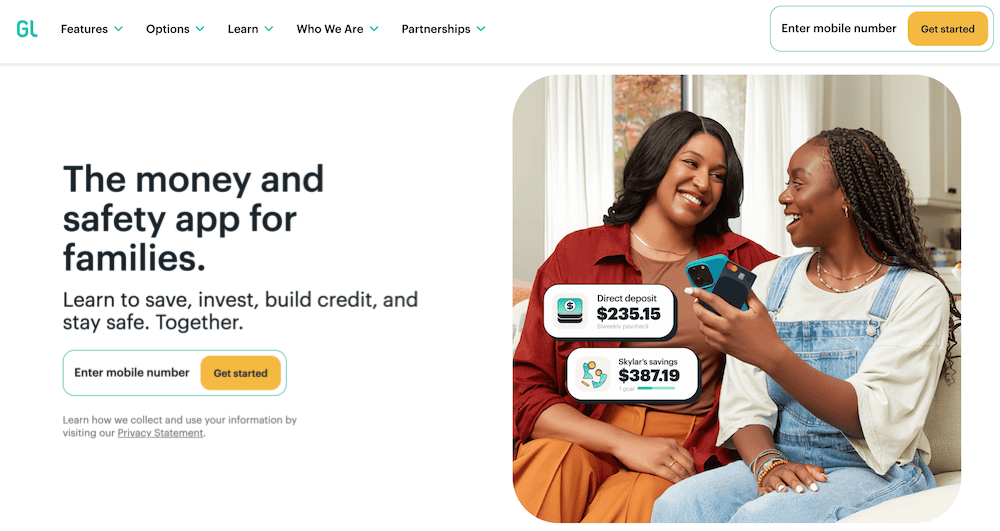
A great all-in-one financial app to help with these money rules is Greenlight. The Greenlight debit card allows kids to begin spending, but provides parents with peace of mind by giving them control over where their kids can spend money. Parents also can choose to receive alerts that tell them when, and how much, money is spent on the Greenlight debit card.
Greenlight works like a prepaid debit card, allowing you to transfer money onto the card for your child to pay for expenses at approved locations. You can choose how much money to load onto the card, and your child will be cleared to make approved purchases so long as a money balance backs up the card.
If your child asks for extra money to get added to the card, you can have them take a photo of the purchase they want to make and receive your approval. This gives you control and allows you to have discussions with your child about why a purchase might be a good or bad idea. And if your child has a job, they can add their own funds to the card via direct deposit.
Greenlight boasts numerous other features, too:
- Parents can open an investment account for kids to get their children investing in stocks and exchange-traded funds (ETFs) for the first time.
- Greenlight offers monthly savings rewards based on your tier, listed in the box below.
- Max, Infinity, and Family Shield families can also earn 1% cash back on their spending.
- You may also set up “Parent-Paid Interest” between you and your child, which allows you to foot the bill and pay interest on accounts for up to five kids.
Each monthly Greenlight subscription includes debit cards for up to five kids. Replacement cards cost $3.50 each but are free the first time. If you need to replace your card quickly, you can get express delivery for $24.99. The company also offers a personalized card, with your own photo or design, for $9.99.
Greenlight has no minimum age requirements for this card, but recommends starting at age 6 or older. Read more in our Greenlight card review or sign up today.
- Greenlight is a financial solution for kids that allows them to spend with a debit card, earn money on savings, and even invest their money.
- Greenlight offers flexible parental controls for each child and real-time notifications of each transaction. And it's the only debit card that lets you choose the exact stores where kids can spend on the card.
- Parents can use this app to teach kids how to invest with a brokerage account through Greenlight Max, Infinity, and Family Shield plans.
- Greenlight also provides educational materials such as "Level Up" lessons that simplify investing concepts, as well as videos about their favorite companies.
- Families can earn 2% (Core), 3% (Max), 5% (Infinity), or 6% (Family Shield) per annum on their average daily savings balance of up to $5,000 per family. Also, Max and Infinity families can earn 1% cash back on their monthly expenditures.
- Unlike many apps that simply provide features and controls, Greenlight is also designed to spark discussions with children about spending, investing, and more, fostering a better educational experience.
- Best-in-class parental controls (can prohibit specific stores)
- Can add brokerage account to invest in stocks
- Intuitive Parent + Kid apps
- Competitive cash back & interest rates
- Parent-Paid Interest
- High price points
- No cash reload options
- No parent / child lending
Related: Best Greenlight Alternatives [Debit Cards for Kids & Teens]
→ Set Up a Bank Account for Teens

Once your child becomes a teenager, you’ll want to get them a bank account. The piggy jar might evoke fond memories, but it doesn’t accept Direct Deposit or cash checks.
If you want to set up a bank account for teens, you have plenty of options. You can use a custodial bank. You can use an account associated with your own bank to make transferring money to their account easier.
You can also consider using an online-only account like Greenlight as mentioned above, or even a free Axos High-Yield Savings Account. The latter allows for easy transfers to external accounts and is how my wife and I manage our money.
Other decisions you’ll want to consider before setting up a checking account for teens:
- Will you only open a checking account with a debit card, or also a savings account?
- Will the bank account also come with a debit card? Will it be a prepaid debit card? Have a look at the best debit cards teens
- Will the debit card have overdraft protection?
- Will you add your teenager as an authorized user on your own credit card?
- How will money transfer between accounts (if at all)?
→ Track Finances to Spend Money Wisely

Now that your teen has established an income, created a budget, aligned on money rules and set up a banking solution, it’s time for them to track their finances in the wild. Doing so keeps them engaged, giving you both greater confidence about making informed financial decisions.
As famous business consultant Peter Drucker says, “If you can’t measure it, you can’t manage it.” Drucker, who is widely credited as the thought leader behind modern business management practices, advised companies to rely on data to make decisions.
Yes, some people have great intuition about how to do things right, but everyone can use data to learn more and improve.
And the very same thing applies to teens (or anyone!) and tracking their expenses. Here’s how teens can track their money:
- Review account activity. First, your teen and you will want to review all account activity for the past month. Some people prefer a weekly budget, but most people budget monthly since this aligns better with common living expenses such as rent or a phone bill. Add into this any cash expenses or earnings. Combined, this will create a complete picture of your monthly cash flow. (Or said plainly: what money is coming in and what money is going out.)
- Categorize your expenses. Put all purchases made during the month into groups. Doing so will allow you to understand where your money goes. Money leaving your account generally falls into one of three categories: necessities, luxuries or savings. You can also look at expenses as fixed (the same from month to month) or variable (changes from month to month).
- Manage your expenses. Fixed expenses such as your rent, phone bill or debt payments tend to remain stable month-to-month. These are more difficult to reduce without making lifestyle changes such as downsizing or going without. Variable expenses—think eating at a restaurant, buying another pair of shoes or traveling out of state—are less “need” and more “want.” If you’re trying to save toward a goal and need to find money in your budget, you probably can find some savings by cutting back on your variable expenses.
- Save money for goals (and for a rainy day). Whatever’s left each month of your income after you pay for your expenses is savings. It’s important to make room in your budget to save money not just for your goals, but also for a “rainy day”—another way of saying an emergency that requires money to fix. You never want to find yourself short on cash when an unexpected expense crops up.
Thankfully, all of your money needs can be tracked conveniently from your phone through the use of budgeting apps. These on-the-go solutions can make money management more accessible, though they sometimes might require a little legwork.
For instance, some apps require you to log transactions manually. (For teens, Greenlight is one option to consider. It has appealing benefits such as a prepaid debit card with savings goals, expense tracking for purchases made on the card, and joint account management.)
What Types of Expenses Will Teenagers Have?

Teenagers will have a number of competing priorities for their newfound cash. So it’s important to have them create a list of things to save up for so they can learn to balance short-term wants and long-term needs.
Some common types of expenses teenagers will encounter include:
- Car insurance deductibles for accidents
- Car insurance premiums
- Cell phone plans
- Clothing
- College expenses
- Entertainment (it’s important to balance the costs of these types of expenses with a person’s income)
- Extracurricular activities
- Food
- Gasoline
- Gifts for holidays
- Hair care
- High school sporting events
- Makeup supplies
- Online game subscriptions
- Prom photos
- Public transit fares
- School trips
- Traveling abroad
- Vacations
- Video games
- Weekend/summer road trips
Parents and teenagers should also talk to their teen about how everyone should have an emergency fund as the most immediate goal.
While not every teen will face a financial emergency and not have the support of their family, developing the habit of having a dedicated amount of funds to protect against financial hardship is something worthwhile for them to have when they’re on their own.
Adding this line item to your teen’s budget early on will allow your teen to build up cash reserves quickly and ensure an emergency fund is always top of mind.
5 Teenage Money Management Apps
1. Greenlight (Best Overall)
- Available: Sign up here
- Price: $5.99/mo. and up
Greenlight is a powerful app for managing your kids’ spending, teaching them financial lessons and helping them develop financial literacy. The app aims to put money in a controlled environment for parents and children to discuss it openly and build lifelong financial skills from an early age.
- Greenlight is a financial solution for kids that allows them to spend with a debit card, earn money on savings, and even invest their money.
- Greenlight offers flexible parental controls for each child and real-time notifications of each transaction. And it's the only debit card that lets you choose the exact stores where kids can spend on the card.
- Parents can use this app to teach kids how to invest with a brokerage account through Greenlight Max, Infinity, and Family Shield plans.
- Greenlight also provides educational materials such as "Level Up" lessons that simplify investing concepts, as well as videos about their favorite companies.
- Families can earn 2% (Core), 3% (Max), 5% (Infinity), or 6% (Family Shield) per annum on their average daily savings balance of up to $5,000 per family. Also, Max and Infinity families can earn 1% cash back on their monthly expenditures.
- Unlike many apps that simply provide features and controls, Greenlight is also designed to spark discussions with children about spending, investing, and more, fostering a better educational experience.
- Best-in-class parental controls (can prohibit specific stores)
- Can add brokerage account to invest in stocks
- Intuitive Parent + Kid apps
- Competitive cash back & interest rates
- Parent-Paid Interest
- High price points
- No cash reload options
- No parent / child lending
Related: 9 Best Allowance and Chore Apps for Kids [Easy Family Life]
2. Cash App Families (Cash App’s Debit Card for Teens)
- Available: Sign up here
- Price: Free* (no subscription fees)
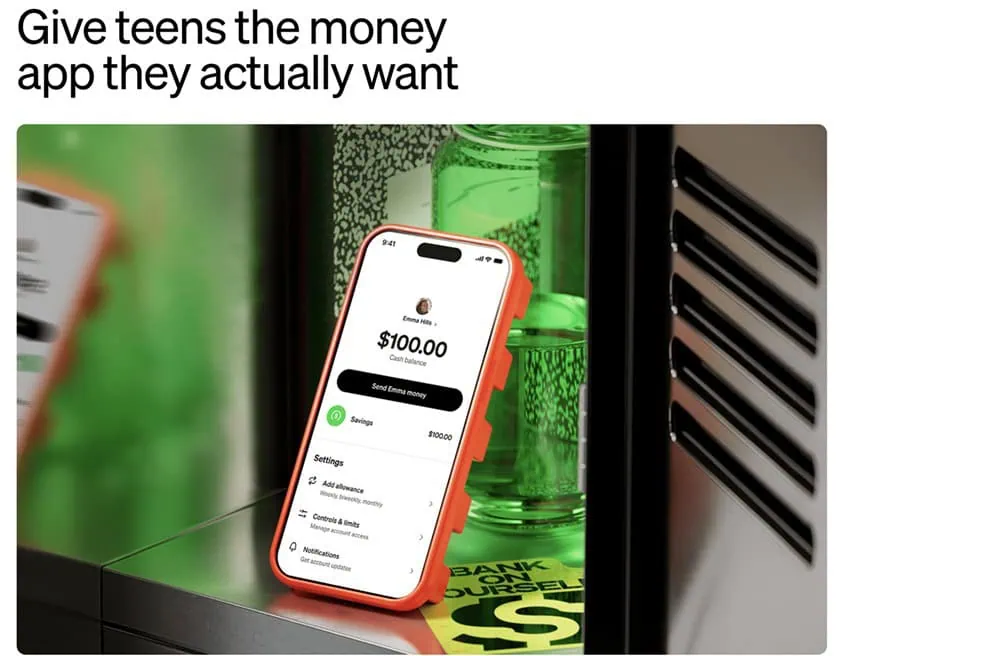
Does your teen need to start learning smart saving, spending, and even investing habits? Cash App Families can accomplish all three—with no subscription fees—putting the power of Cash App into your teen’s hands while keeping their financial safety firmly in yours.
Teens get an account with a designable Cash App Visa® Card, which they can use to spend money where Visa is accepted. Meanwhile, access to Cash App allows them to save money toward specific goals, send money to friends, accept offers for instant discounts at their favorite places, earn high interest on savings³, and check out securely in stores and online by using a QR code.
If your teen direct-deposits $300 or more each month, they’ll also unlock a bevy of other features, including getting paid two days earlier, no ATM fees¹ when withdrawing from more than 40,000 in-network ATMs, and one waived out-of-network ATM withdrawal per month.
Cash App Families even has an investing feature with fractional shares, allowing kids to purchase as little as $1’s worth of stocks and Bitcoin (parent permission is required).²
Meanwhile, parents/guardians who sponsor the teen** enjoy some of the best oversight features among teen debit cards. You can monitor your teen’s activity from your own Cash App or receive real-time transaction alerts for their payments and purchases. You control which features—stocks, Bitcoin², sending money, the Cash App Visa® Card—your teen can access, and certain spending categories are auto-blocked for teens. Parents can also send money for allowance whenever they want, and built-in tools allow parents and teens to budget and save together.
Parents/guardians must download Cash App (also free), then invite their teen to create a sponsored account. Cash App Families can be used by teens ages 13-17. Use our link to learn more about or sign up with Cash App today.
- Cash App Families is a money app and debit card that helps teens ages 13-17** learn about, spend, save, and invest money while under the protection of a large suite of parental oversight tools.
- Teens get a customizable Cash App Visa® Card*, can make and receive instant person-to-person payments, can fund their account with direct deposit, and can even buy as little as $1's worth of stocks and Bitcoin.²
- Your teen can earn 3.50% interest on savings. No account minimums.³
- Pay your kids an allowance, and use Cash App's tools to save and budget together.
- Safety features such as real-time transaction alerts, account monitoring (from the parent's Cash App), alerts for teen payments to new contacts, contact blocking, feature control, and payments control. Also, Cash App auto-blocks certain spending categories to teens, and strangers can't find teens in Cash App search.
- Features such as two-day early payment, free in-network ATM withdrawals, and a monthly reimbursement for an out-of-network ATM withdrawal are unlocked when $300+ is direct-deposited each month.¹
- Free account and Cash App Visa® Card*
- Excellent parental controls (including feature lock and real-time transaction alerts)
- Stock and Bitcoin investing²
- Fractional shares²
- Allowance feature
- Customizable cards ($5+)
- FDIC insurance available on a pass-through basis (if certain conditions are met)***
- Certain benefits, such as free in-network ATM withdrawals¹, require direct deposit of at least $300 monthly
Related: 11 Best Debit Cards for Kids [2026]
3. Acorns Early (Best for Customer Service)
- Available: Acorns Early Lite | Acorns Gold
- Price: Acorns Early Lite: Free 30-day trial, then $8/mo. Acorns Early: $12/mo.
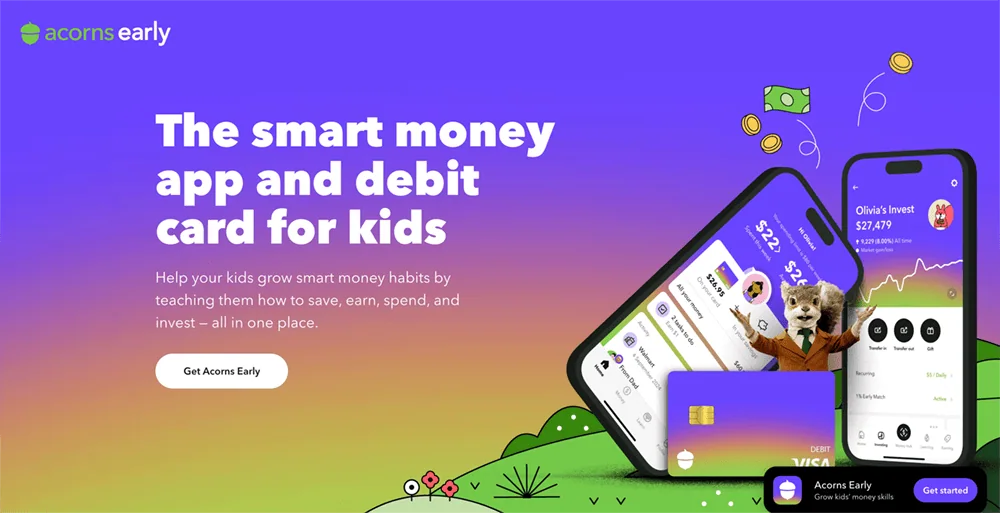
Many reviewers have long painted Acorns Early (formerly GoHenry) as just a way to spend. However, I see it as a real financial solution for minors—a debit card, yes, but also an app-based ecosphere that provides education and experience for the child, as well as ways for parents to keep their kids safe and teach them responsibility.
An Acorns Early account includes a smart money app, as well as Visa debit cards for up to four children. These debit cards can be used to spend anywhere Visa is accepted (so, millions of vendors online and in stores), as well as withdraw cash from ATMs. The standard Acorns Early debit card itself is included in the monthly subscription; however, your child can also stylize their card with one of 35 different designs for a one-time fee. The account also allows kids to set savings goals, which they can fund manually or via autosave.
Acorns Early’s app hosts educational materials to help children and teens alike develop good money habits. One of the more impressive aspects of the program is that it’s explicitly segmented into different age groups, starting with money basics for kids in single-digit ages, then becoming more advanced over time, so the lessons really appear to grow as your children do.
This FDIC-insured account also enjoys a variety of safety features, including chip and PIN protection, secure PIN recovery, and fraud protection. Acorns Early also offers parents additional peace of mind by providing a number of controls, including:
- Real-time spending notifications
- Card lock/unlock
- Savings goal lock/unlock
- Adjustable spending limits on a per-transaction and per-week basis
- Card category block/unblock for in-store purchases, online purchases, and ATM withdrawals
- Adjustable spending block/unblock at stores that sell age-restricted goods such as firearms and alcohol
Also, kids can only spend whatever money is available on the card because it’s a prepaid debit card. That means parents don’t have to worry about costly overdraft fees or their kids running up a debt.
Acorns Early offers a number of ways to fund the account. Parents, of course, can send money in a pinch whenever they want with instant transfers. They can also set up a regular allowance, or tie payment to chores. (And parents get to approve chores before they pay out—no half-done dishes allowed.) Teens can also receive ACH deposits from their employers. And loved ones can either get “Relative accounts” that allow them to send money to your kids, or they can send money via Acorns Early “Giftlinks,” which act similarly to an e-gift card.
Acorns Early also stands out to us as one of the best prepaid debit cards for kids because of its outstanding customer service, which it inherited from GoHenry. Acorns Early users enjoy seven-day-a-week phone service (9 a.m. to 8 p.m. ET Monday-Friday, 9 a.m. to 5 p.m. ET Saturday-Sunday), as well as 24/7 live chat support.
Acorns Early has no minimum age requirements but recommends starting at age 6 or older. Parents have two ways of signing up for Acorns Early:
- Sign up for Acorns Early Lite. This subscription level provides you with everything mentioned above for up to four children.
- Sign up for Acorns Gold. Acorns Gold is the top Acorns subscription tier for adults, and it provides a wealth of banking, investing, and other features. However, it also includes a subscription to Acorns Early (again, good for up to four children), and it unlocks Acorns Early Invest: a UGMA/UTMA custodial account you can use to invest for your kids’ future.
Acorns frequently offers small bonuses for anyone who signs up with our links. You can check out current offers in the box below, or read more about this app in our Acorns Early review.
- Acorns Early is a debit card and financial app designed to provide education, experience, and confidence in saving, spending, and earning, to kids ages 6-18.
- Accounts come with a smart money app and up to 4 Visa debit cards, which allows your kids to spend in stores and online, and withdraw money from ATMs.
- Kids can also earn allowance, complete chores for money, set savings goals, even give to charity.
- Parents can rest easy knowing there are plenty of guardrails in place, including chip-and-PIN technology, fraud protection, and parental controls such as spending notifications, card locking, and adjustable spending limits.
- Acorns Early also provides educational resources tailored for kids of all ages, as well as sterling customer service (including everyday phone availability and 24/7 chat).
- All of the above is available via the Acorns Early Lite subscription.
- An Acorns Gold subscription delivers everything in Acorns Early Lite, as well as access to Acorns Early Invest (a UGMA/UTMA custodial account where you can save toward your kids' future and get a 1% match on up to $7,000 in contributions annually). Parents also enjoy banking and investing features such as an IRA with a 3% match for your first year, a high APY on emergency savings, Acorns' "Round-Ups," and more.
- Special offer (1): Get a free 30-day trial and $5 allowance when you sign up for Acorns Early Lite.
- Special offer (2): Get a $20 bonus investment when you sign up for Acorns Gold.
- Strong parental controls (including card-use controls and adjustable spending limits)
- Chores and allowance
- FDIC insurance
- Allows for ACH payments
- Convenient "Giftlinks" for non-accountholders to give money to kids' accounts
- Customizable cards (with fee)
- Must sign up for Acorns Gold to get investing
- No fee-free ATM network
Related: Acorns Early vs. Greenlight
4. Current
- Available: Sign up here
- Price: Free (no monthly fees)
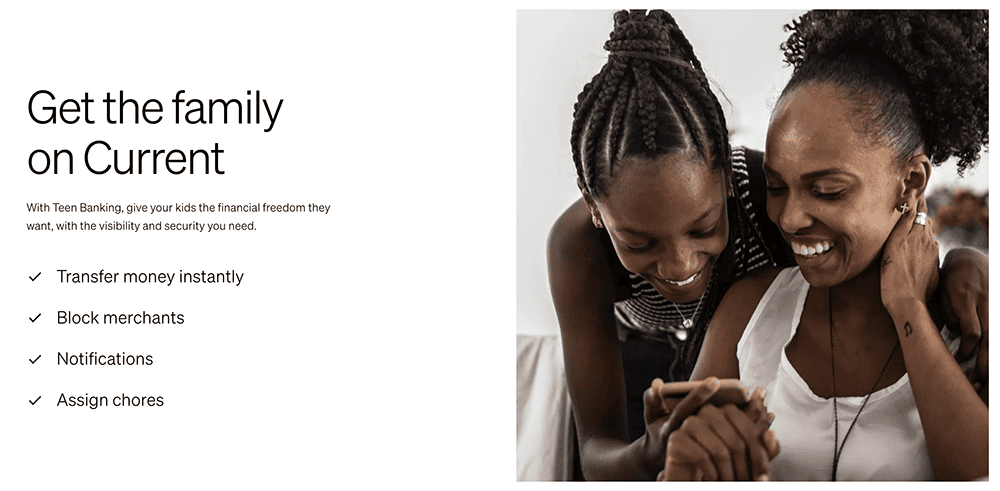
Current is a banking app designed for families; it offers both parent and teen accounts, with the latter acting like prepaid debit cards that parents load for their children. The Current app allows you to track your teen’s spending in real-time, set limits on how much your children can spend, and even block specific merchants on its Visa-enabled debit cards. You also get the peace of mind that comes with knowing your children’s money is safe because it’s not cash—no temptations, just a tool parents can use to help teach teens financial responsibility.
Among Current’s features:
- No minimum required balances, no fees on transfers to other Current accounts, and no hidden fees.
- Create Savings Pods, or Giving Pods, that allow you to save up for various goals.
- Round-Ups allow you to round up purchases to the nearest dollar amount and store the difference in Savings or Giving Pods.
- Buy and sell 27 different cryptocurrencies with zero trading fees.
Teens will love easy allowance deposits, a card they can use in stores or online, instant gas hold removals when buying gas, and access to more than 40,000 fee-free Allpoint ATMs nationwide. They’ll also have the opportunity to learn about financial responsibility and financial independence through Current’s Budgets feature, which allows them to track their spending and even receive alerts when they get too close to (or exceed) a predetermined limit.
The product has no specifically stated minimum age requirement, but the marketing suggests teens are the target audience. However, you might be able to open an account for a younger child.
Read more in our Current review.
- Current is a financial technology platform that lets teens enjoy not just traditional banking basics, but numerous features meant to simplify spending, streamline saving, and set them on the path toward more organized finances.
- Teens can spend with the Current Visa debit card, which allows them to purchase in-store and online, as well as withdraw money fee-free from more than 40,000 in-network Allpoint ATMs.
- Current Teen Accounts also come with Savings Pods, which earn 0.25% APY and allow you to round up purchases (overages are funneled into your savings). Keep a qualifying direct deposit of $200 or more in your account, and you'll earn a full boosted rate of up to 4% annually.
- Parents can monitor their kids' spending, adjust maximum ATM withdrawal and spending limits, and even toggle spending categories (and the Current debit card itself) on and off.
- Parents can also automate allowance payments, pay for chores, instantly transfer money to their teens, and more.
- Free account (no monthly maintenance fees)
- Good parental controls
- Fee-free ATMs
- Cash reloads
- Gas hold deposits
- 24/7 email and live-chat support
- No direct deposit
- No paired investment account
- No card customization

Related: 10 Best Money Apps for Teens Under 18 [Invest, Pay + More]
5. Modak (Debit Card for Kids Without Monthly Subscription Fees)
- Available: Sign up here
- Price: No monthly subscription fees*
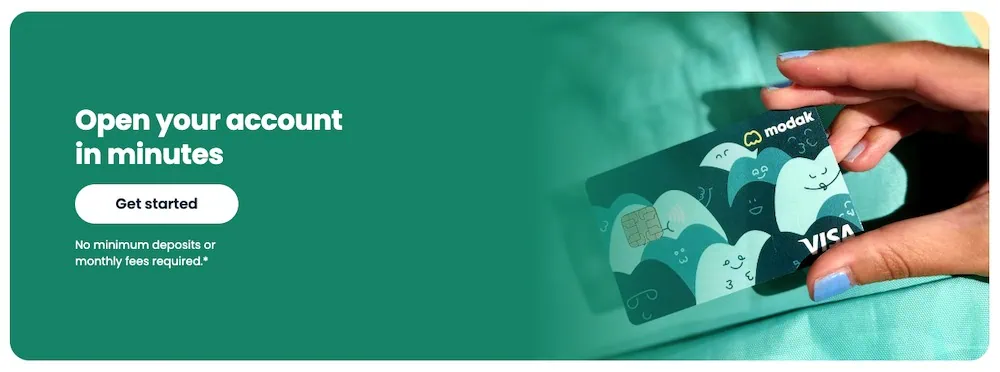
Modak is a feature-rich debit card for kids that not only provides minors with a safe and secure way for minors to learn about financial management, but also plenty of motivation—in the form of rewards.
Kids get a Modak Debit Card—a physical Visa® debit card that they can use anywhere Visa® is accepted. They can use MoCard to make purchases at both brick-and-mortar and virtual vendors, and they can also add their card to the Apple Pay and Google Pay digital wallets. Spending is limited to whatever funds are in the account; if the account is shy, you won’t face an overdraft fee—the purchase simply won’t go through.
And there’s a wealth of options for getting money into a kid’s account. Modak allows parents to fund their kids’ accounts through bank accounts (ACH transfer), debit cards, and credit cards. However, kids can also receive funds through direct deposit if they have a job, Apple Pay and Google Pay, and even Mobucks (or MBX)1—one of the app’s multiple rewards programs:
- MBX: This is an in-app reward system that can be redeemed for actual cash. Kids earn them by completing financial learning challenges, reading lessons, even walking 5,000 steps in a day2.
- Scratch ’em All: Every purchase made with a MoCard unlocks a digital “scratch,” which when scratched reveals a number of rewards, from financial tips and small digital tokens, to MBX, to even AirPods3.
- Referral Program: You can earn $10 for every person you refer to the app, up to eight referrals4.
Kids can even create their own payment link, which they can then send to anyone who wants to fund their account. That not only works great for parents and friends who want to send money for Christmas, birthdays, and other occasions, but it’s also a way kids can get paid for their side hustles.
Meanwhile, parents will love safety and control features such as biometric security measures (fingerprint and facial recognition) for the app, the ability to lock and unlock the child’s card, and spend monitoring. They can also teach financial responsibility through allowance and chore features, as well as through personalized and trackable savings goals. And Modak is a rarity in that it offers 24/7 support (as well as Spanish-language support during business hours) via phone, chat, and email.
The app itself charges no monthly fees* and has no minimum deposit; however, Modak does charge a small fee for certain services, such as for loading a Modak card using a debit or credit card.
A parent can sign up to five children ages 17 and younger. To get started, sign up with Modak today.
- Modak is a free debit card for kids and teens that rewards your child for building their financial smarts ... and good habits of all sorts.
- Comes with a Modak Visa® debit card that can be used anywhere Visa® is accepted, online or in physical locations. The card is also compatible with Apple Pay and Google Pay.
- Security features include easy card lock/unlock, monitoring tools, and biometric measures.
- Age requirement: 17 or younger
- Minimum deposit: None
- Minimum balance required: None
- Free account and card*
- Allowance and chore functions
- Savings goals
- Numerous account funding options
- Compatibility with Apple Pay and Google Pay
- Multiple rewards systems
- No ATM access with card
- Thin educational content
- No transition to adult account when minor turns 18
Modak is a financial technology company and not a FDIC-insured bank. Checking account and the Modak Visa® debit card issued by Lewis & Clark Bank, Member FDIC.
Related: Best Investing Apps for Teens Under 18 [Stock Apps]
Personal Finance for High School Students
Personal finance has increasingly become a hot topic for teenagers and many schools have begun teaching it in a formal way.
You can take it to a more individualized level by not just letting school be where your teenagers learn how to practice personal finance skills.
Getting a first job, creating a budget, setting goals and priorities, establishing bank accounts and investment accounts for kids as well as tracking how they all perform become a core part of managing money wisely.
Consider using some of the teenage money management apps above to aid in this effort. Having everything organized and agreed to at the start will make the entire process far easier to handle and offer fewer surprises.
Read More on Young and the Invested
- 7 Best Investments for Kids [Investing for Children]
- 11 Best Investments for Grandchildren: Ways to Save & Invest
- 8 Best Acorns Alternatives [Better Micro-Investing Apps]
Disclosures
Cash App Families
Cash App is a financial services platform, not a bank. Banking services provided by Cash App’s bank partner(s). Prepaid debit cards issued by Sutton Bank, Member FDIC. Cash App Visa® Debit Flex Cards issued by Sutton Bank, Member FDIC, and The Bancorp Bank, N.A., pursuant to a license from Visa U.S.A. Inc. See terms and conditions for the Sutton prepaid card, Sutton debit flex card, and Bancorp debit flex card. Direct deposit, Savings, Instant Discounts, Direct Deposit and Offers provided by Cash App, a Block, Inc. brand. Offers may not be affiliated with third party merchants
* Card use fees apply. Free Cash App Cards come in black, white, pink, or glow-in-the-dark.
** Teens 13 to 17 can use Cash App with sponsorship by an eligible parent or guardian. To view the eligibility requirements for sponsoring a teen, please visit the Sponsored Accounts section of the Cash App Terms of Service.
*** With a Cash App Card, your money is eligible for FDIC pass-through insurance through Wells Fargo Bank, N.A., Sutton Bank, and/or The Bancorp Bank, N.A., Members FDIC, for up to $250,000 per customer when aggregated with all other deposits held in the same legal capacity at each bank, if certain conditions are met. See the Cash App Terms of Service.
Cash App is a financial services platform, and not an FDIC-insured bank. Prepaid debit cards issued by Sutton Bank, Member FDIC. Cash App Visa® Debit Flex Cards issued by Sutton Bank, Member FDIC, and The Bancorp Bank, N.A., pursuant to a license from Visa U.S.A. Inc..
1 Cash App reimburses ATM fees for all in-network withdrawals when you deposit at least $300 monthly of Qualifying Deposits into Cash App, or spend $500 or more in Qualifying Purchases using your Cash App Card or Cash App Pay in a calendar month. Service fees may apply. See terms for more details.
2 Brokerage services provided by Cash App Investing LLC, member FINRA/SIPC, subsidiary of Block, Inc. Bitcoin services provided by Block, Inc. Bitcoin services are not licensable activity in all U.S. states and territories. Block, Inc. operates in New York as Block of Delaware and is licensed to engage in virtual currency business activity by the New York State Department of Financial Services. Investing and bitcoin are non-deposit, non-bank products that are not FDIC insured and involve risk, including monetary loss. Cash App Investing does not trade bitcoin and Block, Inc. is not a member of FINRA or SIPC. For additional information, see the Bitcoin and Cash App Investing disclosures. Additional fees for securities may apply such as regulatory fees and fees to transfer securities externally. Please see our House Rules for more information.
Fractional shares investing may involve additional risks such as non-transferability. For additional information regarding the unique risks and limitations of fractional shares, please see your Investing Customer Account Agreement.
3 Cash App will pass through a portion of the interest paid on your savings balance held in an account for the benefit of Cash App customers at Wells Fargo Bank, N.A., Member FDIC. To earn interest on your Cash App savings balance, you need to have sponsor approval. Exceptions may apply. Savings yield rate is subject to change.