

Most people know Charles Schwab because of its standing among America’s top retirement account providers. But you don’t need a Schwab account for “Chuck” to help you save for retirement.
Just about anyone can use Schwab’s mutual funds to build their nest egg. Today, I’m going to focus on some of the best Schwab retirement funds for individual retirement accounts (IRAs), no matter who that IRA is through.
Schwab is among the largest providers of mutual funds, giving it the prerequisite scale to charge low fees on those products, indexed and actively managed alike. Better still, most of Schwab’s funds are cheap on a nominal basis, requiring just one dollar when you initially invest. However, to get the most out of some Schwab funds, you’ll want to hold them in an individual retirement account (IRA) or another tax-advantaged account, where you can benefit from their sound strategies without having to worry about the IRS holding out its hand from year to year.
Let me introduce you to the best Schwab retirement funds for IRAs. These funds span the risk spectrum, and each product represents a different long-term investing objective. These products are best held in an IRA because of the tax consequences, but that also means they’re appropriate for similar tax-advantaged accounts, such as 401(k)s and health savings accounts (HSAs).
Editor’s Note: Tabular data presented in this article is up-to-date as of July 29, 2026.
Disclaimer: This article does not constitute individualized investment advice. Individual securities, funds, and/or other investments appear for your consideration and not as personalized investment recommendations. Act at your own discretion.
What Should You Want in a Retirement Fund?
Once you’re ready to invest your retirement savings and put that money to work in mutual funds, you’ll want to consider these critical factors:
- To start, a robust retirement portfolio should provide diversification across various asset classes. This typically means stocks and bonds, though it can also mean alternative asset classes such as real estate or commodities. Diversifying your retirement portfolio across these asset classes can help defray your risk and smooth your returns.
- You’ll also want to think about diversification within each fund. Some products hold dozens of stocks while others hold thousands. Some funds invest heavily in their biggest stocks while others spread their assets out more evenly. So always consider how diversified a fund really is, as well as whether that level of diversification suits your needs.
- Costs matter, too. Every dollar spent on fees and expenses is a dollar no longer available to grow and compound over time, so keeping expenses cut to the bone is vital. Good news there: The best Schwab retirement funds will generally have some of the lowest fees and expenses in the business.
- Don’t forget taxes, either. A taxable account, like a standard brokerage account, is better suited to take advantage of certain tax-advantaged investments, such as municipal bonds. For tax-advantaged accounts, such as IRAs, some of the best investments include bond funds and actively managed stock funds. (I’ll explain why when we get to those funds.)
- Finally, you ideally want your retirement portfolio to produce regular interest and dividend income. Stocks can regularly experience nasty corrections and bear markets, but a good income fund can provide for your living expenses without forcing you to sell at an inopportune time.
Related: 10 Best Schwab Mutual Funds You Can Buy [Low Fees, $1 Minimums]
What Types of Funds Are Available in IRAs?
IRAs generally act very similar to taxable brokerage accounts, insofar as they’re typically self-directed and extremely flexible. You can usually own individual stocks and bonds, as well as just about any type of investment fund—mutual funds, exchange-traded funds (ETFs), and even closed-end funds (CEFs).
ETFs typically beat both mutual funds and CEFs on fees, sometimes by a considerable margin. But there are a few reasons to consider Schwab mutual funds in an IRA:
- They’re cheap, for one. Schwab mutual funds typically offer very low fees—in many cases lower than even many ETFs with a similar strategy.
- Schwab has some of the lowest initial investment minimums in the industry; you can spend as little as $1 to get started.
- Also, some of Schwab’s mutual funds are actively managed, which as I mentioned above is more efficiently held within an IRA. And you very well might prefer to have a human manager overseeing certain strategies rather than buy a fund that simply follows an index.
The biggest difference between an IRA and a brokerage account is their tax treatment. You’re taxed on capital gains, dividends, interest income, and other gains year-in and year-out in a brokerage account. But, generally speaking, the only taxes you’ll ever need to worry about with an IRA is income tax on your withdrawals in retirement.
On that count: Some Schwab mutual funds have more significant tax consequences than others. Some produce a significant amount of interest income, while others trade heavily and, as a result, make short-term capital gains distributions—both of which are taxed at ordinary income rates. In a taxable account, these would be taxable events that you’d pay for each year. But money stashed in tax-advantaged accounts like an IRA grows tax-free, so you get all of the performance of these funds without the year-to-year tax hits.
Related: 8 Best Schwab Index Funds for Thrifty Investors
What Is a Mutual Fund?
A mutual fund is an investment company that pools money from many investors to buy stocks, bonds or other securities. The investors get the benefits of professional management and certain economies of scale. A pool of potentially millions or even billions of dollars is large enough to diversify and might have access to investments that would be impractical for an individual investor to own.
Here’s an example: An investor wanting to mimic the S&P 500 Index (an index made up of 500 large, U.S.-listed companies) would generally have a hard time buying and managing a portfolio of 500 individual stocks, especially in the exact proportions of the S&P 500 Index. Another example: An investor wanting a diversified bond portfolio might have a hard time building one when individual bond issues can have minimum purchase sizes of thousands (or tens of thousands!) of dollars.
Equity funds or bond funds will generally be a far more practical solution.
To invest in a mutual fund, you’ll need to open an account with the fund sponsor or open an investment account with a broker that has a selling agreement in place with the fund sponsor. As a general rule, most large, popular mutual funds will be available at most brokers, so if you open any traditional investment account (like a brokerage or IRA), you’ll have access to most of the mutual funds you’d ever want to invest in.
Make sure you sign up for The Weekend Tea, Young and the Invested’s free weekly newsletter that over 10k monthly readers use to level up their money know-how.
Why Schwab?
Charles Schwab is a U.S.-based brokerage and banking company founded in 1971 as a traditional brokerage company and then as a discount brokerage service in 1974. It is headquartered in San Francisco, California, and operates primarily throughout the United States, but also has international operations.
The firm is the largest publicly traded investment services firm with more than $13 trillion in client assets. Schwab offers a wide range of financial services, such as investment advice and management, trading services, financial planning, banking services, workplace and individual retirement plans, annuities, and more.
On the product side, Schwab features more than 100 funds—it’s known for its active products and seasoned management teams, but it’s also one of the largest providers of indexed mutual funds. Moreover, Schwab’s products feature no load or transaction fees, and below-industry-average annual expenses.
In short: Schwab’s best mutual funds for retirement are generally going to be among your top options period, and they generally won’t make a dent in your wallet.
Related: The 16 Best ETFs to Buy for the Rest of 2026
Empower Advisory Group offers a comprehensive wealth management service known as Personal Strategy Investment Services.
This managed account solution provides clients with discretionary investment management, personalized portfolio construction, and access to financial planning support.

The Best Schwab Retirement Funds to Own in an IRA
I’ve listed these Schwab retirement funds by their overall Morningstar Portfolio Risk Score, from the most conservative to the most aggressive. Here are the risk levels each score range represents:
- 0-23: Conservative
- 24-47: Moderate
- 48-78: Aggressive
- 79-99: Very Aggressive
- 100+: Extreme
These scores are a general gauge of risk compared to all other investments. For example, a bond fund with a score of 20 might be considered a conservative strategy overall, but it could simultaneously be riskier than a number of other bond funds.
With all that out of the way, let’s dig into some of the best Schwab retirement funds you can consider holding in an IRA.
Related: Best Schwab Funds to Hold in an HSA
1. Schwab Short-Term Bond Index Fund

- Style: U.S. short-term bond
- Management: Index
- Assets under management: $1.7 billion
- SEC yield: 4.4%*
- Expense ratio: 0.06%, or 60¢ per year for every $1,000 invested
- Morningstar Portfolio Risk Score: 7 (Conservative)
Bonds are a core holding in just about every portfolio, though you’ll typically own more of them the older you are.
However, bonds also happen to be one of the most tax-inefficient asset classes on earth because the bulk of their returns will generally come from interest paid, and interest income is taxed as ordinary income. If you’re in the 37% tax bracket, then you’re losing 37% of your bond interest to taxes. And for this reason, it will virtually always make sense to hold bonds and bond funds in an HSA, IRA, 401(k), or other tax-deferred account.
Schwab Short-Term Bond Index Fund (SWSBX) is among the lower-risk options in the Schwab arsenal. Nearly 70% of the 3,360-bond portfolio is invested in U.S. Treasuries and other government securities, a quarter is in high-quality corporate short-term bonds, and the remaining sliver is in foreign government bonds.
Related: Best Schwab Retirement Funds for a 401(k) Plan
To be clear: Short-term bonds don’t always make sense for investors, depending on the rate environment.
Right now, for instance, the Federal Reserve is seems torn on whether to raise the federal funds rate (the overnight lending rate used by banks). If it does so, that could weigh on the price of shorter-term debt. But even then, short-maturity bonds offer relatively high yield at relatively low risk.
Consider this: SWSBX’s duration—a measure of interest-rate risk—is 2.6 years. In theory, this means a 1-percentage-point rise in market interest rates would result in a short-term price decline of 2.6% for Schwab’s fund. However, this cuts both ways: A decline in rates could mean a rise of 2.6%. (The actual calculation of duration is fairly complex; it’s the weighted average of the bond’s cash flows. But the key takeaway is that, all else equal, the longer a bond’s time to maturity, the higher its duration—and thus the higher the interest-rate risk.)
In short, Schwab Short-Term Bond Index Fund doesn’t have a ton of upside in the event of a Fed cut, but it also doesn’t have much to lose in the event the central bank raises its target rate. Meanwhile, you’re collecting more than 4%. That makes SWSBX one of the best Schwab funds to hold in an IRA if you’re looking for a defensive position that will earn you a decent amount of income.
* SEC yield reflects the interest earned across the most recent 30-day period. This is a standard measure for funds holding bonds and preferred stocks.
Want to learn more about SNSXX? Check out the Schwab provider site.
Make Young and the Invested your preferred news source on Google
Simply go to your preferences page and select the ✓ box for Young and the Invested. Once you’ve made this update, you’ll see Young and the Invested show up more often in Google’s “Top Stories” feed, as well as in a dedicated “From Your Sources” section on Google’s search results page.
2. Schwab U.S. Aggregate Bond Index Fund
- Style: U.S. intermediate-term bond
- Management: Index
- Assets under management: $8.3 billion
- SEC yield: 4.6%
- Expense ratio: 0.04%, or 40¢ per year for every $1,000 invested
- Morningstar Portfolio Risk Score: 16 (Conservative)
If you’re willing to take on a little more risk for a little more potential reward, you could move up from a money-market fund to a more traditional bond fund.
The Schwab U.S. Aggregate Bond Index Fund (SWAGX), for instance, is a diversified option that covers a wide swath of the bond market. SWAGX, which holds a whopping 12,000-plus debt issues, is categorized by Morningstar as an “Intermediate Core Bond” fund, which very broadly means two things:
- It invests primarily in investment-grade U.S. fixed-income issues, and
- Its duration (a measure of interest-rate sensitivity) usually ranges between 75% and 125% of the three-year average of the Morningstar Cor Bond Index’s effective duration.
Don’t worry. I’ll explain.
To the first part: Every bond that SWAGX currently holds enjoys an “investment-grade” rating, which basically means the credit ratings agencies believe the bond’s issuer has a low risk of default. These bonds are considered relatively safer than (but as a result yield less than) similarly dated below-investment-grade securities, aka high-yield bonds, aka junk. Currently, the largest portion of assets (45%) is invested in U.S. government and agency bonds, while another half of assets is split evenly between mortgage-backed securities (MBSes) and corporate bonds. The rest is peppered across other government-related bonds, municipal bonds, and other debt.
To the second? Intermediate-term bonds are those with remaining maturities of between three and 10 years; that makes up the majority (57%) of SWAGX’s holdings. Another quarter of assets are invested in short-term bonds (three years or below), and the remainder is invested in long-term bonds (10 years or more). That, combined with credit quality, educates the fund’s duration, which currently sits at 5.8 years. While the actual calculation is much more complex, this basically implies that for every 1-percentage-point increase in interest rates, Schwab U.S. Aggregate Bond Index Fund would decline by 5.8% in the short term, and vice versa.
It’s a moderate amount of risk. This means Schwab U.S. Aggregate Bond Index Fund definitely has more room for price appreciation (and losses) than any money market fund, but you can still expect less volatility than you’d get out of a stock fund. You’re also getting a little more yield than you are from SWSBX.
And like SWSBX, the lion’s share of returns will come from interest income, so this Schwab fund is best held in an IRA or another tax-advantaged account.
Want to learn more about SWAGX? Check out the Schwab provider site.
Related: 10 Best Low-Cost Fidelity Index Funds to Buy Now
3. Schwab Balanced Fund

- Style: Moderate allocation
- Management: Active
- Assets under management: $748.2 million
- Dividend yield: 1.8%
- Expense ratio: 0.51%*, or $5.10 per year for every $1,000 invested
- Morningstar Portfolio Risk Score: 40 (Moderate)
We’ll climb the risk ladder a little by moving on to balanced funds, aka allocation funds, aka portfolios in a can.
Whatever you choose to call them, products like Schwab Balanced Fund (SWOBX) are designed to give you exposure to the two primary asset classes—stocks and bonds—in a single holding. More specifically, SWOBX is a “moderate” allocation fund that provides a roughly 60/40 blend of equity and debt (the latter of which also includes a small percentage in cash).
Related: The 10 Best Vanguard Index Funds You Can Buy
While allocation funds are often built with individual stocks and bonds, SWOBX managers Zifan Tang and Patrick Kwok have constructed their portfolio with a small collection of other Schwab mutual funds. Roughly half of the fund’s assets are currently invested in U.S. equities; another 10% is allocated to international stocks. Meanwhile, virtually all of its bond holdings come from Schwab U.S. Aggregate Bond Index Fund, meaning you’re getting exposure to U.S. government bonds, investment-grade corporate debt, MBSes, and anything else SWAGX owns.
Allocation funds like Schwab Balanced are an ultra-simple way to get stock and bond coverage in the click of a button. In fact, if you really wanted it to, SWOBX could act as your entire portfolio—but only if its stock/bond allocations make sense for achieving your financial goals. SWOBX alone might be too conservative for most investors, and instead makes sense as part of a more broadly diversified holdings set.
From a tax standpoint, we want to consider two factors: turnover and income. Schwab Balanced Fund’s turnover (how much a fund buys and sell holdings) is actually pretty restrained, at around 10%. Why does this matter? High turnover can generate significant capital gains, which are distributed to shareholders each year … and those distributions are taxable. From that perspective, SWOBX is fairly tax-efficient. However, like the aforementioned bond funds, Schwab Balanced generates a decent amount of interest income from the debt portfolio, so an IRA or other tax-advantaged account would still make a fitting home.
* 0.53% gross expense ratio is reduced with a 2-basis-point fee waiver for as long as Charles Schwab Investment Management serves as adviser to the fund. The agreement can only be amended or terminated with approval of the fund’s board of trustees.
Want to learn more about SWOBX? Check out the Schwab provider site.
Do you want to get serious about saving and planning for retirement? Sign up for Retire With Riley, Young and the Invested’s free retirement planning newsletter.
4. Schwab Target-Date Funds

- Style: Target-date
- Management: Active
- Expense ratio: Schwab Target Funds: 0.25%-0.58%*, or $2.50-$5.80 per year for every $1,000 invested; Schwab Target Index Funds: 0.08%, or 80¢ per year for every $1,000 invested
- Morningstar Portfolio Risk Score: 26-67 (Moderate-Aggressive)
Target-date funds are similar to allocation funds, but they take an extra step that makes them extremely useful for long-term buy-and-holders.
One of the challenges in retirement planning is getting the asset allocation right, or having an asset class mix that is appropriate for an investor at your age and stage of life. An ideal portfolio for a 20-year-old is likely going to be very different from that of a 40-year-old, and both those portfolios will be different from what’s ideal for a 60-year-old.
An allocation fund will generally keep the same blend of stocks and bonds for as long as the fund exists. However, target-date funds (also called life-cycle funds) are a type of allocation fund that are designed to change their asset allocation over time. Target-date funds start out invested heavily in stocks, then slowly reduce their stock exposure and replace it with bond exposure as they approach their target retirement date, following a glide path.
The target retirement dates are intended to be estimates; they don’t have to be super precise. Generally, most mutual fund families will create target-date funds in five-year increments (say, 2025, 2030, 2035, etc.).
Given the hyper-specific focus on retirement, target-date funds tend to be a mainstay of 401(k) plans. But they’re also at home in other retirement accounts, such as IRAs.
Schwab offers two target-date fund series, both of which hold various funds to provide exposure to U.S. and international stocks and bonds:
- Schwab Target Funds: These hold a collection of actively managed and index funds. While most of Schwab Target Funds’ holdings are other Schwab mutual funds, they will also hold funds from outside providers, including Dodge & Cox and Baird.
- Schwab Target Index Funds: These primarily hold Schwab ETFs.
In general, both of Schwab’s target-date fund series are economical, but the Schwab Target Index Funds are flat-out cheap, at just 0.08% in annual expenses. And at least as far as Morningstar Medalist ratings go, the Target Index series is considered the better of the two, earning a Silver rating.
Also worth noting is that Schwab Target Index Funds, despite the name, do have human managers: Kwok and Tang, mentioned before as managers of SWOBX.
* Schwab Target Funds have temporary fee waivers to limit operating expenses. These waivers will remain as long as Schwab Asset Management serves as the adviser to the funds. The agreement can only be amended or terminated with the approval of the fund’s Board of Trustees.
Want to learn more about Schwab’s target-date funds? Check out the Schwab provider site.
Related: The 9 Best Vanguard Retirement Funds for an IRA
5. Schwab Global Real Estate Fund

- Style: Global real estate
- Management: Active
- Assets under management: $282.1 million
- Dividend yield: 3.4%
- Expense ratio: 0.72%, or $7.20 per year for every $1,000 invested
- Morningstar Portfolio Risk Score: 74 (Aggressive)
Real estate has been a preferred asset class since the dawn of human civilization. And today, real estate investment trusts (REITs) offer the potential for both high yield and respectable capital gains.
REITs enjoy a special tax status that allows them to avoid corporate taxation so long as they distribute at least 90% of their net profits as dividends. Because of REITs’ tax incentive, the real estate sector tends to be among the highest-yielding, and thus a perennial favorite among income investors.
The problem? A large percentage of the total return comes from taxable dividends, which makes REITs very tax-inefficient. What’s more, REIT dividends are generally not classified as “qualified dividends.” Qualified dividends are taxed at the long-term capital gains rate (0%, 15% or 20% depending on your tax bracket). Non-qualified dividends are taxed as ordinary income, like bond interest, and can face rates as high as 37%, depending on your bracket. Thus, it makes more sense to hold REITs and REIT funds in a tax-advantaged fund such as an IRA rather than a taxable brokerage account.
Schwab investors looking for real estate exposure could consider the Schwab Global Real Estate Fund (SWASX). The fund is a diversified REIT fund with a global presence. Nearly 60% of the fund is invested in American REITs, with the rest scattered across Europe, Asia, Australia, and Canada. The portfolio has minimal exposure to the office sector, which has been affected by work-from-home policies, and is most heavily allocated to diversified, retail, and industrial properties.
This is a growth-focused real estate fund that focuses on total return, including both capital gains and income. But its 3%-plus current yield is mighty competitive in a world in which the S&P 500 yields barely above 1%.
Another reason to consider SWASX is its high turnover. There is no precise, universally accepted threshold for what constitutes “a lot” of active trading, but I would consider any fund with portfolio turnover over 30% or so to be fairly tax-inefficient. The higher that number goes, the more inefficient the fund. Schwab Global Real Estate has annual turnover of about 85%, which means it could distribute a lot of short-term capital gains. Between that and the aforementioned non-qualified dividends, and you’re looking at a lot of taxable returns.
Fortunately, you can avoid immediate tax consequences by holding Schwab Global Real Estate in a tax-deferred account like an IRA.
Want to learn more about SWASX? Check out the Schwab provider site.
Do you want to get serious about saving and planning for retirement? Sign up for Retire With Riley, Young and the Invested’s free retirement planning newsletter.
6. Schwab Select Large Cap Growth Fund

- Style: U.S. large-cap growth stock
- Management: Active
- Assets under management: $2.0 billion
- Dividend yield: N/A
- Expense ratio: 0.73%, or $7.30 per year for every $1,000 invested
- Morningstar Portfolio Risk Score: 77 (Aggressive)
An old Wall Street maxim says “you never go broke taking a profit.”
There is a lot of wisdom in that quote. As a general rule, buying and holding good stocks or good funds and allowing them to compound over years or even decades is the way to go. But having at least part of your portfolio in actively traded strategies can also make sense, particularly in bear markets. Actively traded strategies have their stretches when they outperform passive index strategies, and they can potentially help you to avoid major declines.
Take, for example, the Schwab Select Large Cap Growth Fund (LGILX), which is sub-advised by American Century Investment Management and JPMorgan Investment Management. Being a growth fund, LGILX is extremely heavy in technology and tech-adjacent stocks; it includes Nvidia (NVDA), Google parent Alphabet (GOOGL), Apple (AAPL), and Microsoft (MSFT), as well as most of the rest of the large-cap growth stocks you would expect to see.
Smart management has resulted in outperformance of LGILX’s category average across most meaningful time frames. However, this high performance occasionally comes at the cost of a lot of active trading. The most recent turnover reading is 26%, but I’ve seen it much higher (above 60%). And regardless of the turnover figure from one year to the next, Schwab Select Large Cap Growth has a history of making sizable capital-gains distributions in most years.
In a standard brokerage account, that represents a large potential tax liability. Thus, LGILX is exactly the kind of actively managed fund best held in a retirement account like an IRA. The tax deferral neutralizes the negative impacts of active trading, allowing us to enjoy the full benefits of the trading gains.
Want to learn more about LGILX? Check out the Schwab provider site.
7. Schwab Small-Cap Equity Fund

- Style: U.S. small-cap stock
- Management: Active
- Assets under management: $661.3 million
- Dividend yield: 0.1%
- Expense ratio: 1.09%, or $10.90 per year for every $1,000 invested
- Morningstar Portfolio Risk Score: 82 (Very Aggressive)
As I mentioned before, actively managed funds will almost always have significantly higher turnover than passive index funds, meaning they potentially create more taxable capital gains.
This phenomenon can be especially pronounced in the world of small-cap equities. Because smaller companies are often younger companies, the small-cap space tends to move quickly. Successful companies “graduate” to mid- or even large-cap status, and those that are unsuccessful often disappear altogether. This often results in a lot of changes to a portfolio’s holdings.
In other words: If actively managed funds in general are best held in a tax-deferred account, this is even truer for actively managed small-cap funds.
Case in point, check out Schwab Small Cap Equity Fund (SWSCX), managed by Wei Li, Iain Clayton, and Holly Emerson. Their 340-stock portfolio has a turnover of 108%, effectively meaning that each year, on average, the entire portfolio turns over (and then a little more on top). Capital-gains distributions have historically been meaningful in size.
Small-cap stocks showed some energy in 2025’s second half and have outperformed their large-cap peers in 2026, too. But zooming out to the past few years, they’ve lagged while the market has been dominated by the “Magnificent Seven” mega-cap stocks. Still, SWSCX has managed to return an annualized 11.1% since inception, and that’s not too shabby. Also, while the strategy itself is pretty aggressive compared to other strategies, it actually presents pretty average-level risk among small-cap blend funds.
Want to learn more about SWSCX? Check out the Schwab provider site.
Related: 7 Best Vanguard Dividend Funds [Low-Cost Income]
Track Your Portfolio With Empower
- Available: Sign up here
- Price: Tools: Free. Wealth Management: Starts at 0.89% of assets annually.*
Empower is one of our top-rated financial services firms for people of any income level thanks to the quality and breadth of its offerings:
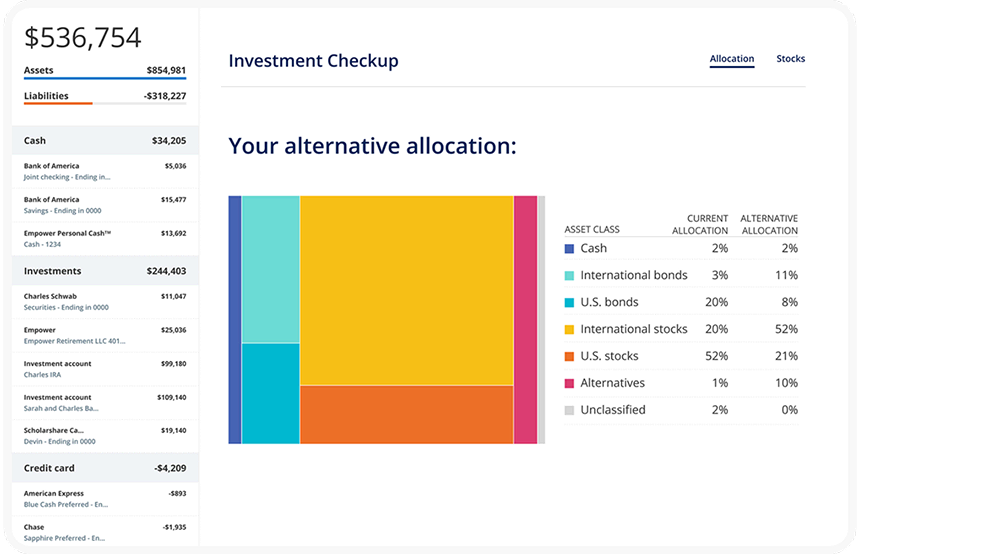
- Free financial tools: Empower’s free Personal Dashboard includes a host of useful tools, including a savings planner, retirement planner, financial calculators, and even a cost planner for your children’s education. But the tool that sets Empower apart is its Investment Checkup tool, which assesses portfolio risk, analyzes past performance, provides a target allocation for your portfolio, and lets you compare your portfolio to the S&P 500 and Empower’s “Smart Weighting” Recommendation.
- Fee-based wealth management services: Empower also offers several suites of advisory services depending on your investible assets. People with as little as $100,000 can get unlimited financial advice and retirement planning and a professionally managed portfolio. Clients with higher assets can access more services, including dedicated financial advisors, specialists in areas such as real estate and stock options, and even access to private equity.
Use our exclusive link to sign up for the Empower Personal Dashboard, whether that’s for the free tools or the advisory services. If you have $100,000 or more in investible assets, you’ll also be able to schedule a free initial 30-minute financial consultation with an Empower professional.
- Empower offers both a free set of portfolio, net worth, and cash flow tracking tools, as well as paid asset management service.
- Link Empower to your bank and investing accounts, credit cards, and more to see a single view of useful information and data, including your net worth.
- Empower Advisory Group offers a comprehensive wealth management service known as Personal Strategy. This managed account solution provides clients with discretionary investment management, personalized portfolio construction, and access to financial planning support. Accounts investing $100k to $250k receive unlimited advice and retirement planning help from financial advisors, as well as a professionally managed ETF portfolio with reviews upon request. Higher asset tiers offer access to dedicated advisors, estate planning, and tax specialists, plus additional investment options like access to private equity.**
- Special offer: If you have $100k+ in investible assets, sign up with our link to schedule a free initial 30-minute financial consultation with an Empower professional.
- Free portfolio tracker (Dashboard)
- Free net worth, cash flow, and investment reporting tools (Dashboard)
- Tax-loss harvesting (Personal Strategy)
- Dividend reinvestment (Personal Strategy)
- Automatic rebalancing (Personal Strategy)
- Low investment expense ratios (Personal Strategy)
- High number of investment accounts supported (Personal Strategy)
- Low $100k minimum for investment management (Personal Strategy) compared to traditional advisors.
- Moderately high investment management fee (0.89% AUM) compared to other online advisors (Personal Strategy)
- No dedicated advisor unless you have $250k+ in assets
Schwab Retirement Funds for IRAs: Frequently Asked Questions (FAQs)

What is the minimum investment amount on Schwab mutual funds?
Schwab is one of the most friendly fund companies for beginners. That’s not just because both its mutual funds and ETFs sport below-industry-average expense ratios, but because you don’t need much money to invest in them in the first place. Most Schwab mutual funds have the barest of investment bare minimums—you can literally start with as little as $1.
That’s extremely beneficial in self-directed accounts like an IRA. Many mutual funds from other providers require high minimums in the thousands of dollars, hamstringing investors with little capital to work with.
Related: 7 Best Fidelity Retirement Funds for IRA Investors
What are index funds?
There are two kinds of funds: actively managed funds and index funds.
With an actively managed fund, one or more managers are in charge of selecting all of the fund’s holdings. They’ll likely have a specific strategy to adhere to, and they’ll be tasked with beating a benchmark index, but they’ll be given a lot of discretion about how to achieve that. These managers will identify opportunities, conduct research, and ultimately buy and sell a fund’s stocks, bonds, commodities, and so on.
An index fund, on the other hand, is effectively run by algorithm. The fund will attempt to track an index, which is just a group of assets that are selected by a series of rules. The S&P 500 and Dow Jones Industrial Average? Those are indexes with their own selection rules. Index funds that track these indexes will generally hold the same stocks, in the same proportions, giving you equal exposure and performance (minus fees) to those indexes.
If you guessed that it’s more expensive to pay a conference room full of fund managers than it is a computer that tracks an index, you’d be right. That’s why actively managed funds tend to cost much more in fees than index funds.
And that’s why ETFs are generally cheaper. Most (but not all) mutual funds are actively managed, while most (but not all) ETFs are index funds.
Related: 15 Dividend Kings for Royally Resilient Income
What is an exchange-traded fund?
Exchange-traded funds (ETFs) are actually very similar to mutual funds but feature a handful of significant differences that may make them superior in certain situations.
Like traditional index mutual funds, an ETF will hold a basket of stocks, bonds and other securities. These can be broad and benchmarked to a major index like the S&P 500, or they can be exceptionally narrow and focus on a specific sector or even a specific trading strategy. For the most part, anything that can be held in an exchange-traded fund can also be held in a mutual fund.
However, unlike mutual funds, ETFs trade on major exchanges—such as the New York Stock Exchange or Nasdaq—like a stock. If you want to buy shares, you don’t send the manager money; you just buy shares from another investor on the open market.
The need to buy shares can be problematic when dollar-cost averaging. As an example, let’s say you have exactly $100 to invest, but the shares of the ETF trade for $65. You can only buy one share, and you’re stuck with $35 in cash uninvested.
But ETFs have their own advantages. For one, they have intraday liquidity—that is, if you want to buy or sell in the middle of the trading day (or multiple times throughout the trading day), you can.
The second advantage is tax efficiency. In a traditional mutual fund, redemptions by investors can generate selling by the manager that creates taxable capital gains for the remaining investors who didn’t sell. This doesn’t happen with ETFs, as the manager isn’t forced to buy or sell anything when an investor sells their shares.
Like we said, many investors use “ETF” and “index fund” interchangeably. That’s because most exchange-traded funds are index funds—but not all. Some are actively managed.
As is the case with Schwab mutual index funds, Schwab ETFs—most of which are indexed—tend to have some of the lowest costs in the business in terms of fees and expenses.
Related: 8 Best Vanguard Retirement Funds for a 401(k)
Why does a fund’s expense ratio matter so much?
Every dollar you pay in expenses is a dollar that comes directly out of your returns. So, it is absolutely in your best interests to keep your expense ratios to an absolute minimum.
The expense ratio is the percentage of your investment lost each year to management fees, trading expenses and other fund expenses. Because index funds are passively managed and don’t have large staffs of portfolio managers and analysts to pay, they tend to have some of the lowest expense ratios of all mutual funds.
This matters because every dollar not lost to expenses is a dollar that is available to grow and compound. And over an investing lifetime, even a half a percent can have a huge impact. If you invest just $1,000 in a fund generating 5% per year after fees, over a 30-year horizon, it will grow to $4,116. However, if you invested $1,000 in the same fund, but it had an additional 50 basis points in fees (so it only generated 4.5% per year in returns), it would grow to only $3,584 over the same period.
Want to talk more about your financial goals or concerns? Our services include comprehensive financial planning, investment management, estate planning, taxes, and more! Schedule a call with Riley to discuss what you need, and what we can do for you.