

Charles Schwab has dedicated plenty of ad spend to its investment accounts and wealth management services. But I’d argue the most powerful way the financial giant can help people grow their nest eggs is via the Schwab retirement funds that sit in your 401(k) plan.
Schwab’s retirement funds are some of the largest and most cost-efficient in the game. If you have a 401(k) through your workplace, there’s a good chance you have at least one (if not several) Schwab mutual funds to choose from. Given both their typically low fees and sound construction, you should at least give these products a look.
But if not, you’re not necessarily out of luck. Because as long as your brokerage or individual retirement account (IRA) gives you access to mutual funds, you can buy Schwab’s retirement products there, too. And unlike many other mutual fund families that make you spend hundreds or even thousands of dollars on your initial purchase, you can start buying most investor-class Schwab shares for as little as $1.
If you’re looking to update your 401(k), read on. Today I’m going to shine a light on some of the best Schwab retirement funds for 401(k)s and similar workplace plans.
Your plan might not hold one, some, or all of these. But if they don’t, you can always ask your plan sponsor to include them—or consider buying them in other tax-advantaged accounts, such as an IRA or health savings account (HSA).
Editor’s Note: Tabular data presented in this article is up-to-date as of Aug. 9, 2026.
Disclaimer: This article does not constitute individualized investment advice. Individual securities, funds, and/or other investments appear for your consideration and not as personalized investment recommendations. Act at your own discretion.
What Should You Want in a Retirement Fund?
When you invest your retirement savings in an account like a 401(k), you’ll want to keep a few things in mind:
- Costs: Every dollar spent on fees and expenses is a dollar no longer available to grow and compound over time, so keeping expenses cut to the bone is vital. Schwab’s retirement funds generally boast low annual fees, so they fit the bill.
- Taxes: A taxable account (like a standard brokerage account) is better suited to take advantage of certain tax-advantaged investments, such as municipal bonds. For tax-advantaged accounts, such as 401(k)s, some of the best investments include bond funds (where the interest income won’t be taxed) and actively managed stock funds (where the capital gains distributions from heavy trading won’t be taxed).
- Income: You probably want your retirement portfolio to produce at least some regular income—in the form of both bond interest and dividend income. Stock prices can suffer during nasty corrections and bear markets, but income-generating funds can help provide for your living expenses without forcing you to sell at an inopportune time. How much income your account should produce depends on your own circumstances. For instance, older investors tend to be more concerned with income while younger investors focus more on growth.
- Diversification: You’ve probably heard that your portfolio should be “diversified,” which means holding a variety of investments, whether that’s holding multiple assets (stocks, bonds, alternative investments), but that could also mean holding, say, stocks from different countries, or stocks from different sectors. And investment funds, which can own any number of stocks, bonds, or other holdings all at once, can help you achieve that diversification. But every fund has its own level of built-in diversification. Some funds hold dozens of stocks while others hold thousands. Some funds invest heavily in their biggest stocks while others spread their assets out more evenly. So always consider how diversified a fund really is, as well as whether that level of diversification suits your needs.
Do you want to get serious about saving and planning for retirement? Sign up for Retire With Riley, Young and the Invested’s free retirement planning newsletter.
What Types of Funds Are Available in 401(k) Plans?

Virtually every 401(k) plan is limited to mutual funds. While a handful of plans might offer exchange-traded funds (ETFs), they’re typically limited to mutual funds—and a handful, at that. Rather than a self-directed account, where you have your pick of virtually the entire mutual fund universe, 401(k)s only let you invest in, say, 10, 15, or 20 mutual funds, each of which cover a specific investing style.
While ETFs typically offer lower costs, mutual funds have certain qualities more befitting a 401(k).
For one, mutual funds don’t trade all day on an exchange, which discourages long-term investors from panic-selling during a particularly bad day in the market. They also allow for fractional share ownership, which is important given that 401(k) plan investors are typically allocating a fixed amount of money to their account every paycheck.
Related: 8 Best Schwab Index Funds for Thrifty Investors
What Is a Mutual Fund?

A mutual fund is an investment company that pools money from many investors to buy stocks, bonds or other securities. The investors get the benefits of professional management and certain economies of scale. A pool of potentially millions or even billions of dollars is large enough to diversify and might have access to investments that would be impractical for an individual investor to own.
Here’s an example: An investor wanting to mimic the S&P 500 Index (an index made up of 500 large, U.S.-listed companies) would generally have a hard time buying and managing a portfolio of 500 individual stocks, especially in the exact proportions of the S&P 500 Index. Another example: An investor wanting a diversified bond portfolio might have a hard time building one when individual bond issues can have minimum purchase sizes of thousands (or tens of thousands!) of dollars.
Equity funds or bond funds will generally be a far more practical solution.
To invest in a mutual fund, you’ll need to open an account with the fund sponsor or open an investment account with a broker that has a selling agreement in place with the fund sponsor. As a general rule, most large, popular mutual funds will be available at most brokers, so if you open any traditional investment account (like a brokerage or IRA), you’ll have access to most of the mutual funds you’d ever want to invest in.
Related: 10 Best Schwab Mutual Funds You Can Buy [Low Fees, $1 Minimums]
Why Schwab?
Charles Schwab is a U.S.-based brokerage and banking company founded in 1971 as a traditional brokerage company and then as a discount brokerage service in 1974. It is headquartered in San Francisco, California, and operates primarily throughout the United States, but also has international operations.
Schwab is the largest publicly traded investment services firm in the U.S., and as of summer 2026, it boasted more than $13 trillion in assets under management (AUM). It offers a wide range of financial services, such as investment advice and management, trading services, financial planning, banking services, workplace and individual retirement plans, annuities, and more.
On the product side, Schwab offers more than 100 different funds that collectively have attracted more than $1 trillion in assets under management (AUM). Some of those are “active” funds run by seasoned investing managers, but others are efficient, inexpensive “passive” funds tied to a rules-based index.
Moreover, Schwab’s funds feature no load or transaction fees. Like with minimum initial investments, these aren’t really a concern within a 401(k), but they’re advantageous in other accounts, including IRAs and taxable brokerages. Schwab’s products also commonly charge below-industry-average annual expense ratios.
In short: Schwab’s best 401(k) funds will generally be among the top options (if they’re offered), and their fees likely won’t make much of a dent in your returns.
Make sure you sign up for The Weekend Tea, Young and the Invested’s free weekly newsletter that over 10k monthly readers use to level up their money know-how.
The Best Schwab Retirement Funds for Your 401(k)
These Schwab retirement funds are ordered by their Morningstar Portfolio Risk Score. Here are the risk levels each score range represents:
- 0-23: Conservative
- 24-47: Moderate
- 48-78: Aggressive
- 79-99: Very Aggressive
- 100+: Extreme
These scores five us a general gauge of risk compared to all other investments. For example, a bond fund with a score of 20 might be considered a conservative strategy overall, but it could simultaneously be riskier than a number of other bond funds.
With all that out of the way, let’s dig into some of the best Schwab retirement funds to hold in a 401(k) that you might consider diving into this year.
Related: The 16 Best ETFs to Buy Right Now
1. Schwab Short-Term Bond Index Fund

- Style: U.S. short-term bond
- Management: Index
- Assets under management: $1.7 billion
- SEC yield: 4.4%*
- Expense ratio: 0.06%, or 60¢ per year for every $1,000 invested
- Morningstar Portfolio Risk Score: 7 (Conservative)
Bonds are a core holding in just about every portfolio, though you’ll typically own more of them the older you are.
That said, bonds are among the most tax-inefficient asset classes on earth. That’s because the bulk of their returns come in the form of interest income, which is taxed as ordinary income. If you’re in the 37% tax bracket, for instance, you’re losing 37% of your bond interest to taxes. Fortunately, you can dodge this problem by holding bonds and bond funds in a tax-deferred account like a 401(k), IRA, or HSA.
Schwab Short-Term Bond Index Fund (SWSBX) is among the lower-risk options in the Schwab arsenal. Nearly 70% of the 3,360-bond portfolio’s assets are invested in U.S. Treasuries and other government securities. Another 25% of assets are wrapped up in high-quality corporate short-term bonds, and the remaining sliver is being used to own foreign government bonds.
To be clear: Short-term bonds don’t always make sense for investors, depending on the rate environment. Right now, for instance, short-term bonds still offer relatively high yields for relatively low risk. That’s good. But after starting 2026 with expectations that the Federal Reserve would continue lowering its benchmark interest rate like it did in 2024 and 2025, Wall Street now thinks there’s a greater chance for a rate hike. And changes in the federal funds rate (the overnight lending rate used by banks) will have a stronger impact on the price of shorter-term bonds. That’s not so good.
Let’s go back to SWSBX. Duration—a measure of interest-rate risk—is 2.6 years. In theory, this means a 1-percentage-point rise in market interest rates would result in a short-term price decline of 2.6% for Schwab’s fund. However, this cuts both ways: A decline in rates could mean a rise of 2.6%. (The actual calculation of duration is fairly complex; it’s the weighted average of the bond’s cash flows. But the key takeaway is that, all else equal, the longer a bond’s time to maturity, the higher its duration—and thus the higher the interest-rate risk.)
In short, Schwab Short-Term Bond Index Fund doesn’t have a ton of upside in the event of a Fed cut, but it also doesn’t have much to lose in the event the central bank raises its target rate. Meanwhile, you’re collecting more than 4%. That makes SWSBX one of the best Schwab funds to hold in an 401(k) if you’re looking for portfolio protection that throws off a decent level of income.
* SEC yield reflects the interest earned across the most recent 30-day period. This is a standard measure for funds holding bonds and preferred stocks.
Want to learn more about SWSBX? Check out the Schwab provider site.
Related: 8 Best Vanguard Retirement Funds for a 401(k) Plan
2. Schwab U.S. Aggregate Bond Index Fund

- Style: U.S. intermediate-term bond
- Management: Index
- Assets under management: $8.3 billion
- SEC yield: 4.7%
- Expense ratio: 0.04%, or 40¢ per year for every $1,000 invested
- Morningstar Portfolio Risk Score: 16 (Conservative)
If you’re willing to take on a little more risk for a little more potential reward, you could move up from a money-market fund to a more traditional bond fund.
The Schwab U.S. Aggregate Bond Index Fund (SWAGX), for instance, is a diversified option that covers a wide swath of the bond market. SWAGX, which holds a whopping 12,000-plus debt issues, is categorized by Morningstar as an “Intermediate Core Bond” fund, which very broadly means two things:
- It invests primarily in investment-grade U.S. fixed-income issues, and
- Its duration (a measure of interest-rate sensitivity) usually ranges between 75% and 125% of the three-year average of the Morningstar Cor Bond Index’s effective duration.
Don’t worry. I’ll explain.
To the first part: Every bond that SWAGX currently holds enjoys an “investment-grade” rating, which basically means the credit ratings agencies believe the bond’s issuer has a low risk of default. These bonds are considered relatively safer than (but as a result yield less than) similarly dated below-investment-grade securities, aka high-yield bonds, aka junk. Currently, the largest portion of assets (45%) is invested in U.S. government and agency bonds, while another half of assets is split evenly between mortgage-backed securities (MBSes) and corporate bonds. The rest is peppered across other government-related bonds, municipal bonds, and other debt.
To the second? Intermediate-term bonds are those with remaining maturities of between three and 10 years; that makes up the majority (60%) of SWAGX’s holdings. Another quarter of assets are invested in short-term bonds (three years or below), and the remainder is invested in long-term bonds (10 years or more). That, combined with credit quality, educates the fund’s duration, which currently sits at 5.8 years.
It’s a moderate amount of risk. This means SWAGX definitely has more room for price appreciation (and losses) than any money market fund, but you can still expect less volatility than you’d get out of a stock fund. Meanwhile, you’re getting a few more basis points in yield (a basis point is one one-hundredth of a percentage point) and the potential for greater capital gains in a bull market for bonds.
And like SWSBX, the lion’s share of returns will come from interest income, so this Schwab fund is best held in an 401(k), IRA, or another tax-advantaged account.
Want to learn more about SWAGX? Check out the Schwab provider site.
Related: The 10 Best Vanguard Index Funds You Can Buy
3. Schwab Target-Date Funds

- Style: Target-date
- Management: Active
- Expense ratio: Schwab Target Funds: 0.25%-0.58%*, or $2.50-$5.80 per year for every $1,000 invested; Schwab Target Index Funds: 0.08%*, or 80¢ per year for every $1,000 invested
- Morningstar Portfolio Risk Score: 26-66 (Moderate-Aggressive)
One of the challenges in retirement planning is getting the asset allocation right, or having an asset class mix that is appropriate for an investor at your age and stage of life. An ideal portfolio for a 20-year-old is likely going to be very different from that of a 40-year-old, and both those portfolios will be different from what’s ideal for a 60-year-old.
That’s where target-date funds can really add value.
Target-date funds—also called “lifecycle” funds—are a type of mutual fund that are designed to change their asset allocation over time. Target-date funds start out invested heavily in stocks, then slowly reduce their stock exposure and replace it with bond exposure as they approach their target retirement date, following a glide path.
The target retirement dates are intended to be estimates; they don’t have to be super precise. Generally, most mutual fund families will create target-date funds in five-year increments (say, 2030, 2035, 2040, etc.).
Given the hyper-specific focus on retirement, target-date funds tend to be a mainstay of 401(k) plans.
Schwab offers two target-date fund series, both of which hold various funds to provide exposure to U.S. and international stocks and bonds:
- Schwab Target Funds: These hold a collection of actively managed and index funds. While most of Schwab Target Funds’ holdings are other Schwab mutual funds, they will also hold funds from outside providers, including Dodge & Cox and Baird.
- Schwab Target Index Funds: These primarily hold Schwab ETFs.
In general, both of Schwab’s target-date fund series are economical, but the Schwab Target Index Funds are flat-out cheap, at just 0.08% in annual expenses. And at least as far as Morningstar Medalist ratings go, the Target Index series is considered the better of the two, earning a Silver rating.
Also worth noting is that Schwab Target Index Funds, despite the name, do have human managers: currently, they are Zifan Tang and Patrick Kwok.
* Schwab Target Funds and Schwab Target Index Funds have temporary fee waivers to limit operating expenses. These waivers will remain as long as Schwab Asset Management serves as the adviser to the funds. The agreement can only be amended or terminated with the approval of the fund’s board of trustees.
Want to learn more about Schwab’s target-date funds? Check out the Schwab provider site.
Make Young and the Invested your preferred news source on Google
Simply go to your preferences page and select the ✓ box for Young and the Invested. Once you’ve made this update, you’ll see Young and the Invested show up more often in Google’s “Top Stories” feed, as well as in a dedicated “From Your Sources” section on Google’s search results page.
4. Schwab Dividend Equity Fund

- Style: U.S. large-cap dividend stock
- Management: Active
- Assets under management: $676.3 million
- Dividend yield: 1.5%
- Expense ratio: 0.89%, or $8.90 per year for every $1,000 invested
- Morningstar Portfolio Risk Score: 57 (Aggressive)
Once upon a time, dividends were previously taxed like bond interest, as ordinary income. But following the tech bust of 2000-02, the Bush administration changed the tax laws in an attempt to encourage more responsible behavior from both investors and the companies they invest in. The thinking was that lowering the tax on dividends would encourage more companies to pay dividends and encourage more investors to take a long-term investor mindset as opposed to a short-term gambler mindset.
So now, when a stock pays a dividend, it’s typically classified as “qualified,” and qualified dividends have the same favorable capital gains tax rates as long-term capital gains (0%, 15%, or 20%). It’s a godsend for income investors, but let’s be clear: Dividend stocks are still woefully tax-inefficient. Long-term capital gains remain unrealized—and thus not taxable—until you sell, whereas dividends are still taxed when they are received … even if at a lower rate than in decades past.
For this reason, it’s generally going to make sense to keep dividend stocks and dividend funds in a tax-deferred retirement account. And one worthy contender is the Schwab Dividend Equity Fund (SWDSX).
Managers Wei Li, Bill McMahon, and James Serhant aim to hold dividend stocks but produce less risk than the Russell 1000 Value Index. The largest of their 66 holdings include some traditional higher-than-average yielders, such as Exxon Mobil (XOM), Walmart (WMT), and JPMorgan Chase (JPM). However, it also holds some “growthier” blue-chip stocks with a history of consistently paying dividends, too, including names such as Broadcom (AVGO) and Google parent Alphabet (GOOGL).
The combination of those two kinds of dividend stocks results in a modest amount of income out of SWDSX, though its 1.5% yield is about 50 basis points better than the S&P 500 right now.
If you’re looking for a good collection of dividend-paying workhorses that you can own for the long term, Schwab Dividend Equity is a worthy addition to your retirement portfolio.
Want to learn more about SWDSX? Check out the Schwab provider site.
Related: 8 Best High-Yield Dividend Stocks: The Pros’ Picks
5. Schwab S&P 500 Index Fund

- Style: U.S. large-cap stock
- Management: Index
- Assets under management: $149.6 billion
- Dividend yield: 1.0%
- Expense ratio: 0.02%, or 20¢ per year for every $10,000 invested
- Morningstar Portfolio Risk Score: 72 (Aggressive)
If we’re talking about IRS consequences alone, a taxable account is much better positioned to take advantage of an index fund’s tax efficiency than a tax-advantaged account. However, given that a 401(k) is often an investor’s primary (and sometimes only) investing account, and given that performance is the ultimate goal, an S&P 500 index fund still belongs in any 401(k).
Why? Well, because the vast majority of fund managers who run large-cap funds (funds that invest in larger companies) struggle to consistently beat the index, particularly after fees. How bad is it? According to the most recent S&P Dow Jones Indices’ SPIVA (S&P Indices versus Active) data, which came at the end of 2025, 86% of actively managed large-cap funds have failed to beat the S&P 500 across the trailing 10-year period, and that number ticks higher to 90% when looking at the past 15 years. Not great!
For that reason, many investors decide that, rather than try to swim upstream, they should simply own the index. And they can do it about as efficiently as possible by owning the Schwab S&P 500 Index Fund (SWPPX).
SWPPX isn’t just an inexpensive way to get access to the S&P 500—it’s one of the cheapest ways across both mutual funds and ETFs alike, charging a razor-thin expense ratio of just 0.02%. You don’t get much closer to free than that.
The S&P 500 is a collection of the largest and most dominant American companies. To be selected for this stock market index, a company must have a market capitalization of at least $22.7 billion, its shares must be highly liquid (shares are frequently bought and sold), at least 50% of its outstanding shares must be available for public trading, it must have positive earnings in the most recent quarter, and the sum of its previous four quarters must be positive. Once a company is in the index, it doesn’t necessarily get kicked out if it fails to meet all of the criteria at some point in the future, but the selection committee would take that under consideration.
Turnover (how much the fund tends to buy and sell holdings) tends to be low, as only a handful of stocks enter or leave the index in any given year. This makes Schwab S&P 500 Index Fund an extremely tax-efficient option for taxable investment accounts. But if you do the majority of your investing through a workplace plan, consider holding SWPPX there, too—sure, you won’t enjoy a premium tax edge, but you’ll be putting your money into one of Schwab’s best retirement funds for 401(k)s.
Want to learn more about SWPPX? Check out the Schwab provider site.
Related: The 11 Best Fidelity Funds You Can Own
6. Schwab Global Real Estate Fund

- Style: Global real estate
- Management: Active
- Assets under management: $268.0 million
- Dividend yield: 3.2%
- Expense ratio: 0.72%, or $7.20 per year for every $1,000 invested
- Morningstar Portfolio Risk Score: 74 (Aggressive)
Real estate is one of the most popular “alternative” assets (anything outside of stocks and bonds), but it’s expensive to invest in physical real estate. Most of us don’t have the capital it takes to buy an apartment complex or a strip mall. Fortunately, publicly traded real estate investment trusts (REITs) offer the potential for both high yield and respectable capital gains at the affordable price of a share of stock.
REITs enjoy a special tax status that allows them to avoid corporate taxation so long as they distribute at least 90% of their net profits as dividends. Because of this tax incentive, REITs tend to be one of the highest-yielding sectors and a perennial favorite among income investors.
Unfortunately, this also makes REITs very tax-inefficient, as a large percentage of the total return comes from taxable dividends. What’s more, REIT dividends are generally not classified as qualified dividends, but non-qualified dividends. Non-qualified dividends are taxed as ordinary income, like bond interest, and can face rates as high as 37%, depending on your bracket. Thus, it makes more sense to hold REITs and REIT funds in a tax-advantaged fund like a 401(k) rather than a taxable brokerage account.
Schwab investors looking for real estate exposure could consider the Schwab Global Real Estate Fund (SWASX). This is a diversified REIT fund, boasting 116 real estate companies around the globe. A little more than 55% of assets are invested in American REITs, with the rest scatted across Europe, Asia, Australia, and Canada. The portfolio is most heavily allocated to diversified, industrial, and retail properties, and it only has minimal exposure to the office sector, which has been affected by work-from-home policies.
This growth-focused real estate fund focuses on total return, so not just income, but capital gains too. But its 3%-plus current yield is mighty competitive in a world in which the S&P 500 yields 1%.
Another reason to consider SWASX for your 401(k) is the fund’s high turnover. Portfolio trading can sometimes generate capital gains, which are can be passed on to you, and you would then become responsible for paying capital gains taxes on those distributions. Active trading strategies can be very tax-inefficient if they pass along a lot of short-term capital gains, which are taxed as ordinary income at rates up to 37%.
There is no precise, universally accepted threshold for what constitutes “a lot” of active trading, but I would consider any fund with portfolio turnover over 30% or so to be fairly tax-inefficient. The higher the number, the more inefficient the fund. Schwab Global Real Estate has annual turnover of about 85%, which means it could distribute a lot of short-term capital gains. Fortunately, you can avoid those immediate tax consequences in a tax-deferred account like a 401(k).
Want to learn more about SWASX? Check out the Schwab provider site.
Do you want to get serious about saving and planning for retirement? Sign up for Retire With Riley, Young and the Invested’s free retirement planning newsletter.
7. Schwab Select Large Cap Growth Fund

- Style: U.S. large-cap growth stock
- Management: Active
- Assets under management: $2.2 billion
- Dividend yield: N/A
- Expense ratio: 0.73%, or $7.30 per year for every $1,000 invested
- Morningstar Portfolio Risk Score: 77 (Aggressive)
Generally speaking, buying and holding good stocks or good funds and allowing them to compound over years or even decades is the way to go. But having at least part of your portfolio in actively traded strategies can also make sense, particularly in bear markets. Actively traded strategies have their stretches when they outperform passive index strategies, and they can potentially help you to avoid major declines.
As a for-instance, let’s look at the Schwab Select Large Cap Growth Fund (LGILX), which is sub-advised by American Century Investment Management and JPMorgan Investment Management. Being a growth fund, LGILX is extremely heavy in technology stocks; it owns Nvidia (NVDA), Microsoft, Broadcom, and most of the other large-cap growth stocks you would expect to see.
Smart management has resulted in outperformance of LGILX’s category average across most meaningful time frames. This high performance sometimes comes at the cost of a lot of active trading. While annual portfolio turnover is only about 25% right now, in recent history, that number has been closer to 60%—a large potential tax liability in a taxable account. Also telling: The fund has a long history of distributing sizable capital gains at the end of each year.
Thus, Schwab Select Large Cap Growth is exactly the kind of actively managed fund best held in a retirement account like a 401(k). The tax deferral neutralizes the negative impacts of active trading, allowing us to enjoy the full benefits of the trading gains.
Want to learn more about LGILX? Check out the Schwab provider site.
Related: Best Fidelity Retirement Funds for a 401(k) Plan
Learn More About These and Other Funds With Morningstar Investor
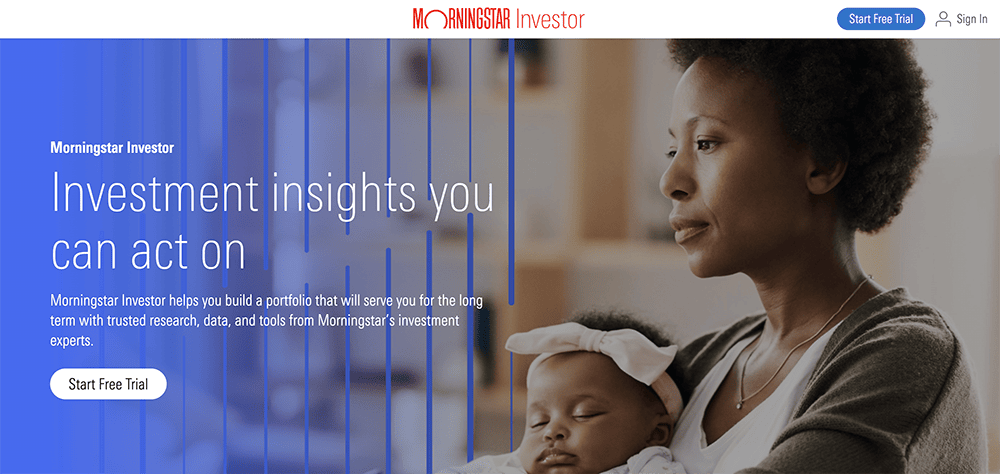
If you’re buying a fund you plan on holding for years (if not forever), you want to know you’re making the right selection. And Morningstar Investor can help you do that.
Morningstar Investor provides a wealth of information and comparable data points about mutual funds and ETFs—fees, risk, portfolio composition, performance, distributions, and more. Morningstar experts also provide detailed explanations and analysis of many of the funds the site covers.
With Morningstar Investor, you’ll enjoy a wealth of features, including Morningstar Portfolio X-Ray®, stock and fund watchlists, news and commentary, screeners, and more. And you can try it before you buy it. Right now, Morningstar Investor is offering a free seven-day trial and a discount on your first year’s subscription when you use our exclusive link.
- Morningstar Investor offers expert research, investing analysis, and advisor-grade portfolio management tools that are tailor-made for buy-and-hold investors.
- Morningstar is one of the most prized sources of mutual fund and exchange-traded fund (ETF) data in the world.
- How does your portfolio stack up? Put it through Morningstar's Portfolio X-Ray, which will provide insights such as whether you have too many overlapping holdings or whether you're paying too much in fees.
- Special Offer 1: Click our sign-up link to receive $50 off your first year of Morningstar Investor. (Annual plan only.)
- Special Offer 2: Students receive one year of Morningstar Investor access for just $25!
- Special Offer 3: Teachers receive a 60% discount on Morningstar Investor access.
- Top-flight fund research and analysis
- Portfolio management tool
- Powerful screener
- Watchlists
- Tailored news and commentary
- Below-average charting
- High monthly billing rate
Track Your Portfolio With Empower
- Available: Sign up here
- Price: Tools: Free. Wealth Management: Starts at 0.89% of assets annually.*
Empower is one of our top-rated financial services firms for people of any income level thanks to the quality and breadth of its offerings:
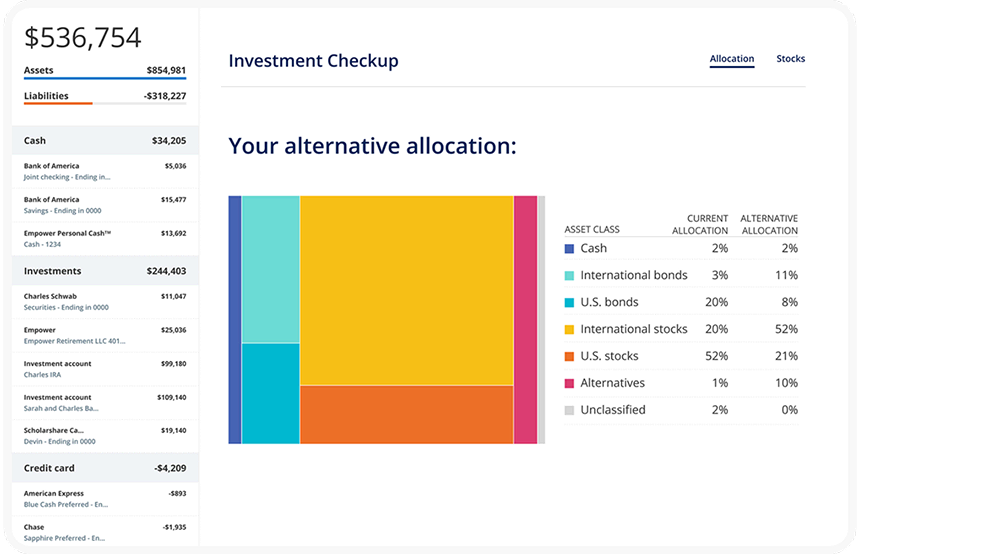
- Free financial tools: Empower’s free Personal Dashboard includes a host of useful tools, including a savings planner, retirement planner, financial calculators, and even a cost planner for your children’s education. But the tool that sets Empower apart is its Investment Checkup tool, which assesses portfolio risk, analyzes past performance, provides a target allocation for your portfolio, and lets you compare your portfolio to the S&P 500 and Empower’s “Smart Weighting” Recommendation.
- Fee-based wealth management services: Empower also offers several suites of advisory services depending on your investible assets. People with as little as $100,000 can get unlimited financial advice and retirement planning and a professionally managed portfolio. Clients with higher assets can access more services, including dedicated financial advisors, specialists in areas such as real estate and stock options, and even access to private equity.
Use our exclusive link to sign up for the Empower Personal Dashboard, whether that’s for the free tools or the advisory services. If you have $100,000 or more in investible assets, you’ll also be able to schedule a free initial 30-minute financial consultation with an Empower professional.
- Empower offers both a free set of portfolio, net worth, and cash flow tracking tools, as well as paid asset management service.
- Link Empower to your bank and investing accounts, credit cards, and more to see a single view of useful information and data, including your net worth.
- Empower Advisory Group offers a comprehensive wealth management service known as Personal Strategy. This managed account solution provides clients with discretionary investment management, personalized portfolio construction, and access to financial planning support. Accounts investing $100k to $250k receive unlimited advice and retirement planning help from financial advisors, as well as a professionally managed ETF portfolio with reviews upon request. Higher asset tiers offer access to dedicated advisors, estate planning, and tax specialists, plus additional investment options like access to private equity.**
- Special offer: If you have $100k+ in investible assets, sign up with our link to schedule a free initial 30-minute financial consultation with an Empower professional.
- Free portfolio tracker (Dashboard)
- Free net worth, cash flow, and investment reporting tools (Dashboard)
- Tax-loss harvesting (Personal Strategy)
- Dividend reinvestment (Personal Strategy)
- Automatic rebalancing (Personal Strategy)
- Low investment expense ratios (Personal Strategy)
- High number of investment accounts supported (Personal Strategy)
- Low $100k minimum for investment management (Personal Strategy) compared to traditional advisors.
- Moderately high investment management fee (0.89% AUM) compared to other online advisors (Personal Strategy)
- No dedicated advisor unless you have $250k+ in assets

Schwab Retirement Funds for 401(k)s: Frequently Asked Questions (FAQs)

What is the minimum investment amount on Schwab mutual funds?
Schwab is one of the most beginner-friendly fund companies. That’s not just because both its mutual funds and ETFs sport below-industry-average expense ratios, but because you don’t need much money to invest in them in the first place. Most Schwab mutual funds have the barest of investment bare minimums—you can literally start with as little as $1.
That doesn’t matter so much in a 401(k), where there are no minimum investments. (When you invest in a 401(k), you set percentage allocations to each fund, and the amount you contribute to each paycheck is appropriately parceled out.) But that’s extremely beneficial in self-directed accounts, be it an IRA, HSA, taxable brokerage, etc.
Related: 11 Best Vanguard Funds for the Everyday Investor
What are index funds?
There are two kinds of funds: actively managed funds and index funds.
With an actively managed fund, one or more managers are in charge of selecting all of the fund’s holdings. They’ll likely have a specific strategy to adhere to, and they’ll be tasked with beating a benchmark index, but they’ll be given a lot of discretion about how to achieve that. These managers will identify opportunities, conduct research, and ultimately buy and sell a fund’s stocks, bonds, commodities, and so on.
An index fund, on the other hand, is effectively run by algorithm. The fund will attempt to track an index, which is just a group of assets that are selected by a series of rules. The S&P 500 and Dow Jones Industrial Average? Those are indexes with their own selection rules. Index funds that track these indexes will generally hold the same stocks, in the same proportions, giving you equal exposure and performance (minus fees) to those indexes.
If you guessed that it’s more expensive to pay a conference room full of fund managers than it is a computer that tracks an index, you’d be right. That’s why actively managed funds tend to cost much more in fees than index funds.
And that’s why ETFs are generally cheaper. Most (but not all) mutual funds are actively managed, while most (but not all) ETFs are index funds.
Related: Plan for These 7 Hidden Retirement Costs
Why does a fund’s expense ratio matter so much?
Every dollar you pay in expenses is a dollar that comes directly out of your returns. So, it is absolutely in your best interests to keep your expense ratios to an absolute minimum.
The expense ratio is the percentage of your investment lost each year to management fees, trading expenses and other fund expenses. Because index funds are passively managed and don’t have large staffs of portfolio managers and analysts to pay, they tend to have some of the lowest expense ratios of all mutual funds.
This matters because every dollar not lost to expenses is a dollar that is available to grow and compound. And over an investing lifetime, even a half a percent can have a huge impact. If you invest just $1,000 in a fund generating 5% per year after fees, over a 30-year horizon, it will grow to $4,116. However, if you invested $1,000 in the same fund, but it had an additional 50 basis points in fees (so it only generated 4.5% per year in returns), it would grow to only $3,584 over the same period.
Want to talk more about your financial goals or concerns? Our services include comprehensive financial planning, investment management, estate planning, taxes, and more! Schedule a call with Riley to discuss what you need, and what we can do for you.