


Growth investors have long looked to technology stocks for outsized returns. While virtually every sector is certainly capable of delivering growth, no other slice of the market is more willing than tech companies to funnel most if not all of their cash into research, development, marketing, and anything else they can to take market share.
And that’s exactly why tech dividend stocks stand out.
Yes, technology companies can walk and chew gum at the same time (metaphorically speaking). It happens more often than you realize. Some of the market’s largest tech names, including Apple (AAPL) and Nvidia (NVDA), pay at least some portion of their cash directly back to shareholders. Sure, it’s unusual to find meaningful sources of yield in this sector … but it’s not impossible.
Today, let’s look at some of the best tech dividend stocks you can buy. The companies on this list are among some of Wall Street’s favorite ways to invest in the sector, not just for their ability to keep growing, but also for their above-average (to high) levels of dividend income.
Editor’s Note: Tabular data presented in this article is up-to-date as of Aug. 20, 2026.
Featured Financial Products
Disclaimer: This article does not constitute individualized investment advice. Individual securities, funds, and/or other investments appear for your consideration and not as personalized investment recommendations. Act at your own discretion.
Why Do People Typically Invest in Tech Stocks?

The technology sector’s appeal is pretty straightforward: Disruptive technologies can sometimes lead to dramatic revenue (and eventually profit) growth, and dramatic gains in a firm’s stock price as a result.
And as time has passed, technology has increasingly become a part of everything—to the point where technology is a primary driver of growth for other sectors. Technology and communications are effectively intertwined. E-commerce completely changed consumer companies. Technological advances are shaping offerings in the health care and financial industries.
Unsurprisingly, then, it’s difficult to find better growth opportunities than what the tech sector has to offer.
Why Do People Invest in Dividend Stocks?
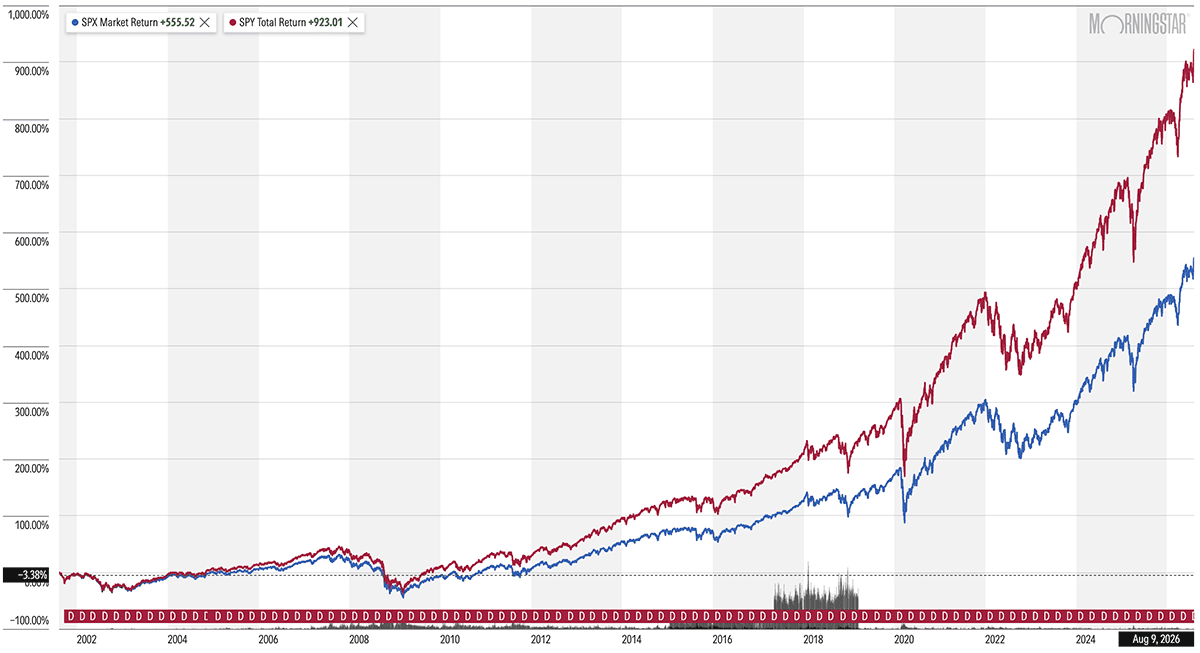
A dividend is a cash payment that a company makes to its shareholders. It’s an excellent additional source of investment return that complements price gains—and it means different things for different investors.
For anyone who isn’t yet retired, cash from dividend stocks is just more fuel to reinvest so you can keep growing your portfolio.
Consider the 25-year chart above. This looks at both the price performance of the S&P 500 (blue line) over the past quarter-century, as well as the total return (red line), which factors in price returns as well as dividends paid and reinvested. Look at how much that reinvested cash has added to the equation: The price performance is an impressive 555%, but dividends helped drive about 370 additional points of return!
Dividends can also mean something more once you’ve reached retirement: a source of passive income.
When you retire, you no longer receive a regular paycheck from an employer. Instead, you have to rely on Social Security checks and whatever you’ve saved up for retirement. Investors typically withdraw money from their nest egg to pay the bills in retirement, but a steady stream of stock-dividend and bond-interest income can reduce how much of your investment accounts you have to draw down—keeping your nest egg better intact for longer.
* I used the SPDR S&P 500 ETF Trust (SPY), an S&P 500 index fund, to produce the index’s total return in Morningstar. The SPY’s total return factors in the fund’s small annual expenses, while the index’s price return does not. Thus, the S&P 500 Index’s total return, on its own, is actually a little better than what’s presented in this chart.
Make sure you sign up for The Weekend Tea, Young and the Invested’s free weekly newsletter that over 10k monthly readers use to level up their money know-how.
How I Picked These Tech Dividend Stocks

This list of the best technology dividend stocks is pretty straightforward, selected based on the following criteria:
Market cap: I started with a selection universe of companies listed on major U.S. exchanges with a market capitalization of at least $300 million, which is the bottom of the range for small-cap stocks. (Stocks smaller than that can be considered small caps, but are often broken out into micro- and nano-cap stocks.)
Wall Street rating: From there, I excluded any company with a consensus analyst rating (provided by S&P Global Market Intelligence) of Hold or below. S&P boils down consensus ratings down to a numerical system where …
- 1 to 1.5: Strong Buy
- 1.5 to 2.5: Buy
- 2.5 to 3.5: Hold
- 3.5 to 4.5: Sell
- 4.5 to 5: Strong Sell
Indeed, every tech dividend stock on this list has a rating of 2 or less, indicating that at worst they enjoy a very firm consensus Buy rating, if not an outright Strong Buy rating.
Dividend yield: I then looked for stocks that yield more than the broader market, using the S&P 500 as a proxy. The S&P 500 currently yields 1.1%, so I excluded any stocks yielding less than 1.5% to give me a little wiggle room if the market’s yield expands. And, in fact, no stock on this list currently yields less than 2%.
Now, let’s take a look at the stocks, which are listed in descending order of their consensus rating (from the “worst” rating to the best.)
Related: 7 Best Value Stocks to Buy Right Now
Best Tech Dividend Stock #5: OneSpan

- Market cap: $575.6 million
- Dividend yield: 3.3%
- Consensus analyst rating: 2.00 (Buy)
OneSpan (OSPN) is a provider of cybersecurity and electronic signature software. Its offerings include high-assurance identity verification, transaction signing, mobile security, authentication, secure video collaboration, and more.
Like many other cybersecurity stocks, OSPN teetered throughout the first few months of 2026 before picking up momentum heading into the summer. Among reasons for optimism in OneSpan is the July launch of its DigipassOne authentication platform, which integrates multiple services that previously were only available as standalone products. The company will add new services to DigipassOne later this year, and they believe the potential for authentication for artificial intelligence (AI) agents in consumer banking could open up the company’s total addressable market.
“OneSpan launched its unified authentication platform last month, and the solution provides greater opportunity for cross-selling the company’s breadth of products across its extensive banking customer base,” says B. Riley Securities analyst Erik Suppiger, who rates shares at Buy. “The platform will also be instrumental for enabling authentication of AI agents for banking, which management suggested is a compelling long-term opportunity.”
OSPN admittedly doesn’t have a very big analyst following, at just five pros right now. But a majority (three) of them say the stock is a Buy, while the remaining two call it a Hold.
OneSpan is also one of the best tech dividend stocks to buy now by virtue of its well-above-average yield of 3%-plus, which is roughly thrice what you can get from the S&P 500. This isn’t a long-lived distribution: The company began paying a 12-cent quarterly dividend at the start of 2025, then raised it by 8% at the start of 2026. But at about 40% of this year’s estimated earnings, it’s plenty sustainable.
Do you want to get serious about saving and planning for retirement? Sign up for Retire With Riley, Young and the Invested’s free retirement planning newsletter.
Need Help Picking Stocks? Consider These Top-Rated Services
|
Best Introductory Stock Picking Service

|
Data-Driven Stock Picking Service

|
Best Proprietary Ranking System

|
|
Primary Rating:
4.7
|
Primary Rating:
4.3
|
Primary Rating:
4.2
|
|
$99/yr. ($100 first-year savings)
|
$449/yr. ($50 discount)*
|
30-day free trial, then $249/yr.
|
Best Tech Dividend Stock #4: Universal Display

- Market cap: $4.1 billion
- Dividend yield: 2.3%
- Consensus analyst rating: 1.78 (Buy)
Universal Display (OLED) researches, develops, and supplies organic light emitting diode (OLED) technologies and materials for use in displays and lighting.
The company boasts more than 6,000 issued and pending patents, giving it a massive licensing arsenal that it uses to drive revenues from OLED manufacturers for basically anything with a screen: mobile phones, tablets, laptops, TVs, and wearables, not to mention lighting products. It also offers phosphorescent OLED (PHOLED) technology and materials; the system boasts luminous efficiencies that are up to four times higher than conventional fluorescent OLEDs. Universal Display also provides technology development and support services to manufacturers that help accelerate the commercialization of its technologies.
OLED displays generally feature better contrast, refresh rate, and form factors than liquid crystal display (LCD). That’s why Wall Street believes the company will eventually dig itself out of its current bear market, which has lopped off 44% of OLED’s value over the past year.
“In the next five years, we expect OLED display to continue market share gain across product verticals and help bring new designs such as foldable phones/tablets to mass market,” say Oppenheimer analysts, who rate shares at Outperform (equivalent of Buy). “Although revenue volatility remains high on a quarterly basis, we believe the long-term trend of OLED adoption and Universal Display’s competitive strength remain sound.”
Oppenheimer is one of six Buy calls on the stock, which compares well to three Holds and no Sells.
Universal Display started paying a 3¢ dividend in 2017, and it has raised that distribution every year since, to its current 50¢ per share. It’s a relatively quick ramp-up that currently has OLED shares yielding more than 2%. And that payout represents less than half of 2026’s earnings estimates.
Related: 10 Best Index Funds You Can Buy Now
Best Tech Dividend Stock #3: Dolby Laboratories

- Market cap: $5.9 billion
- Dividend yield: 2.3%
- Consensus analyst rating: 1.75 (Buy)
Dolby Laboratories (DLB) is one of the biggest names in audio, though it does so much more, including imaging, accessibility, and other solutions for TV, broadcast, and live entertainment.
Its technologies include AVC, a digital video codec used in mobile devices, set-top boxes, cameras, and more; AAC, HE-AAC, and extened HE-AAC digital audio codecs; Dolby Atmos, an immersive surround-sound technology; Dolby Vision, a premium HDR video format; and Dolby AC-4, a next-generation audio compression codec used in modern broadcasting and streaming. It also offers Dolby Cinemas—premium cinemas that include its branded technologies—the cloud-based Dolby.io developer platform, and much more.
“Adoption of Dolby Vision continues to grow, particularly within autos, TV, and social media,” say William Blair analysts, who rate DLB shares at Outperform. “A handful of automotive manufacturers in China have begun incorporating Dolby Vision into their cars, particularly as self-driving capabilities improve, and the in-car entertainment experience becomes more important.”
Those analysts point out that Dolby Vision also boasted about 30% penetration in televisions last year, and that Instagram began supporting it during the first quarter of 2026 (and has since expanded it to Facebook). Dolby Vision is also endorsed by Douyin, the Chinese app for TikTok, for use in Apple (AAPL) and Alphabet’s (GOOGL) Android devices.
Dolby also has a thin analyst following, but of the four pros with ratings on the stock, three say it’s a Buy, while the lone dissenter is a Hold.
DLB started paying dividends since 2010 but didn’t improve the distribution until 2019. Since then, DLB has offered up intermittent raises. Today, its 33¢ quarterly dividend comes out to just 30% of 2026 profit estimates.
Make Young and the Invested your preferred news source on Google
Simply go to your preferences page and select the ✓ box for Young and the Invested. Once you’ve made this update, you’ll see Young and the Invested show up more often in Google’s “Top Stories” feed, as well as in a dedicated “From Your Sources” section on Google’s search results page.
Related: The 10 Best Dividend ETFs [Get Income + Diversify]
Best Tech Dividend Stock #2: Microchip Technology
- Market cap: $41.5 billion
- Dividend yield: 2.4%
- Consensus analyst rating: 1.56 (Buy)
Technology-sector weakness hasn’t spared semiconductor companies, either. But Wall Street remains bullish on several chip names, including a couple that belong among the best tech dividend stocks, too.
Microchip Technology (MCHP), for instance, is an Arizona-based producer of microcontrollers, analog semiconductors, and a number of other components. Its products are used across a variety of industries, including automotive, industrial, computing, communications, lighting, motor control, thermal management, radio frequency (RF), and more. Admittedly, MCHP isn’t your standard AI or smart-device play, but it’s still exposed to many of the tech trends investors want to see.
“MCHP has established a highly diversified, high-performance analog and embedded computing business model, with an impressively diverse revenue base across multiple metrics,” say Stifel analysts Tore Svanberg and Kyle Smith (Buy). They point out that Microchip Technology is leveraged to six secular megatrends in semiconductors, including networking/connectivity, edge computing, datacenter, e-mobility, sustainability, and AI.
“After a solid finish to FY26 and a strong 1Q27, Microchip is now on track for sustained expansion,” adds Argus Research analyst Jim Kelleher (Buy). “The company is experiencing acceleration in most markets, led by its fast-growing data center business, and revenue and adjusted EPS are on track for sustained expansion in FY27 and FY28.”
While Microchip Technology might not be as growthy as the likes of Nvidia (NVDA) or Advanced Micro Devices (AMD), the pros still see a lot of bottom-line upside from the company, projecting profits to improve by 45% annually on average over the next five years.
Also, Microchip Technology had built a long streak of quarterly dividend raises, but that streak stopped as of the February 2025 payout; MCHP has kept the payout level ever since. Regardless, the quarterly 45.5¢ per share comes out to a yield of more than 2%, which beats most tech stocks by a considerable distance.
Related: 10 Monthly Dividend Stocks for Frequent, Regular Income
Best Tech Dividend Stock #1: Opera Limited
- Market cap: $1.6 billion
- Dividend yield: 4.4%
- Consensus analyst rating: 1.17 (Strong Buy)
Norwegian web browser company Opera Limited (OPRA), actually a subsidiary of China’s Kunlun Tech, might not be the first name you think of when you think of web browsers. It’s largely popular in Africa and increasingly so in Europe.
But it has been around for quite some time—indeed, its Opera browser launched in 1995, making it one of the oldest desktop browsers still in use.
The Opera browser now exists in several forms, including Opera Mini, Opera GX for PCs and mobile, Opera for Android and iOS, and Opera for Computers. Its other products include sports score app Apex Football, virtual private network offering Opera VPN Pro, and AI-powered personalized news discovery and aggregation service Opera News.
And like with many browsers, Opera is now in the AI game, recently shipping its Opera Neon agentic AI.
“We view Opera Neon as a differentiated offering given its model-agnostic approach, which should appeal to users and allow them to get the best capabilities across multiple LLM models,” say B. Riley Securities analysts Naved Khan and Ryan Powell, who rate shares at Buy. “Commentary from [management] suggests that while agentic browsing is not yet mainstream, the company expects to learn how AI power users are using the browser and plans to implement key findings into its broader product suite.”
B. Riley calls it a “best idea” from its 26th annual institutional investor conference, saying its positive views are underpinned by three key drivers: sustained double-digit growth in advertising, healthy growth in query revenue, and the anticipated initial public offering (IPO) of OPay by the end of the year. (Opera has a 9.5% stake in OPay.)
Opera doesn’t have a huge Wall Street following, but all six covering analysts rate the stock at Buy. In fact, its consensus rating is so high that OPRA isn’t just one of the best tech dividend stocks you can buy, but one of the best tech stocks period. And their consensus view is for average annual profit growth of about 20% over the long run.
But what really stands out about Opera is its massive dividend, which at more than 4% is high for any sector and easily puts it among the top tech dividend stocks you can buy. Just note that OPRA only pays biannually (instead of the U.S. standard quarterly), and that its 40¢-per-share dividend hasn’t budged since it was initiated in 2023.
Related: 8 Best High-Yield Dividend Stocks: The Pros’ Picks
What If I Need Help Picking Stocks?

Motley Fool Stock Advisor is a stock picking service that espouses my favorite, plain-vanilla trading style: buy-and-hold. Fool analysts provide recommendations for both “Steady Eddies” and potential high-flying stocks with sound fundamentals—exactly the combination of holdings you want to generate strong performance without risking extremely high volatility.
Importantly, Stock Advisor doesn’t just give you a list of tickers and call it a day. It also provides investment rationales and research for each pick to help educate you before you buy.
Stock Advisor has returned more than 900% since its founding in February 2002, more than tripling the S&P 500 over that time (as of 6/11/26). You can join this service at a discounted rate for the first year, and get a 30-day membership-fee-back period, if you sign up for Stock Advisor today.
- Motley Fool Stock Advisor is a stock service that provides recommendations for both "steady Eddie" and high-flying stocks, as well as a few ETFs for investors who want diversified holdings, too.
- Just getting started? Stock Advisor provides 10 "Foundational Stocks" you can use to anchor your portfolio.
- You're not alone! Stock Advisor membership also gives you access to a community of investors who also want to outperform the market and love talking shop.
- Enjoy access to GamePlan: Motley Fool's financial planning hub, which includes advice on personal finances, taxes, retirement, and more, as well as calculators and other financial tools.
- Limited-Time Offer: Get your first year with Stock Advisor for $99 (vs. $199 usual value)—a 50% discount for new members!—by clicking our link.*
- Discounted introductory price
- Strong outperformance above S&P 500
- High overall average return for stock picks
- High renewal price
- Not every stock is a winner
What Is Dividend Yield?

Perhaps the most important metric in the dividend universe is known as dividend yield. This is a simple financial ratio that tells you the percentage of a company’s share price that is paid out across a year’s worth of dividend distributions.
Expressed as a mathematical equation, it’s simply:
Dividend yield = annual dividend / price x 100
The idea here is to normalize dividend payments regardless of stock price, different quarterly payments, even different payment frequencies (like monthly or annually). For instance, each of the following fictional stocks all have a dividend yield of 2.5%:
- Alpha Corp. currently trades for $40 a share. It pays a 25¢ quarterly dividend, for $1.00 per year in full. ($1 / $40 x 100 = 2.5%)
- Beta Inc. pays $1 in the first quarter, $2 in Q2, $3 in Q3 and $4 in Q4. That’s $10 in dividends for the full year. It trades for $400 a share. ($10 / $400 x 100 = 2.5%)
- Gamma Ltd. pays $2.50 just once per year. It trades for $100 a share. ($2.50 / $100 x 100 = 2.5%)
The idea is to focus on the percent of your initial investment you get back, and help you compare apples to apples.
Taking this math a step further, you learn that a company can suddenly feature a very high dividend yield through one of two very different ways: the share price falling very quickly, or the dividend growing very rapidly.
Alpha Corp., which trades for $40 per share, pays a 25¢ quarterly dividend that yields 2.5%. In a month, it yields 5.0%. Here are two ways that could have happened.
- Alpha Corp. doubled its dividend to 50¢ per share, for a full $2 per share across the year. The share price stays the same. ($2 / $40 x 100 = 5.0%)
- Alpha Corp. kept its dividend the same, but its share price plunged in half to $20 per share. ($1 / $20 x 100 = 5.0%)
Clearly, that 5% yield appears to be much safer and reliable in one scenario than the other.
Related: 14 Best Investing Research & Stock Analysis Websites
What Is a Payout Ratio?
As with dividend yield, it’s important to normalize the dividend payout ratio for a stock. This is simply the percentage of a company’s earnings per share that is being distributed via dividends. It’s calculated as:
Payout ratio = dividends per share / earnings per share x 100
As an example, a stock that makes $100 million in profits and has 10 million shares of public stock has $10 in earnings per share. And if that company pays $5 annually in dividends, it has a payout ratio of 50% ($5 / $10 x 100 = 50%).
Related: What Are the Average Retirement Savings By Age?
What Is ‘Yield on Cost’?
When you look up a stock’s information, the dividend yield listed is based on the most recent dividend and the current stock price.
That yield is often actually different than the one current shareholders enjoy. That yield is called “yield on cost,” which is the payout based on what you paid, at the moment you invested.
Let’s say you buy a stock at $100, and it pays $1 per share. It yields 1.0% when you buy it ($1 / $100 x 100 = 1.0%).
In a year, that stock has doubled to $200 per share, and it also doubled its dividend to $2 per share. If you look up its information, its dividend is still 1.0% ($2 / $200 x 100 = 1.0%).
That’s not your yield on cost, however. You’re still receiving that higher dividend of $2 per share. But your cost basis is still the original $100 you bought the share at. So now, your yield on cost has doubled, to 2.0% ($2 / $100 * 100 = 2.0%)!
Want to talk more about your financial goals or concerns? Our services include comprehensive financial planning, investment management, estate planning, taxes, and more! Schedule a call with Riley to discuss what you need, and what we can do for you.