

When it comes to prepaid debit cards for teens and kids, there are few brands as well known as Greenlight card. From its low monthly fee, to its feature-filled product offering or its ease of use, Greenlight is a great option for parents looking to teach their children about responsible financial habits and how money works in the real world.
However, just because Greenlight stands atop the debit card for kids market doesn’t mean it is always your best choice. Other prepaid cards offer similar features at different price points better adjusted to your needs and situation. So, if you don’t want your child using a Greenlight card right out of the gate, there are several Greenlight alternatives that might be better suited to your needs!
In this article we’ll take a look at some of these alternatives to Greenlight and help you decide which is best for your family.
Best Greenlight Alternatives—Top Picks
|
Best Kids Debit Card From a Major Bank

|
Best Debit Card for Customer Service

|
Feature-Rich Teen App + Debit Card

|
|
4.7
|
4.4
|
4.4
|
|
Free (no monthly fees)
|
Acorns Early Lite: 30-day free trial, then $8/mo. Acorns Gold (Includes Acorns Early Invest): $12/mo.
|
No subscription fees.
|
What Are the Best Greenlight Alternatives to Consider?
Below, we’ve compiled a list of the best alternatives to Greenlight that should work for your needs. Not all are prepaid or paid card options, so look at each and compare which one makes the most sense for your needs.
| App | Apple App Store Rating / "Best For" | Fees | Promotions |
|---|---|---|---|
 Cash App Families (For Teens) Cash App Families (For Teens) | ☆ 4.8 / 5 Excellent parental controls and no monthly fees. | No monthly fees | None |
 Acorns Early Acorns Early | ☆ 4.7 / 5 Accessible customer service support | Acorns Early Lite: $8/mo. Acorns Gold (Includes Acorns Early Invest): $12/mo. | Acorns Early Lite: Free 30-day trial + $5 allowance upon signup. Acorns Gold: $20 bonus investment when you sign up and make recurring investments. |
 Chase First Banking Chase First Banking | ☆ 4.8 / 5 High customer satisfaction from a major bank card and no monthly fees | No subscription fees | None |
 BusyKid BusyKid | ☆ 3.4 / 5 Teaching balanced financial approach via chores & allowance | $4/mo., billed annually (Supports up to 5 cards) | None |
 FamZoo FamZoo | ☆ 4.6 / 5 Financial literacy resources | Monthly: 1-month free trial, then $5.99/mo. Annually: 2-month free trial, then $59.90/yr. (16% discount) | 1- or 2-month free trial (depends on payment schedule) |
 Axos First Checking Axos First Checking | ☆ 4.7 / 5 Teens ready to learn about money management | Free (no monthly fees) | None |
 Current Current | ☆ 4.8 / 5 Innovation and product features | Free (no monthly fees) | None |
 Capital One Teen Money Capital One Teen Money | ☆ 4.8 / 5 Free kid checking account from a big bank | Free (no monthly fees) | None |
| Note: Apple App Store Rating as of Sept. 24, 2026. | |||
1. Cash App Families (Cash App’s Debit Card for Teens)
- Available: Sign up here
- Price: Free* (no subscription fees)
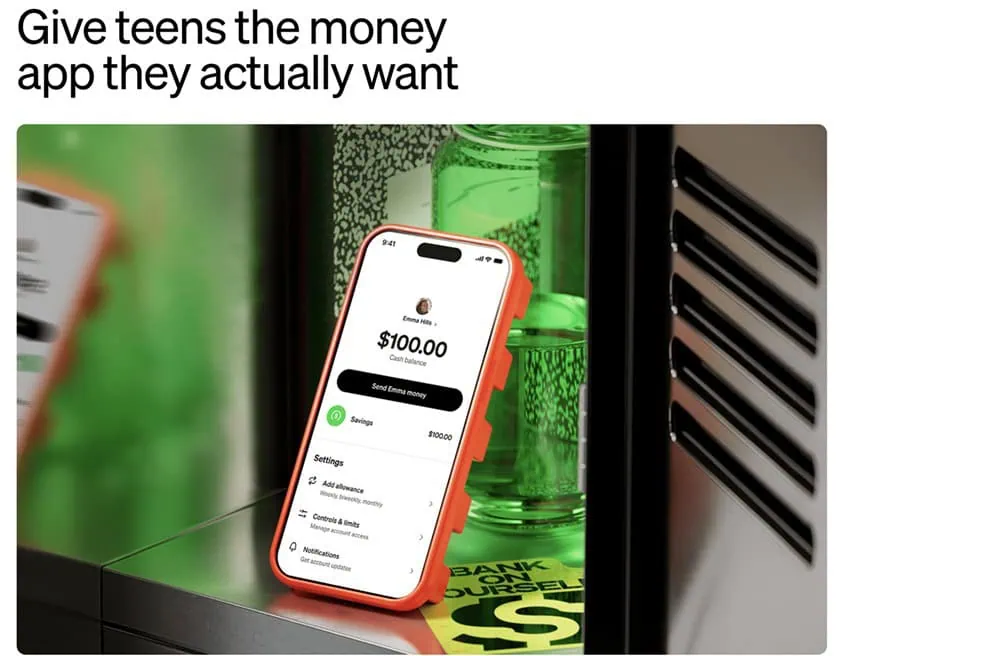
Does your teen need to start learning smart saving, spending, and even investing habits? Cash App Families can accomplish all three—with no subscription fees—putting the power of Cash App into your teen’s hands while keeping their financial safety firmly in yours.
Teens get an account with a designable Cash App Visa® Card, which they can use to spend money where Visa is accepted. Meanwhile, access to Cash App allows them to save money toward specific goals, send money to friends, accept offers for instant discounts at their favorite places, earn high interest on savings³, and check out securely in stores and online by using a QR code.
If your teen direct-deposits $300 or more each month, they’ll also unlock a bevy of other features, including getting paid two days earlier, no ATM fees¹ when withdrawing from more than 40,000 in-network ATMs, and one waived out-of-network ATM withdrawal per month.
Cash App Families even has an investing feature with fractional shares, allowing kids to purchase as little as $1’s worth of stocks and Bitcoin (parent permission is required).²
Meanwhile, parents/guardians who sponsor the teen** enjoy some of the best oversight features among teen debit cards. You can monitor your teen’s activity from your own Cash App or receive real-time transaction alerts for their payments and purchases. You control which features—stocks, Bitcoin², sending money, the Cash App Visa® Card—your teen can access, and certain spending categories are auto-blocked for teens. Parents can also send money for allowance whenever they want, and built-in tools allow parents and teens to budget and save together.
Parents/guardians must download Cash App (also free), then invite their teen to create a sponsored account. Cash App Families can be used by teens ages 13-17. Use our link to learn more about or sign up with Cash App today.
- Cash App Families is a money app and debit card that helps teens ages 13-17** learn about, spend, save, and invest money while under the protection of a large suite of parental oversight tools.
- Teens get a customizable Cash App Visa® Card*, can make and receive instant person-to-person payments, can fund their account with direct deposit, and can even buy as little as $1's worth of stocks and Bitcoin.²
- Your teen can earn 3.50% interest on savings. No account minimums.³
- Pay your kids an allowance, and use Cash App's tools to save and budget together.
- Safety features such as real-time transaction alerts, account monitoring (from the parent's Cash App), alerts for teen payments to new contacts, contact blocking, feature control, and payments control. Also, Cash App auto-blocks certain spending categories to teens, and strangers can't find teens in Cash App search.
- Features such as two-day early payment, free in-network ATM withdrawals, and a monthly reimbursement for an out-of-network ATM withdrawal are unlocked when $300+ is direct-deposited each month.¹
- Free account and Cash App Visa® Card*
- Excellent parental controls (including feature lock and real-time transaction alerts)
- Stock and Bitcoin investing²
- Fractional shares²
- Allowance feature
- Customizable cards ($5+)
- FDIC insurance available on a pass-through basis (if certain conditions are met)***
- Certain benefits, such as free in-network ATM withdrawals¹, require direct deposit of at least $300 monthly
Related: 11 Best Debit Cards for Kids [2026]
2. Chase First Banking (Best Kids’ Debit Card From a Major Bank)
- Available: Sign up here
- Price: Free (no monthly fees)
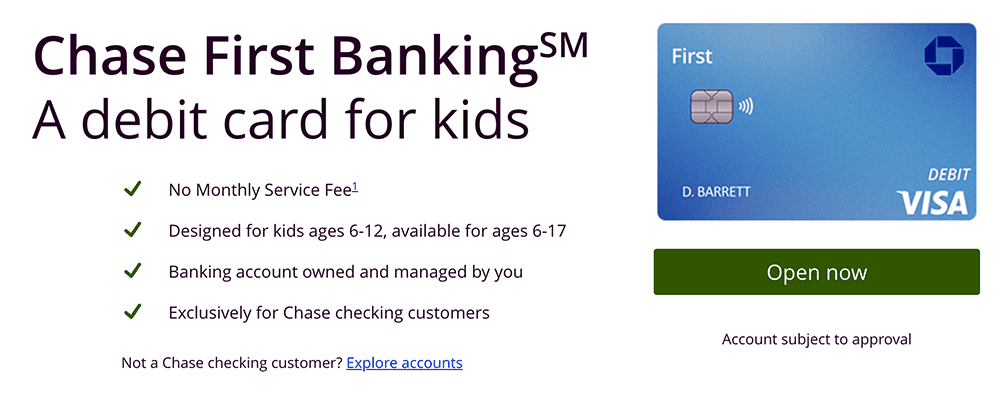
Ready to teach your little ones about earning, saving, and spending money, but not quite sure if you have the time, patience, and/or expertise? Chase First BankingSM offers simple banking for both of you in one location—the Chase Mobile® App—for free.
Chase First BankingSM helps parents teach teens and kids about money by giving parents the control they want and kids the freedom they need to learn. Among the account’s many features?
- One of the best free debit cards for kids and teens—it works anywhere Visa is accepted, and can be used to withdraw money fee-free* from more than 14,000 Chase ATMs nationwide
- Savings goals that you can track via the Chase Mobile® App
- Parental controls, such as setting limits on where and how much they can spend and withdraw from ATMs
- Account alerts that let you know where your child is spending
- Recurring chores and allowance
The account is designed with kids 6-12 in mind, and available for ages 6-17. To get started, you’ll first need to be a Chase customer with a qualifying Chase checking account. If you don’t already have one, consider opening a Chase Total Checking® or Chase Secure BankingSM account to qualify.
- Chase Total Checking® also grants access to thousands of branches and ATMs. You can pay $0 in monthly fees, subject to meeting certain conditions.** And you can collect a $400 new-customer bonus when you make total direct deposits of $1,000 or more within 90 days of coupon enrollment.
- Chase Secure BankingSM offers the same Chase ATMs and branch locations as well as a $125 sign-up bonus when you make stated qualifying activities and meet certain conditions.
Once you open a qualifying Chase Checking account, you may use our link to apply for a Chase First BankingSM account for your child.
- Chase First Banking is a free, just-for-kids banking account that teaches children and teens about their finances through the Chase Mobile® app and a Visa debit card.
- The account is designed with kids 6-12 in mind, and available for ages 6-17.
- Kids can use their debit card anywhere Visa is accepted, and withdraw money fee-free* from thousands of Chase ATMs.
- Parents can enjoy peace of mind by limiting how much and where their children can spend and withdraw money, and set up spending alerts.
- Parents can reward responsibility with allowance transfers, set to repeat on the schedule you choose.
- You must be a current Chase customer with a qualifying Chase checking account to sign up. If you don’t already have one, consider opening a Chase Total Checking or Chase Secure Banking account to qualify.
- Free account
- No monthly maintenance fees
- Chore and allowance functionality
- Parental controls on spend/ATM limit and location
- No paired investment account
- No interest
Related: 10 Best Kids Savings Accounts + Children’s Bank Accounts
3. Acorns Early (Best for Customer Service)
- Available: Acorns Early Lite | Acorns Gold
- Price: Acorns Early Lite: Free 30-day trial, then $8/mo. Acorns Early: $12/mo.
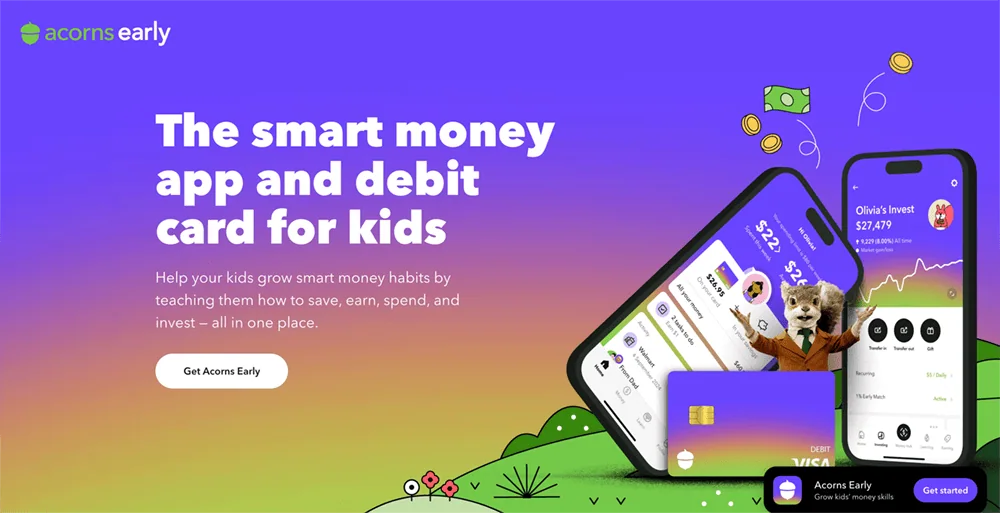
Many reviewers have long painted Acorns Early (formerly GoHenry) as just a way to spend. However, I see it as a real financial solution for minors—a debit card, yes, but also an app-based ecosphere that provides education and experience for the child, as well as ways for parents to keep their kids safe and teach them responsibility.
An Acorns Early account includes a smart money app, as well as Visa debit cards for up to four children. These debit cards can be used to spend anywhere Visa is accepted (so, millions of vendors online and in stores), as well as withdraw cash from ATMs. The standard Acorns Early debit card itself is included in the monthly subscription; however, your child can also stylize their card with one of 35 different designs for a one-time fee. The account also allows kids to set savings goals, which they can fund manually or via autosave.
Acorns Early’s app hosts educational materials to help children and teens alike develop good money habits. One of the more impressive aspects of the program is that it’s explicitly segmented into different age groups, starting with money basics for kids in single-digit ages, then becoming more advanced over time, so the lessons really appear to grow as your children do.
This FDIC-insured account also enjoys a variety of safety features, including chip and PIN protection, secure PIN recovery, and fraud protection. Acorns Early also offers parents additional peace of mind by providing a number of controls, including:
- Real-time spending notifications
- Card lock/unlock
- Savings goal lock/unlock
- Adjustable spending limits on a per-transaction and per-week basis
- Card category block/unblock for in-store purchases, online purchases, and ATM withdrawals
- Adjustable spending block/unblock at stores that sell age-restricted goods such as firearms and alcohol
Also, kids can only spend whatever money is available on the card because it’s a prepaid debit card. That means parents don’t have to worry about costly overdraft fees or their kids running up a debt.
Acorns Early offers a number of ways to fund the account. Parents, of course, can send money in a pinch whenever they want with instant transfers. They can also set up a regular allowance, or tie payment to chores. (And parents get to approve chores before they pay out—no half-done dishes allowed.) Teens can also receive ACH deposits from their employers. And loved ones can either get “Relative accounts” that allow them to send money to your kids, or they can send money via Acorns Early “Giftlinks,” which act similarly to an e-gift card.
Acorns Early also stands out to us as one of the best prepaid debit cards for kids because of its outstanding customer service, which it inherited from GoHenry. Acorns Early users enjoy seven-day-a-week phone service (9 a.m. to 8 p.m. ET Monday-Friday, 9 a.m. to 5 p.m. ET Saturday-Sunday), as well as 24/7 live chat support.
Acorns Early has no minimum age requirements but recommends starting at age 6 or older. Parents have two ways of signing up for Acorns Early:
- Sign up for Acorns Early Lite. This subscription level provides you with everything mentioned above for up to four children.
- Sign up for Acorns Gold. Acorns Gold is the top Acorns subscription tier for adults, and it provides a wealth of banking, investing, and other features. However, it also includes a subscription to Acorns Early (again, good for up to four children), and it unlocks Acorns Early Invest: a UGMA/UTMA custodial account you can use to invest for your kids’ future.
Acorns frequently offers small bonuses for anyone who signs up with our links. You can check out current offers in the box below, or read more about this app in our Acorns Early review.
- Acorns Early is a debit card and financial app designed to provide education, experience, and confidence in saving, spending, and earning, to kids ages 6-18.
- Accounts come with a smart money app and up to 4 Visa debit cards, which allows your kids to spend in stores and online, and withdraw money from ATMs.
- Kids can also earn allowance, complete chores for money, set savings goals, even give to charity.
- Parents can rest easy knowing there are plenty of guardrails in place, including chip-and-PIN technology, fraud protection, and parental controls such as spending notifications, card locking, and adjustable spending limits.
- Acorns Early also provides educational resources tailored for kids of all ages, as well as sterling customer service (including everyday phone availability and 24/7 chat).
- All of the above is available via the Acorns Early Lite subscription.
- An Acorns Gold subscription delivers everything in Acorns Early Lite, as well as access to Acorns Early Invest (a UGMA/UTMA custodial account where you can save toward your kids' future and get a 1% match on up to $7,000 in contributions annually). Parents also enjoy banking and investing features such as an IRA with a 3% match for your first year, a high APY on emergency savings, Acorns' "Round-Ups," and more.
- Special offer (1): Get a free 30-day trial and $5 allowance when you sign up for Acorns Early Lite.
- Special offer (2): Get a $20 bonus investment when you sign up for Acorns Gold.
- Strong parental controls (including card-use controls and adjustable spending limits)
- Chores and allowance
- FDIC insurance
- Allows for ACH payments
- Convenient "Giftlinks" for non-accountholders to give money to kids' accounts
- Customizable cards (with fee)
- Must sign up for Acorns Gold to get investing
- No fee-free ATM network

Related: Acorns Early (Formerly GoHenry) vs. Greenlight
4. BusyKid (Prepaid Visa Debit Card for Kids)
- Available: Sign up here
- Price: $4/mo. billed annually. (Up to 5 cards)
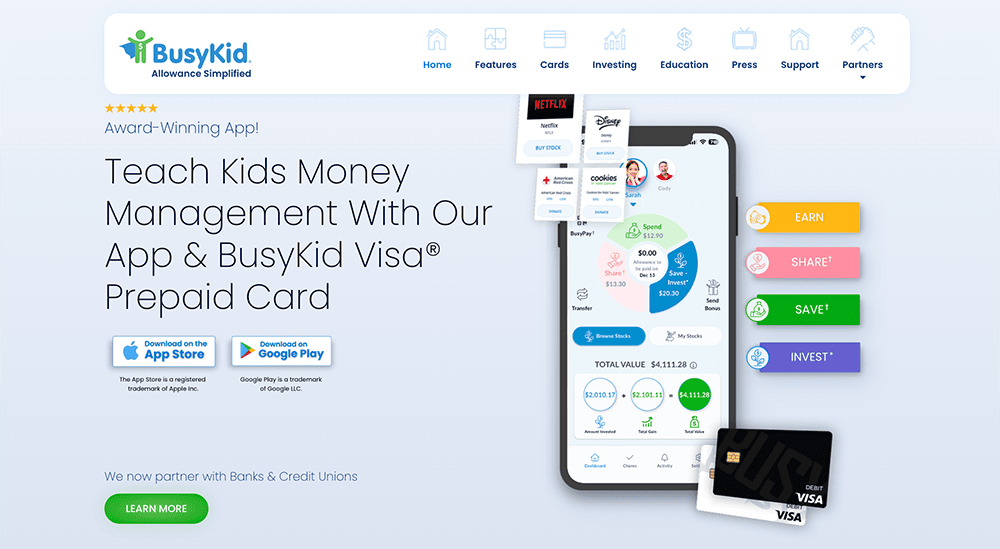
If you’re looking for prepaid debit cards for kids that also teach your children about money, lets you pay them allowance, and allows them to spend, consider the award-winning BusyKid app and the connected BusyKid Visa Spend Card.
BusyKid started as an easy-to-use, interactive chore app for kids, but has since added a prepaid debit card that allows your children to spend their money in stores and online. Your children can earn real money by completing chores and other tasks around the house, then use the app to learn valuable financial skills, such as budgeting, saving, and even giving back.
Parents can pay allowance on an ad hoc basis, or they can set up Auto-Allowance. When parents add to their children’s accounts, that money can be split between Save, Share, and Spend:
- Save: Parents can automatically allocate money toward a savings basket; however, parents can also match any money their children elect to save.
- Donate: Children can choose which charities they would like to give money to, and parents must approve before the cash is transferred.
- Spend: When they’re ready for independence, BusyKid has a Visa Spend Card so kids are never without cash in hand.
Also, with BusyKid, the parent isn’t the only person who can add money to child accounts. With a share of the QR code, grandparents, aunts, uncles, other family members, and even friends can add money—from birthday presents to paying for chores–for a $1 fee (plus any credit card or bank transaction costs).
Finally, BusyKid also allows children to invest their earnings through the app. Doing so requires setting up a separate Apex Clearing account. Children can choose to invest in hundreds of stocks and ETFs with as little as $10.
In addition to the $4 monthly subscription, BusyKid charges other fees, including 50¢ per declined transaction, $5 for a card reissue, and a $5 monthly fee for paper statements.
- BusyKid is an award-winning, parent-approved app that educates kids about money.
- Parents can pay allowance on an ad hoc basis, or they can set up Auto-Allowance.
- Parents can split allowance money across Save (and even match money in the Save category), Spend (which kids can access with their Visa Spend Card), and Donate (children can choose charities to donate to; parents must approve).
- Parents can set up a separate Apex Clearing brokerage account to allow their children to invest earnings through BusyKid, with as little as $10.
- Feature-heavy allowance function
- Offers investment functionality
- Combines several kid-focused financial needs in one app
- Charges a fee
- Lower customer user ratings than competitors

Related: 10 Best Banking Apps for Kids & Teens [Kid + Teen Banking]
5. FamZoo (Best for Financial Education)
- Available: Sign up here
- Price: Monthly: 1-month free trial, then $5.99/mo. Annually: 2-month free trial, then $59.90/yr. (16% discount)
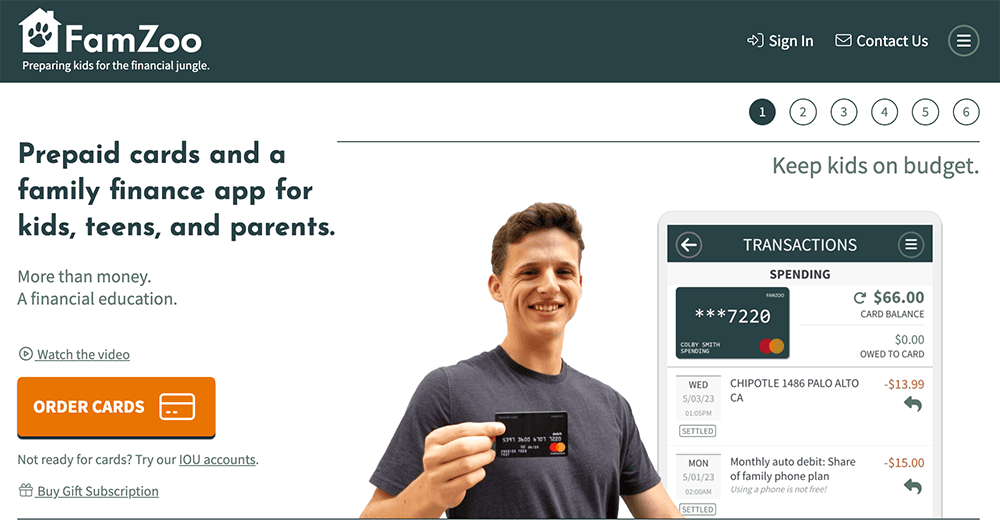
FamZoo is another service for parents interested in opening a prepaid debit card to manage their children’s spending.
FamZoo rates as our top education choice because of both its robust financial education library, and functions that have financial literacy in mind. For instance, its chore features include payment checklists that teach kids the value of a dollar by tying chores and odd jobs to rewards and even penalties. You can also teach younger children the basics of money through the automated allowance feature, which lets you set a fixed amount or even automatically raise it as they age.
Spending, Saving, and Giving accounts separate funds into different purposes. With “Parent-Paid Interest,” you can teach your kids the power of compound interest over time. Other features include direct deposit, savings goal tracking, and FDIC insurance.
Parents can fund a FamZoo account through numerous routes, including bank transfers, Direct Deposit, even cash. Typically, parents will load their primary funding card, then they will transfer those funds onto their kids’ cards. But you do have the option of directly funding kids’ cards.
There are plenty of safety features, too. And there’s no risk of having your bank account information stolen from FamZoo—because FamZoo never asks for it. Adults can monitor transactions, you can temporarily lock and unlock cards, and you can set up real-time alerts for card activity and remaining balances.
- FamZoo is the prepaid debit card used by families to teach children good financial habits from an early age.
- Many of the app's functions also have financial literacy in mind, including Parent-Paid Interest, parental loans, and reimbursements.
- Robust allowance and chore functions include features such as automatic allowance, payment checklists, even chore penalties.
- FamZoo lets you fund your account in a variety of ways, including bank account, debit card, payment app, digital wallet, and cash.
- Robust, customizable allowance and chores functions.
- Prepaid card without overdraft fees
- Highly customizable allowance and chores functions
- Strong financial education resource library
- Parent-paid interest
- No paired investment account
- Weak parental controls

Related: Greenlight vs. FamZoo
6. Axos First Checking (Best Free Greenlight Alternative)
- Available: Sign up here
- Price: Free (no monthly fees)
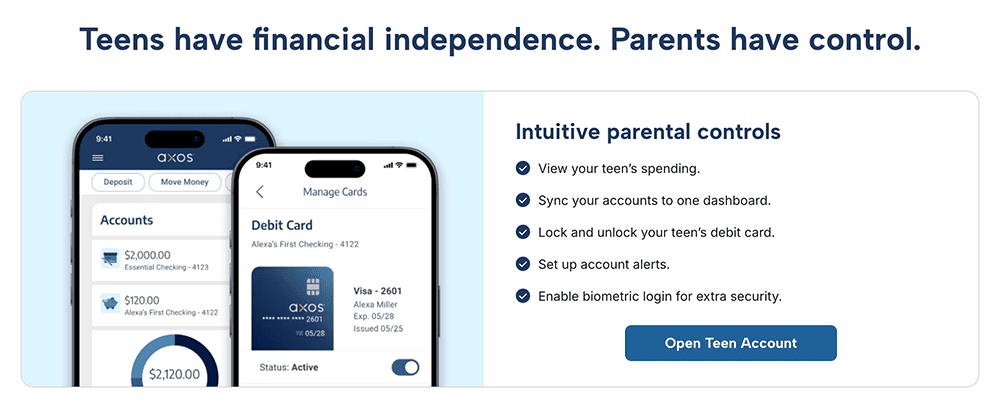
Axos First Checking is a free joint bank account for teens and adults offered by Axos Bank—an online-only bank with a focus on technology-driven finance.
First Checking offers teens and their parents (or other adult owners of the account) a free debit card, peer-to-peer transfers, direct deposit, bill pay, extensive security features, even interest payments.
The Axos First Checking account comes with a debit card—you can choose either Visa or Mastercard—that you can use to spend in store and online, as well as to withdraw cash. While Axos Bank doesn’t have its own ATM system, Axos offers fee-free access to 91,000 ATMs nationwide, and it reimburses up to $12 in third-party ATM fees every month.
If you’re worried that your (or your teen’s) card is lost or stolen? You can lock and unlock the card from your Axos account. And the card limits cash withdrawals to $100 daily and debit transactions to $500 daily.
Axos First Checking charges zero monthly maintenance fees, overdraft fees, and non-sufficient fund fees. It’s designed for teens between ages 13 and 17 (up to 18 years old in Alabama). And once your teen reaches adulthood, it’s easy to convert to another Axos checking account, giving the newly minted adult full control.
Read more in our Axos First Checking Account review.
- Axos Bank First Checking is a joint checking account targeted for teenagers ages 13-17 and their parents.
- Account holders get a Visa or Mastercard debit card that can be used to spend online or in person, or to withdraw cash at any ATM. (Axos provides up to $12 in monthly domestic ATM fee reimbursements.)
- No monthly maintenance, overdraft, or non-sufficient fund fees.
- The debit card's security features include account alerts, card locking, and daily transaction alerts of $100 (cash) and $500 (debit).
- Currently, you can earn up to 0.10% APY on any balance.
- Free (no monthly maintenance fees)
- ATM fee reimbursements (up to $12 per month)
- Converts to adult checking account after minor reaches age of majority
- No paired investment account
- No robust financial literacy resources

Related: 7 Best Investments for Kids [Investing for Children]
7. Current (An Easy Banking App for Families)
- Available: Sign up here
- Price: Free (no monthly fees)
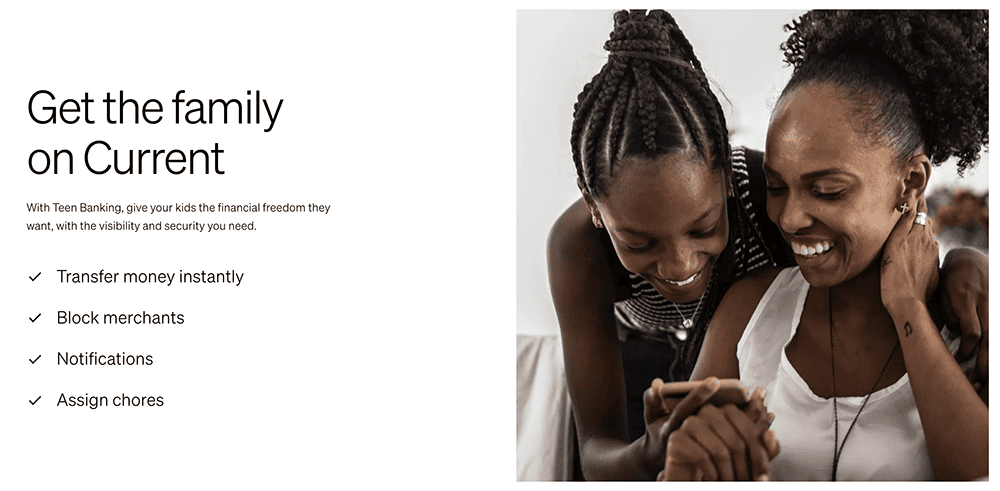
Current is a banking app designed for families; it offers both parent and teen accounts, with the latter acting like prepaid debit cards that parents load for their children. The Current app allows you to track your teen’s spending in real-time, set limits on how much your children can spend, and even block specific merchants on its Visa-enabled debit cards. You also get the peace of mind that comes with knowing your children’s money is safe because it’s not cash—no temptations, just a tool parents can use to help teach teens financial responsibility.
Among Current’s features:
- No minimum required balances, no fees on transfers to other Current accounts, and no hidden fees.
- Create Savings Pods, or Giving Pods, that allow you to save up for various goals.
- Round-Ups allow you to round up purchases to the nearest dollar amount and store the difference in Savings or Giving Pods.
- Buy and sell 27 different cryptocurrencies with zero trading fees.
Teens will love easy allowance deposits, a card they can use in stores or online, instant gas hold removals when buying gas, and access to more than 40,000 fee-free Allpoint ATMs nationwide. They’ll also have the opportunity to learn about financial responsibility and financial independence through Current’s Budgets feature, which allows them to track their spending and even receive alerts when they get too close to (or exceed) a predetermined limit.
The product has no specifically stated minimum age requirement, but the marketing suggests teens are the target audience. However, you might be able to open an account for a younger child.
Read more in our Current review.
- Current is a financial technology platform that lets teens enjoy not just traditional banking basics, but numerous features meant to simplify spending, streamline saving, and set them on the path toward more organized finances.
- Teens can spend with the Current Visa debit card, which allows them to purchase in-store and online, as well as withdraw money fee-free from more than 40,000 in-network Allpoint ATMs.
- Current Teen Accounts also come with Savings Pods, which earn 0.25% APY and allow you to round up purchases (overages are funneled into your savings). Keep a qualifying direct deposit of $200 or more in your account, and you'll earn a full boosted rate of up to 4% annually.
- Parents can monitor their kids' spending, adjust maximum ATM withdrawal and spending limits, and even toggle spending categories (and the Current debit card itself) on and off.
- Parents can also automate allowance payments, pay for chores, instantly transfer money to their teens, and more.
- Free account (no monthly maintenance fees)
- Good parental controls
- Fee-free ATMs
- Cash reloads
- Gas hold deposits
- 24/7 email and live-chat support
- No direct deposit
- No paired investment account
- No card customization

Related: 9 Best Debit Cards for Teens [Reviewed by a CPA + Father]
8. Capital One MONEY (Best Free Teen Checking Account)
- Available: Read our review and sign up
- Price: Free (no monthly fees)
Capital One MONEY Teen Checking is one of Young and the Invested’s top choices for parents who want to financially empower their kids at an early age. Yes, this free checking account is predominantly aimed at teenagers, but it’s actually available to kids as young as 8 years old.
This joint checking account offers flexibility for kids and a touch of tranquility for parents. Kids get a Mastercard debit card that they can use at millions of merchants across the U.S., as well as in roughly 210 countries and territories worldwide. Your teen also enjoys access to one of the largest fee-free ATM networks among kids debit cards—more than 70,000+ Capital One, MoneyPass, and AllPoint machines. They can also send and receive money via Zelle, receive direct deposits from employers, and even cash paper checks by snapping a couple photos within the highly rated Capital One app.
Parents, meanwhile, can also pay their kids a regular allowance, or make one-time payments as gifts or rewards. They also can monitor their teens’ transactions, lock and unlock their child’s card, and control their kid’s access to (and transfer limits within) Zelle.
To learn more about the account, read our Capital One MONEY Teen Checking review. Or you can sign up today by clicking “Get Started” above.
- Capital One MONEY is a full-fledged money management account that comes with both a debit card and a highly rated mobile app.
- Boasts one of the largest nationwide fee-free ATM networks, which currently stands at more than 70,000 machines nationwide.
- Security features include monitoring tools and easy card lock/unlock.
- Age requirement: 8+ with a parent-sponsored account
- APY: 0.10%
- Minimum deposit: None
- Minimum balance required: None
- Free account and card
- Access to 70,000+ fee-free ATMs
- Access to Zelle
- Mobile check deposit
- Cash deposits
- Allowance
- Ability to migrate account to 360 Checking when minor becomes 18
- Sparse educational tools
- Few rewards or perks

Related: 9 Best Teen Checking Accounts [Banks for Teens]
What Are Prepaid Debit Cards for Kids?

A prepaid card is a type of payment card that can be loaded with funds in advance and then used to purchase goods or services without incurring debt from the issuer. The most common type of prepaid cards is a prepaid debit card (which acts like making bank account withdrawals when purchasing goods and services).
Prepaid cards for a child allow you to avoid non-sufficient funds fees or overdraft charges because they can only spend what they have on the card.
Related: How Old Do You Have to Be to Invest in Stocks by Yourself?
What Is the Greenlight Debit Card for Kids?
The Greenlight app offers a feature-filled financial platform meant to help parents teach their kids important personal finance skills and build useful money habits including how to save, earn, invest, spend and give money responsibly. The Greenlight app and prepaid card function as a purpose-built solution for families to learn about money through use of a prepaid debit card with parental controls, notifications and safety features.
Further, the Greenlight prepaid card and app offers a parent account for establishing chore plans and administering weekly allowance payments for successful completion of assigned tasks.
From there, parents can show their kids how to use the included investing platform (on a higher plan through Greenlight Max) to invest in stocks for kids and exchange-traded funds (ETFs). This can show real-life lessons of compound interest and encourage children to save and invest funds regularly.
- Greenlight is a financial solution for kids that allows them to spend with a debit card, earn money on savings, and even invest their money.
- Greenlight offers flexible parental controls for each child and real-time notifications of each transaction. And it's the only debit card that lets you choose the exact stores where kids can spend on the card.
- Parents can use this app to teach kids how to invest with a brokerage account through Greenlight Max, Infinity, and Family Shield plans.
- Greenlight also provides educational materials such as "Level Up" lessons that simplify investing concepts, as well as videos about their favorite companies.
- Families can earn 2% (Core), 3% (Max), 5% (Infinity), or 6% (Family Shield) per annum on their average daily savings balance of up to $5,000 per family. Also, Max and Infinity families can earn 1% cash back on their monthly expenditures.
- Unlike many apps that simply provide features and controls, Greenlight is also designed to spark discussions with children about spending, investing, and more, fostering a better educational experience.
- Best-in-class parental controls (can prohibit specific stores)
- Can add brokerage account to invest in stocks
- Intuitive Parent + Kid apps
- Competitive cash back & interest rates
- Parent-Paid Interest
- High price points
- No cash reload options
- No parent / child lending

Read More on Young and the Invested
- Should You Open a Child Bank Account with a Debit Card?
- Best Trading Accounts for Minors [Stock Investing Under 18]
- 5 Best Investment Accounts for Kids [Child Investment Plans]
Disclosures
Cash App Families
Cash App is a financial services platform, not a bank. Banking services provided by Cash App’s bank partner(s). Prepaid debit cards issued by Sutton Bank, Member FDIC. Cash App Visa® Debit Flex Cards issued by Sutton Bank, Member FDIC, and The Bancorp Bank, N.A., pursuant to a license from Visa U.S.A. Inc. See terms and conditions for the Sutton prepaid card, Sutton debit flex card, and Bancorp debit flex card. Direct deposit, Savings, Instant Discounts, Direct Deposit and Offers provided by Cash App, a Block, Inc. brand. Offers may not be affiliated with third party merchants
* Card use fees apply. Free Cash App Cards come in black, white, pink, or glow-in-the-dark.
** Teens 13 to 17 can use Cash App with sponsorship by an eligible parent or guardian. To view the eligibility requirements for sponsoring a teen, please visit the Sponsored Accounts section of the Cash App Terms of Service.
*** With a Cash App Card, your money is eligible for FDIC pass-through insurance through Wells Fargo Bank, N.A., Sutton Bank, and/or The Bancorp Bank, N.A., Members FDIC, for up to $250,000 per customer when aggregated with all other deposits held in the same legal capacity at each bank, if certain conditions are met. See the Cash App Terms of Service.
Cash App is a financial services platform, and not an FDIC-insured bank. Prepaid debit cards issued by Sutton Bank, Member FDIC. Cash App Visa® Debit Flex Cards issued by Sutton Bank, Member FDIC, and The Bancorp Bank, N.A., pursuant to a license from Visa U.S.A. Inc..
1 Cash App reimburses ATM fees for all in-network withdrawals when you deposit at least $300 monthly of Qualifying Deposits into Cash App, or spend $500 or more in Qualifying Purchases using your Cash App Card or Cash App Pay in a calendar month. Service fees may apply. See terms for more details.
2 Brokerage services provided by Cash App Investing LLC, member FINRA/SIPC, subsidiary of Block, Inc. Bitcoin services provided by Block, Inc. Bitcoin services are not licensable activity in all U.S. states and territories. Block, Inc. operates in New York as Block of Delaware and is licensed to engage in virtual currency business activity by the New York State Department of Financial Services. Investing and bitcoin are non-deposit, non-bank products that are not FDIC insured and involve risk, including monetary loss. Cash App Investing does not trade bitcoin and Block, Inc. is not a member of FINRA or SIPC. For additional information, see the Bitcoin and Cash App Investing disclosures. Additional fees for securities may apply such as regulatory fees and fees to transfer securities externally. Please see our House Rules for more information.
Fractional shares investing may involve additional risks such as non-transferability. For additional information regarding the unique risks and limitations of fractional shares, please see your Investing Customer Account Agreement.
3 Cash App will pass through a portion of the interest paid on your savings balance held in an account for the benefit of Cash App customers at Wells Fargo Bank, N.A., Member FDIC. To earn interest on your Cash App savings balance, you need to have sponsor approval. Exceptions may apply. Savings yield rate is subject to change.