


Many Americans’ working years are spent receiving a single stream of income from a single job. That paycheck might come monthly, twice a month, or biweekly, but it was a steady flow that you could easily budget around.
However, in retirement, your money will flow in from multiple streams—there’ll be some pretty concrete sources of income, but you’ll very likely collect what’s referred to as “variable income,” too.
Don’t panic. That sounds a lot less scary than it is. Variable income largely refers to money you pull in from retirement and other accounts, though it can also refer to pay you receive from any work you do. These earnings can be pretty stable—they’re just not guaranteed the way Social Security, pensions, and other income sources are.
Want to learn more? Read on as I more fully explain predictable and variable income, then provide you with several pointers for how to budget with a variable income in retirement.
Predictable vs. Variable Income

Predictable or “reliable” retirement income sources are those that are guaranteed throughout your retirement. Note that these income sources might not stay the same throughout retirement. For example, your Social Security increases through the annual Social Security cost-of-living adjustment (COLA).
Besides Social Security, some predictable income may include (but isn’t limited to):
- Pensions
- Annuities
- Permanent life insurance
Variable income can fluctuate throughout retirement. Some examples of variable income you may have in retirement include (but aren’t limited to):
- Retirement account withdrawals
- Earnings from taxable savings and investment accounts
- Income from a part-time job
Variable Income Budgeting Tips

A variable income can make budgeting a bit trickier, but it can still be very manageable. The following tips can make your money management easier.
Do you want to get serious about saving and planning for retirement? Sign up for Retire With Riley, Young and the Invested’s free retirement planning newsletter.
1. Consolidate Accounts

Consolidating financial accounts can make money management easier.
Let’s say you have multiple 401(k) accounts (one from your current workplace, and one from a former workplace), a traditional individual retirement account (IRA), and a Roth IRA. A 401(k) rollover of your former workplace account would give you one less retirement-income source to manage and track, and you could instead manage that money right alongside your current IRA.
Or let’s say you use the digital envelope budgeting method and have multiple savings accounts. Transferring all of that money into just a single savings account would simplify your finances by making it easier to view your total savings balance in one dashboard, not several.
That said, if you’re married to having multiple accounts, you can use a net worth tracker like Empower to keep tabs on everything from a single dashboard.
- Empower offers both a free set of portfolio, net worth, and cash flow tracking tools, as well as paid asset management service.
- Link Empower to your bank and investing accounts, credit cards, and more to see a single view of useful information and data, including your net worth.
- Empower Advisory Group offers a comprehensive wealth management service known as Personal Strategy. This managed account solution provides clients with discretionary investment management, personalized portfolio construction, and access to financial planning support. Accounts investing $100k to $250k receive unlimited advice and retirement planning help from financial advisors, as well as a professionally managed ETF portfolio with reviews upon request. Higher asset tiers offer access to dedicated advisors, estate planning, and tax specialists, plus additional investment options like access to private equity.**
- Special offer: If you have $100k+ in investible assets, sign up with our link to schedule a free initial 30-minute financial consultation with an Empower professional.
- Free portfolio tracker (Dashboard)
- Free net worth, cash flow, and investment reporting tools (Dashboard)
- Tax-loss harvesting (Personal Strategy)
- Dividend reinvestment (Personal Strategy)
- Automatic rebalancing (Personal Strategy)
- Low investment expense ratios (Personal Strategy)
- High number of investment accounts supported (Personal Strategy)
- Low $100k minimum for investment management (Personal Strategy) compared to traditional advisors.
- Moderately high investment management fee (0.89% AUM) compared to other online advisors (Personal Strategy)
- No dedicated advisor unless you have $250k+ in assets

Related: What to Do With Your 401(k) When You Retire
2. Take Retirement Account Withdrawals Strategically

It’s likely that at least part of your retirement is funded, or will be funded, through retirement account withdrawals. Don’t treat these accounts like an ATM. Rather than simply taking out however much you want, when you want, from whichever account feels convenient, your budget will appreciate it if you have a withdrawal strategy.
That doesn’t just mean “take out money every two weeks or every month.” It also means “have a plan for which accounts you withdraw from, and when.”
There are a couple different schools of thought on this, but here’s what I believe to be the best account withdrawal order to maximize your ability to grow your wealth over the course of your retirement:
- First, draw from taxable accounts (standard brokerage).
- Next, draw from tax-deferred accounts (401(k), IRA, etc.).
- Last, draw from tax-exempt accounts (Roth 401(k), Roth IRA, etc.).
One exception to this rule: If you have short-term investments (held for a year or less) that have appreciated in value within a taxable brokerage account, it might behoove you to wait before you sell. That’s because if you wait to sell an investment until you’ve held it for longer than a year, and you sell it for a profit, that profit will be subject to more favorable long-term capital gains tax rates.
A big retirement withdrawal mistake is taking withdrawals from any tax-advantaged retirement account before you reach age 59½. That’s because unless you meet one of the exemption criteria, you’ll not only have to pay tax at your ordinary tax rate, but also a 10% early withdrawal penalty.
Young and the Invested Tip: If you do need to withdraw funds at a younger age, see if you qualify to take advantage of the Rule of 55 or Rule 72(t).
Related: Rule of 55 vs Rule 72(t): What’s the Difference?
3. Remember Required Minimum Distributions (RMDs)

You might receive enough money through your predictable income sources to cover all of your essential expenses. And because you have enough money, you might decide to let the funds in your retirement accounts grow indefinitely.
Except, you can only really do that with Roth accounts and taxable accounts. But tax-deferred retirement accounts, such as 401(k)s and traditional IRAs, are subject to required minimum distributions (RMDs).
RMDs are a minimum amount that account holders have to withdraw from applicable accounts each year when they reach a certain age. Right now, that age is 73 for most accounts, but the beginning age is set to increase. Anyone who turns 74 after Dec. 31, 2032 will have the starting age of 75.
Not taking your RMDs before the deadline each year results in a penalty. However much of the RMD that isn’t withdrawn in time could be subject to an excise tax of 25%. So as you budget in retirement, you’ll need to remember this required income source.
Why does this matter? Because RMDs can increase your income, which can put you in a higher tax bracket and also increase the price of your Medicare premiums.
Fortunately, there are a few ways to reduce RMDs, such as making a qualified charitable distribution (QCD) directly from an IRA to a qualified charitable organization and having that money count against your RMDs. (Note: QCDs have an annual limit.)
Related: How Much Is My Required Minimum Distribution (RMD) If I Have $1 Million in My Retirement Accounts?
4. Know How Working Affects Social Security Benefits

Rather than going abruptly from full-time work to around-the-clock retiree, some people choose to ease into retirement. This might mean reducing their hours, switching to a less stressful job, or both.
That variable income might be nice or even necessary to have, but it might affect your Social Security benefits.
To be clear: You can still receive Social Security while working. However, if your earnings are too high while collecting Social Security and you haven’t reached full retirement age (FRA) based on the Social Security Administration’s definition, some of your earnings would be temporarily deducted from your benefit.
In the eyes of your budget, that could make your “reliable” Social Security payment a little more variable, at least for a while. So if you’re trying to decide whether to work while you collect benefits, understand whether doing so could affect your Social Security check, and if so, by how much.
Related: When Should You Take Social Security?
5. Plan for Taxes

Don’t believe the myth: Retirees pay taxes in retirement.
Most, if not all, of your variable retirement income is taxed. Are you doing some self-employed work during retirement? Expect to pay more in taxes than you did as an employee. It’s suggested to set aside about 25% to 30% of your self-employment earnings for tax preparation.
Withdrawals of both contributions and earnings from Roth retirement accounts are tax-free, assuming you are at least 59 ½ and the account has been open for at least five years. However, withdrawals made from tax-deferred retirement accounts are taxed as ordinary income.
And yes, even Social Security benefits can be taxed.
Per usual, if you sell assets from a taxable brokerage account, you’ll be expected to pay capital gains taxes. Keep taxes in mind as you arrange your retirement budget so you don’t have any unpleasant surprises come tax season.
Related: How Can I Lower My Taxes in Retirement? 8 Proven Strategies
6. Keep Your Portfolio Diversified
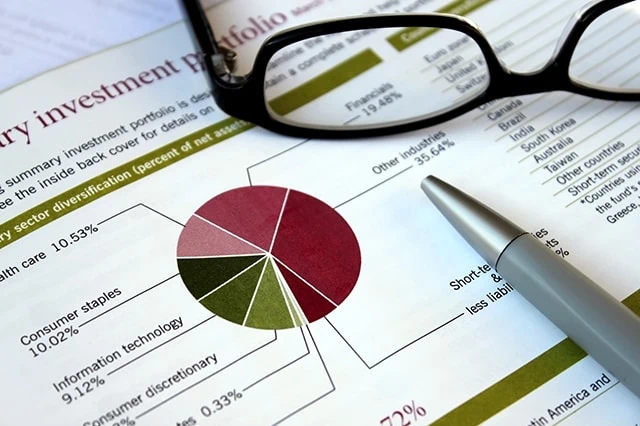
Budgeting is easier when you have ample money to work with, so it’s vital to keep your retirement accounts properly allocated to investments that are suitable for your age, risk tolerance, and goals.
A diversified portfolio generally helps you manage risk, no matter your age. But how you diversify that portfolio will change over time. When you’re younger, you’ll typically want to own growth investments like stocks, but as you grow older, you’ll want to increasingly shift toward holding bonds and other fixed-income investments. However, some retirees take this to an extreme and completely forgo growth, which is a mistake—one that could result in your retirement savings running dry before you pass.
If you haven’t already, you’ll want to discuss the best investments for your unique financial situation—and how those investments might evolve over time—with a professional.
Want to talk more about your financial goals or concerns? Our services include comprehensive financial planning, investment management, estate planning, taxes, and more! Schedule a call with Riley to discuss what you need, and what we can do for you.

Related: How to Choose a Financial Advisor