

In a world of investment research tools that tend to focus solely on stock data and recommendations, Morningstar Investor is a more holistic solution.
This research platform not only provides long-term buy-and-hold investors with the equity knowhow they need—it’s also the premier source of information about mutual funds and exchange-traded funds, and a portfolio management tool to boot.
And today, I’m going to provide you with an in-depth look.
My Morningstar Investor review will explain the service’s various features and costs, and help you determine whether a subscription is right for you.
Morningstar Investor at a Glance
- Morningstar Investor offers expert research, investing analysis, and advisor-grade portfolio management tools that are tailor-made for buy-and-hold investors.
- Morningstar is one of the most prized sources of mutual fund and exchange-traded fund (ETF) data in the world.
- How does your portfolio stack up? Put it through Morningstar's Portfolio X-Ray, which will provide insights such as whether you have too many overlapping holdings or whether you're paying too much in fees.
- Special Offer 1: Click our sign-up link to receive $50 off your first year of Morningstar Investor. (Annual plan only.)
- Special Offer 2: Students receive one year of Morningstar Investor access for just $25!
- Special Offer 3: Teachers receive a 60% discount on Morningstar Investor access.
- Top-flight fund research and analysis
- Portfolio management tool
- Powerful screener
- Watchlists
- Tailored news and commentary
- Below-average charting
- High monthly billing rate

My Background With Morningstar Investor
Most of my reviews of brokers, investment services, and data providers have involved an extended but ultimately trial-basis experience for the sole purpose of providing readers with a rigorous evaluation.
Not so with Morningstar.
I’ve worked in financial media for 15 years, and I’ve used a variety of Morningstar products for the entirety of that career. I started out using its free data, then was later exposed to Morningstar Direct, and I’m currently subscribed to Morningstar Investor, which I’ve used for the past few years.
In short: I’m intimately familiar with Morningstar broadly, and Morningstar Investor specifically.
The good news is when I say Morningstar Investor is an exceedingly useful product, you can take that to the bank. The bad news—at least, I’m sure, in the eyes of the Investor marketing team—is that I’ve played with it long enough to point out a few minor agitations.
Morningstar Investor at a Glance

Morningstar Investor is a rich platform of investment research tools designed for the buy-and-hold crowd.
Morningstar’s ratings are among the service’s most revered features, but it also provides a wealth of information and comparable data points about mutual funds and ETFs—fees, risk, portfolio composition, performance, distributions, and more. Morningstar experts also provide detailed explanations and analysis of many of the funds the site covers.
Stock owners shouldn’t feel left out—Morningstar also provides everything you need for stock research, including equity data, corporate financials, analysis, and even Star Ratings of publicly traded companies.
But Morningstar doesn’t just help you select investments—it provides you with a way to manage your portfolio and keep tabs on your net worth.
Do you want to get serious about saving and planning for retirement? Sign up for Retire With Riley, Young and the Invested’s free retirement planning newsletter.
Morningstar Features
Now, let’s dig into a few of Morningstar’s most interesting tools and capabilities.
Morningstar Medalist Ratings
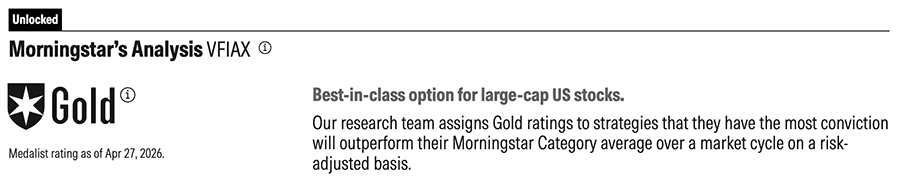
Morningstar’s original Star Rating—which measures a fund’s risk-adjusted past returns—has been around since 1985 and helped steer countless investors toward cheaper, better-constructed mutual funds and ETFs.
But Morningstar doesn’t just look to the past. Its forward-looking Medalist Ratings use traits such as a fund’s parent organization, the managers responsible for making decisions, and fund strategies to determine a fund’s ability to outperform over the long term. (You must be a Morningstar Investor subscriber to access Medalist Ratings.)
I frequently boot up Morningstar Investor and run a quality screen before writing each of my mutual fund and ETF articles—and that quality screen virtually always involves Morningstar’s Medalist ratings.
Per Morningstar:
“For actively managed funds, the top three ratings of Gold, Silver, and Bronze all indicate that our analysts expect the rated investment vehicle to produce positive alpha relative to its Morningstar Category index over the long term, meaning a period of at least five years. For passive strategies, the same ratings indicate that we expect the fund to deliver alpha relative to its Morningstar Category index that is above the lesser of the category median or zero over the long term.”
A Medalist rating doesn’t mean Morningstar is necessarily bullish on the underlying asset class or categorization. It’s merely an expression of confidence in the fund compared to its peers. But it’s still an exceedingly helpful piece of information.
Morningstar Reviews
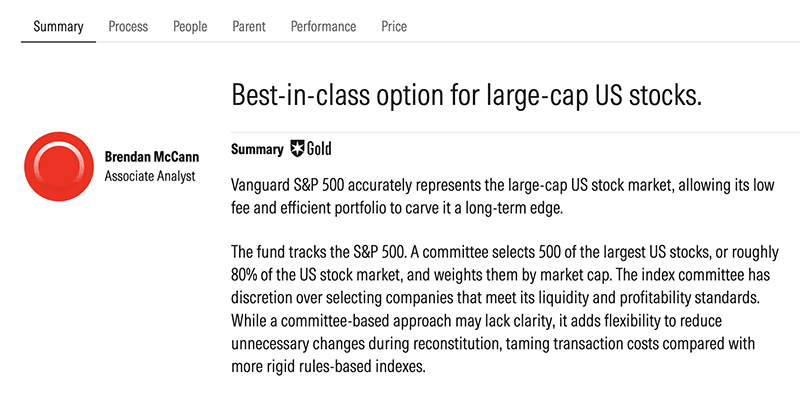
Morningstar Investor also unlocks Morningstar’s reviews, which tell you why a fund has earned the rating it has. Morningstar looks at the fund’s process, its management, the quality of the fund provider, its past performance, and its fees and other expenses compared to competitor funds.
Stock Research
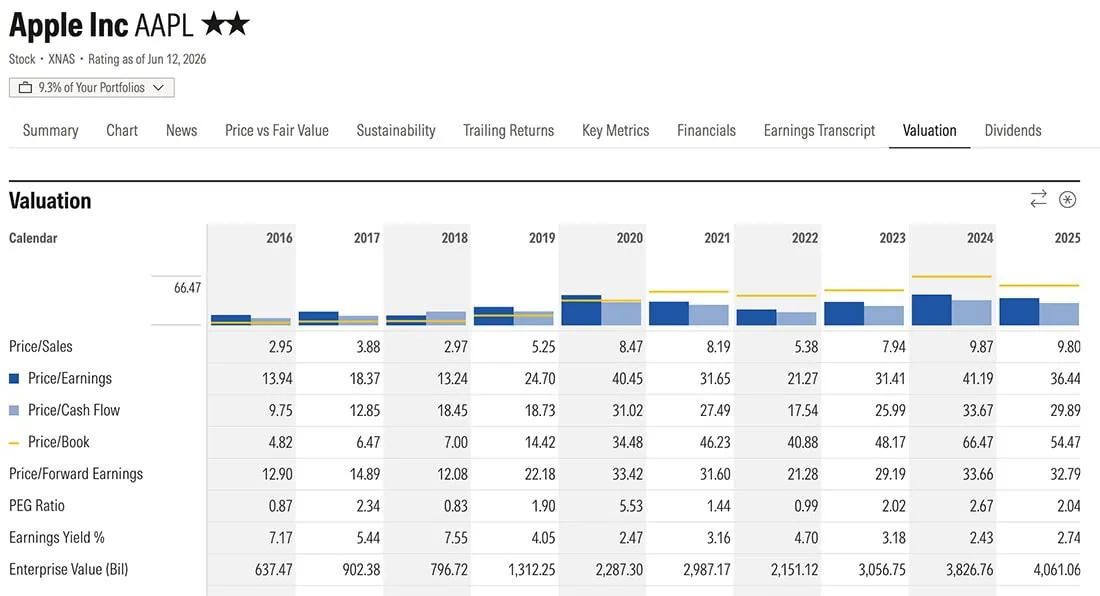
Morningstar Investor isn’t just for fund investors, however. It’s one of the best places to get stock data, whether you’re like me and need to grab prices and past dividend payments on deadline, or if you’re like the vast majority of other people out there who simply wants to know more about stocks, whether they’re prospective holdings or shares you’ve held for years.
Morningstar provides you with recent news, valuations, past returns, key financial metrics, a decade’s worth of financial statements, dividend histories, even transcripts from earnings report conference calls.
It’s arguably more information than any retail investor needs … but I’d argue that means it’ll always be enough.
Screeners
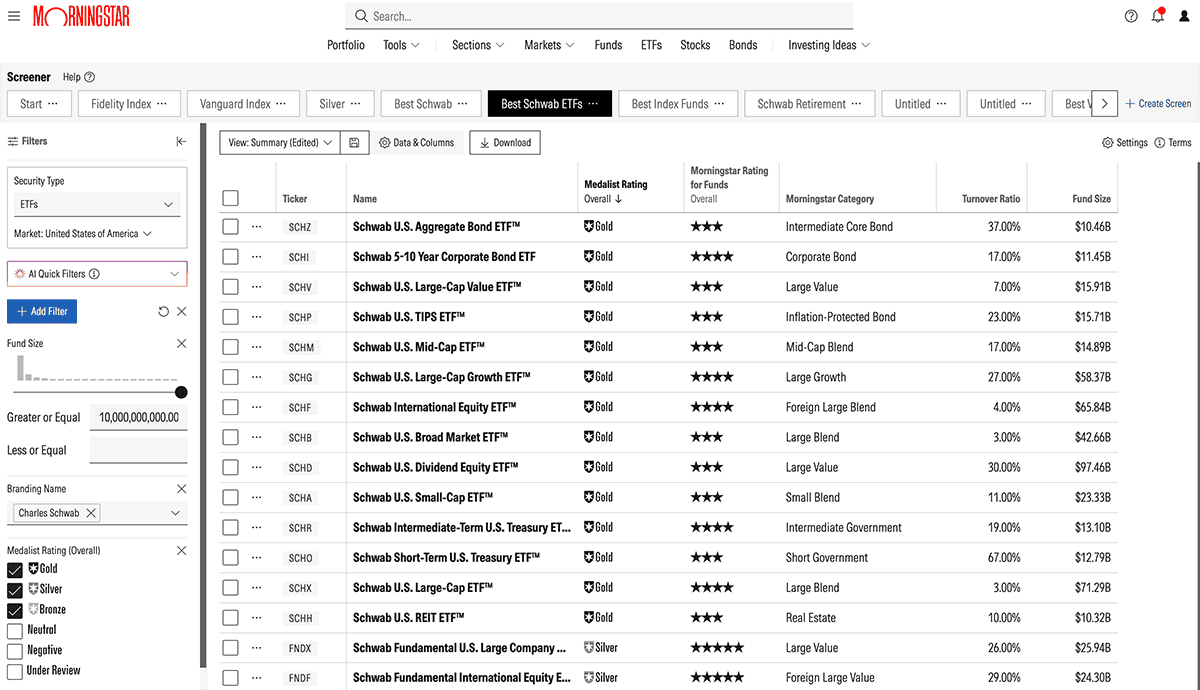
As I mentioned above, Morningstar’s screeners are a fundamental part of my research.
But they’re extremely useful for any investor looking to either find new funds or compare products to their current holdings. You can screen across dozens of criteria, including Morningstar’s ratings, style, fund size, yield, and more.
Portfolio X-Ray

One of my favorite tools within the portfolio manager is Morningstar X-Ray, which evaluates your portfolio and tells you where you stand on asset allocation, sector concentration, geographic holdings, and even equity styles (large/mid/small, value/core/growth). It also tells you how your portfolio compares to benchmark portfolios with varying amounts of risk.
It’s an extremely powerful tool—one that I’ve actually used to explain to readers how to rebalance their portfolios.
Investing Ideas
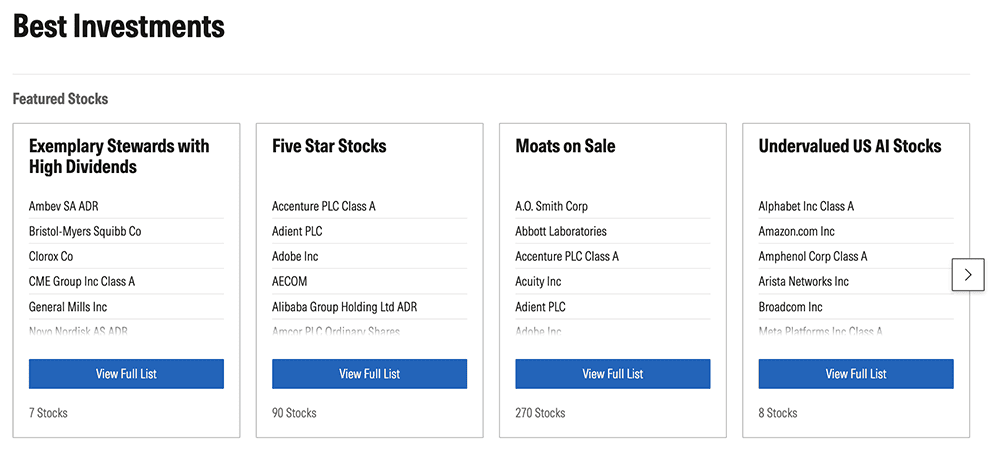
Morningstar also provides a wide variety of “best investments” ideas. The image above shows a few screens, such as undervalued AI stocks, companies with wide “moats” trading at a discount, and five-star-rated stocks.
There’s plenty more stock ideas past that, not to mention numerous ideas for mutual fund and ETF investors, too.
Morningstar Investor Weaknesses
Most anything I could describe as a significant shortcoming has less to do with Morningstar Investor as a service, and more with what it is you’re looking for in a research tool.
For instance, Morningstar doesn’t have much in the way of technical analysis tools. Basic charting? Yes. But its capabilities aren’t anything close to what you get from true stock charting apps.
It’s also not a true recommendation service. While it does provide investment ideas and even model portfolios, it doesn’t act like a traditional stock picking service that might very well provide some long-term holding ideas, but ultimately monitors the portfolio over time and will suggest when to sell holdings should the need arise.
As far as the nitpicky issues I mentioned earlier? Fund pages are occasionally laggy when I’m trying to grab data for stories. The act of saving fund screens is counterintuitive (you don’t actually save screens, they just remain until you delete them, but you have to manually save data view settings). They’re the kinds of minor gripes you only develop once you work in a tool for hundreds of hours—a threshold I’ve only ever crossed with a handful of products.
Do you want to get serious about saving and planning for retirement? Sign up for Retire With Riley, Young and the Invested’s free retirement planning newsletter.
Who Should Try Morningstar Investor?
I’m repeating myself at this point, but Morningstar Investor is an extremely powerful research tool.
But can you get your money’s worth?
I’ve been so vocal about Morningstar over the years, they’re currently offering our readers a free seven-day trial and a discounted subscription rate on Morningstar Investor (just $199 for the first year) when you sign up using our exclusive link.
It’s a deal—if you actually use it.
Specifically, I think Morningstar Investor makes the most sense for an investor who checks off a majority of these boxes:
- Invests for the long term
- Invests at least part of their portfolio in mutual funds and/or ETFs
- Has at least a basic understanding of core investing data, such as valuation metrics for stocks and component weightings for funds
- Has at least $50,000 invested (though ideally $100,000 or more)
- Spends at least 30 minutes a week reviewing and managing their portfolio
Why $50,000? I tend to think of subscription prices in terms of fees. Once the first-year discount is over, you’ll be paying $249 a year—or 0.5% on a $50,000 portfolio. Once you get close to 1%, you might as well be paying an advisor. But 0.5% is a fair enough fee for a subscription service. (And at $100,000, it’s just a 0.25% fee, which is much more attractive. Obviously, the more you have invested, the smaller the fee as a percentage of your portfolio.)
That said, if you have less invested and you’re willing to make the investment, I won’t talk anyone down from trying to better understand and improve their portfolio.
If you’re interested, check out the box below and click “Start Your 7-Day Trial” to get going!
- Morningstar Investor offers expert research, investing analysis, and advisor-grade portfolio management tools that are tailor-made for buy-and-hold investors.
- Morningstar is one of the most prized sources of mutual fund and exchange-traded fund (ETF) data in the world.
- How does your portfolio stack up? Put it through Morningstar's Portfolio X-Ray, which will provide insights such as whether you have too many overlapping holdings or whether you're paying too much in fees.
- Special Offer 1: Click our sign-up link to receive $50 off your first year of Morningstar Investor. (Annual plan only.)
- Special Offer 2: Students receive one year of Morningstar Investor access for just $25!
- Special Offer 3: Teachers receive a 60% discount on Morningstar Investor access.
- Top-flight fund research and analysis
- Portfolio management tool
- Powerful screener
- Watchlists
- Tailored news and commentary
- Below-average charting
- High monthly billing rate
Who Should Not Try Morningstar Investor?
But I will say, Morningstar isn’t necessarily right for …
- Day traders and swing traders. The service simply isn’t designed around higher-frequency traders. You’re likely going to get more out of swing trade alerts and other services.
- People who solely want stock picks. While Morningstar does provide investment ideas, they’re largely based on screens. True stock picking services tend to track their picks and also provide sell recommendations for them, too.
- People who don’t invest in funds at all. You can certainly get some use out of Morningstar Investor, but I’d argue you’re leaving a lot of functionality on the bench and not getting your money’s worth. If you’re a stock-only investor, I’d suggest other investment research services.