


It’s never too early to teach your children healthy spending and saving habits. Opening a savings account for kids is often one of the very first ways parents start their kids on this journey.
For the record: Adults can always just head down to a local credit union or bank and open a standard savings account in their child’s name. Any kid will benefit from having their own savings account, basic or otherwise.
But by opening up a dedicated kids savings account, parents and their children can enjoy many of the excellent features that come from products specifically designed for youths.
Read on as we explore today’s best savings accounts for children. Each section will detail what sets the bank, credit union, or online financial institution’s account apart from the competition. We’ll also teach you to be a smarter account consumer by discussing the important features of kid savings accounts and answering other commonly asked questions (FAQs) about savings accounts for children.
Let’s dig in!
Best Savings Accounts for Kids—Our Top Picks
|
Kids Money App With Great Safety Features

|
Best All-Around Banking App

|
Best Kids Debit Card for Customer Service

|
Best Kids Debit Card From a Major Bank

|
|
Primary Rating:
4.5
|
Primary Rating:
4.8
|
Primary Rating:
4.4
|
Primary Rating:
4.5
|
|
No subscription fees.
|
Core: $5.99/mo. Max: $10.98/mo. Infinity: $15.98/mo. Family Shield: $19.98/mo. (Each account supports up to 5 children.)
|
Acorns Early Lite: Free 30-day trial, then $8/mo. Acorns Gold: $12/mo.
|
Free (no monthly fees)
|
Best Savings Accounts for Kids
1. Cash App Families (Managed Accounts for Kids)
- Available: Sign up here
- Price: Free* (no subscription fees)
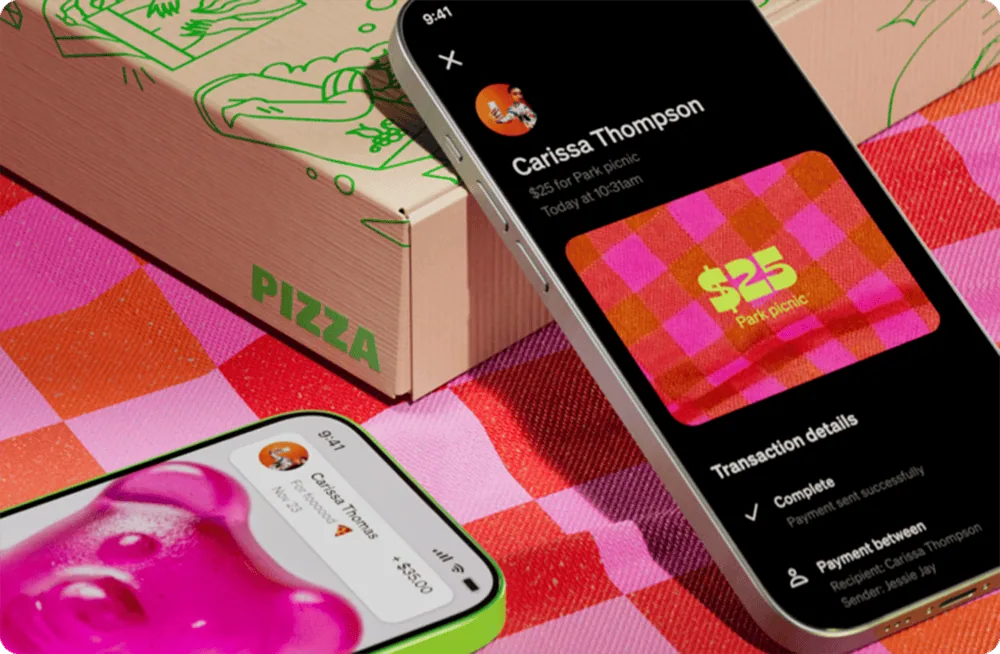
Are your kids too young for Cash App Families’ teen card? No worries—parents can now help their children build good money habits through Cash App Families Managed Accounts.
Cash App managed accounts, designed for kids ages 6 to 12**, are a fully parent-managed money experience that’s designed to make learning about money fun, simple, and safe. There are no subscription fees, no minimum balance requirements, and no hidden charges.
The app enables parents to teach their kids responsibility and consistency by setting up automatic recurring allowances, while kids can track their allowance, savings, and spending in one easy view. Kids don’t just store money with Cash App, either—they can watch it grow thanks to high yields on savings balances.¹ And when they’re ready, they can design their very own customizable Cash App Visa® Card, making their first financial tool feel truly their own with the assistance of their parents/guardians.
Parents, meanwhile, will enjoy the peace of mind that comes from a truly robust set of safety features and controls. All account access lives within your own Cash App, inside the Family Applet—your child never logs in independently. You set the rules, and you can change them anytime.
Your child’s profile is private by default—discoverable only by exact $cashtag or QR code, with no photo or avatar visible in search results. But you can add up to five trusted friends or family members to your child’s approved contact list, so only the people you choose can send them money. You can also set spending limits on their debit card, block specific merchants, and instantly lock or unlock their card with a single tap.
And Cash App’s industry-leading safety features extend fully to managed accounts. Advanced fraud and scam monitoring runs 24/7, automatically flagging or blocking unsafe spending categories and notifying you of any suspicious activity.
Parents/guardians must download Cash App (also free) to create the managed account. Use our link to learn more about or sign up with Cash App today.
- Cash App Families Managed Accounts are accounts designed for kids ages 6-12** to learn about, spend, and save money while being protected by a best-in-class suite of parental controls and security features.
- Kids can earn automatic recurring allowances or receive money from close friends and family.
- Kids can spend their money with a customizable Cash App Visa® Card*, or save it and earn a high 3.50% APY on any balance.¹
- Parental controls include setting debit card spending limits, merchant-specific blocking, and instant card lock/unlock.
- Safety features include real-time transaction alerts, a tightly managed contact list, and advanced 24/7 fraud and scam monitoring. Also, strangers can't find kids in Cash App search.
- Parents must sign up for Cash App first, which they can do via the link below.
- Free account and Cash App Visa® Card*
- High yield on children's savings balances¹
- Recurring allowance
- Robust parental controls
- Outstanding security features
- Customizable cards ($5+)
- FDIC insurance available on a pass-through basis (if certain conditions are met)***
- No investing feature
Related: 10 Best Money Apps for Teens [Invest, Spend, Budget + Pay]
2. Greenlight (Great Savings Rewards + Cash-Back Rates)
- Available: Sign up here
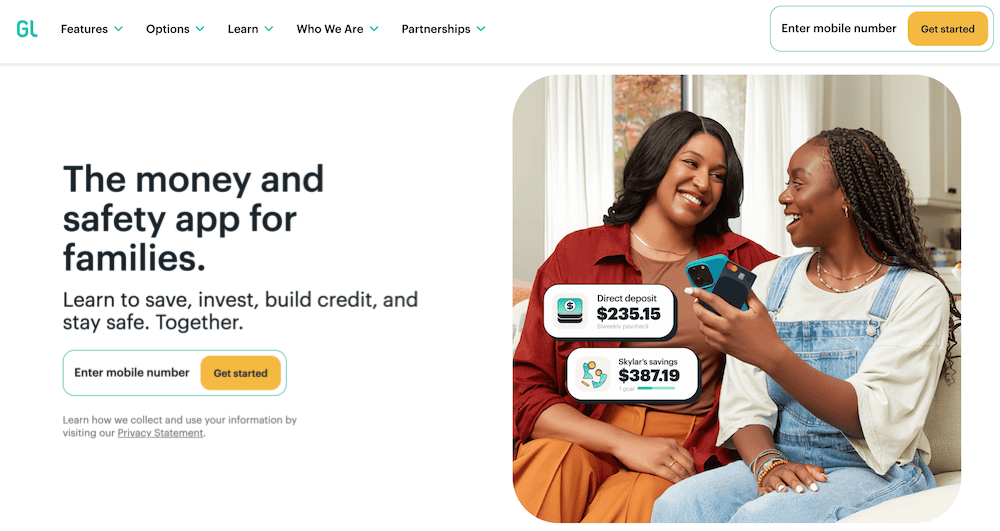
Greenlight, while technically not a savings account, is a family-designed debit card with so many savings features, it trumps many traditional savings products. That includes the ability to earn as much as 5% rewards on savings.
Children can set Savings Goals for specific purposes, whether that’s a new gaming system or college tuition. Then every month, Greenlight calculates your kid’s average daily savings balance, multiplies it by the percent earned annually, and divides it by 12 months to get the monthly reward amount. That amount is deposited proportionally into General Savings as well as any active Savings Goals.
The monthly rewards you can receive on those savings depends on your plan: Core families earn 2% per annum, Max families earn 3% per annum, Infinity families earn 5% per annum, and Family Shield familes earn 6% per annum on an average daily savings balance of up to $5,000 per family.
Also, those in Greenlight Max, Infinity, and Family Shield families can earn 1% cash back on their monthly spending with the kid’s debit card.
Children also can speed up their savings with Round Ups; purchases are rounded up to the next dollar, and the difference is automatically added to their savings.
Want to help your children save more? Parents can set a percentage of allowance to go straight into savings. The allowance can be directly deposited on a schedule or tied to chore completion. Greenlight also offers “Parent-Paid Interest,” where a parent can set an interest rate of anywhere between 1% and 100%, then pay that into the account based on their childrens’ savings. This not only encourages children to save, but also teaches the power of compound interest.
Greenlight also boasts a number of other features for kids and parents alike. For instance, kids will benefit from educational materials, while teens will enjoy direct deposit if they have a job. Parents, meanwhile, enjoy controls such as extremely customizable spending limits—they can let children spend wherever they want, only at certain types of retailers, or even set exact dollar amounts only to be spent at specific stores. You can learn more about Greenlight or sign up here.
- Greenlight is a financial solution for kids that allows them to spend with a debit card, earn money on savings, and even invest their money.
- Greenlight offers flexible parental controls for each child and real-time notifications of each transaction. And it's the only debit card that lets you choose the exact stores where kids can spend on the card.
- Parents can use this app to teach kids how to invest with a brokerage account through Greenlight Max, Infinity, and Family Shield plans.
- Greenlight also provides educational materials such as "Level Up" lessons that simplify investing concepts, as well as videos about their favorite companies.
- Families can earn 2% (Core), 3% (Max), 5% (Infinity), or 6% (Family Shield) per annum on their average daily savings balance of up to $5,000 per family. Also, Max and Infinity families can earn 1% cash back on their monthly expenditures.
- Unlike many apps that simply provide features and controls, Greenlight is also designed to spark discussions with children about spending, investing, and more, fostering a better educational experience.
- Best-in-class parental controls (can prohibit specific stores)
- Can add brokerage account to invest in stocks
- Intuitive Parent + Kid apps
- Competitive cash back & interest rates
- Parent-Paid Interest
- High price points
- No cash reload options
- No parent / child lending
Related: 8 Best Greenlight Alternatives [Cards for Kids & Teens]
3. Chase First Banking (Best Kids’ Debit Card From a Major Bank)
- Available: Sign up here
- Price: Free (no monthly fees)
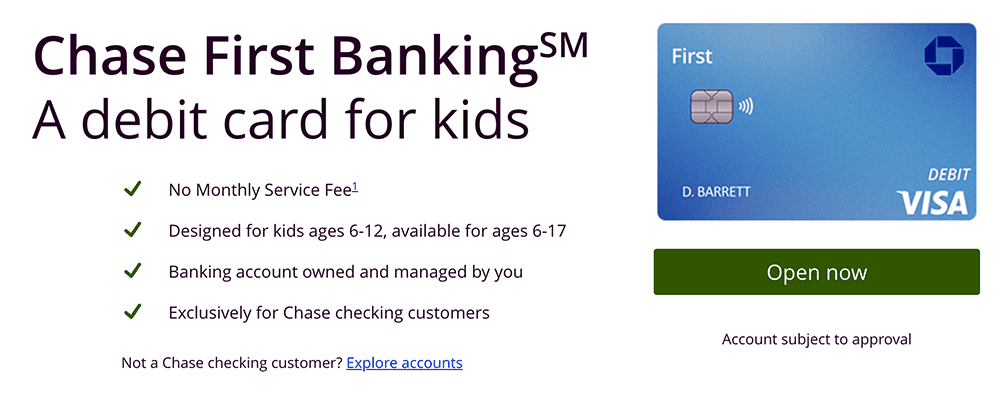
Ready to teach your little ones about earning, saving, and spending money, but not quite sure if you have the time, patience, and/or expertise? Chase First BankingSM offers simple banking for both of you in one location—the Chase Mobile® App—for free.
Chase First BankingSM helps parents teach teens and kids about money by giving parents the control they want and kids the freedom they need to learn. Among the account’s many features?
- One of the best free debit cards for kids and teens—it works anywhere Visa is accepted, and can be used to withdraw money fee-free* from more than 14,000 Chase ATMs nationwide
- Savings goals that you can track via the Chase Mobile® App
- Parental controls, such as setting limits on where and how much they can spend and withdraw from ATMs
- Account alerts that let you know where your child is spending
- Recurring chores and allowance
The account is designed with kids 6-12 in mind, and available for ages 6-17. To get started, you’ll first need to be a Chase customer with a qualifying Chase checking account. If you don’t already have one, consider opening a Chase Total Checking® or Chase Secure BankingSM account to qualify.
- Chase Total Checking® also grants access to thousands of branches and ATMs. You can pay $0 in monthly fees, subject to meeting certain conditions.** And you can collect a $400 new-customer bonus when you make total direct deposits of $1,000 or more within 90 days of coupon enrollment.
- Chase Secure BankingSM offers the same Chase ATMs and branch locations as well as a $125 sign-up bonus when you make stated qualifying activities and meet certain conditions.
Once you open a qualifying Chase Checking account, you may use our link to apply for a Chase First BankingSM account for your child.
- Chase First Banking is a free, just-for-kids banking account that teaches children and teens about their finances through the Chase Mobile® app and a Visa debit card.
- The account is designed with kids 6-12 in mind, and available for ages 6-17.
- Kids can use their debit card anywhere Visa is accepted, and withdraw money fee-free* from thousands of Chase ATMs.
- Parents can enjoy peace of mind by limiting how much and where their children can spend and withdraw money, and set up spending alerts.
- Parents can reward responsibility with allowance transfers, set to repeat on the schedule you choose.
- You must be a current Chase customer with a qualifying Chase checking account to sign up. If you don’t already have one, consider opening a Chase Total Checking or Chase Secure Banking account to qualify.
- Free account
- No monthly maintenance fees
- Chore and allowance functionality
- Parental controls on spend/ATM limit and location
- No paired investment account
- No interest
Related: 9 Best Teen Checking Accounts [Banks for Teens]
4. Revolut <18 (Most Enticing to Children & Teens)
- Available: Sign up here
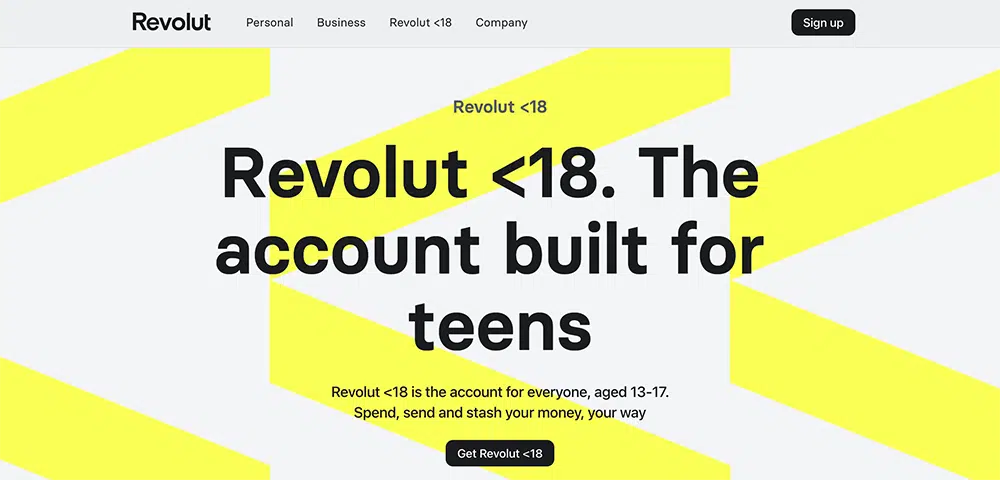
Revolut <18 is a prepaid debit card for kids designed to teach them money skills for life. Aimed at building healthy money habits from an early age, the unique, customizable card¹ empowers parents to have full insight into their kids’ card activity through providing instant spending alerts and parental controls.
You can choose to freeze the card, as well as set controls on how they use the cards online and with contactless payments through your Revolut app. You can also set spending limits on how much your child can use with the prepaid card.
Parents use the card and accompanying app to teach kids about earning, budgeting, saving and even investing money (depending on the plan chosen). You can also use the card to manage chores and allowance, set savings goals as a family, and help your children manage their money.
And if your child did something deserving of a reward? You can send parent-paid bonuses when they complete specific tasks. Simply add money to their digitized piggy bank through the app. You can send and receive money in seconds through Revolut’s payments feature, which allows fast transfers between account holders and also global transfers at transparent rates.
You must have a personal Revolut account before you can open a Revolut <18 account for your children. You can add up to five Revolut <18 accounts per parent account.
To learn more about Revolut <18, visit their site and open an account for yourself and your child.
- Revolut <18 is a prepaid debit card for kids designed to assist parents teach kids ages 6-17 about money. Families can handle chores and allowance, create budgets, set parental controls and more.
- Revolut <18 comes with unique, customizable cards* that parents can use to set up tasks and goals to work on together as a family.
- Prepaid debit card for teens
- Parental controls
- Round-ups
- Chore and allowance management
- Customizable designs (fees apply)
- Children can't load funds, only parents can
- Parents need to have a personal Revolut account

Related: 10 Best Debit Cards for Teens [Reviewed by a CPA + Father]
5. Capital One Kids Savings Account (National Bank Savings Account)

- Available: Click “Open Account” below
If you’re looking for a traditional experience, the Capital One Kids Savings Account is one of the best accounts available nationwide.
The Capital One Kids Savings Account requires no minimum balance to open, charges no monthly service fee, and can be opened at any age. Just note that if the child is younger than age 12, the adult has to be a parent or guardian.
It’s simple to link a parent’s bank account (and doesn’t have to be Capital One!) to a Kids Savings Account and send automatic deposits. Young adults old enough to have a job, or kids who receive checks as gifts from family members, can make mobile deposits with photos of their checks.
APYs are always subject to change. However, Capital One consistently maintains a high APY to help children earn more, and the current APY on the Kids Savings Account is higher than the national savings average.
While many other top savings accounts for kids are online-only, Capital One is one of the few nationwide providers that offers physical branches.
When children become adults, their Kids Savings Account automatically changes into a 360 Savings account.
Related: 10 Best Prepaid Debit Cards for Teens & Kids [Reloadable]
6. Axos Bank First Checking (Best Free Teen Checking Account w/Interest)
- Available: Sign up here
- Price: Free (no monthly fees)
Axos First Checking is a free joint bank account for teens and adults offered by Axos Bank—an online-only bank with a focus on technology-driven finance.
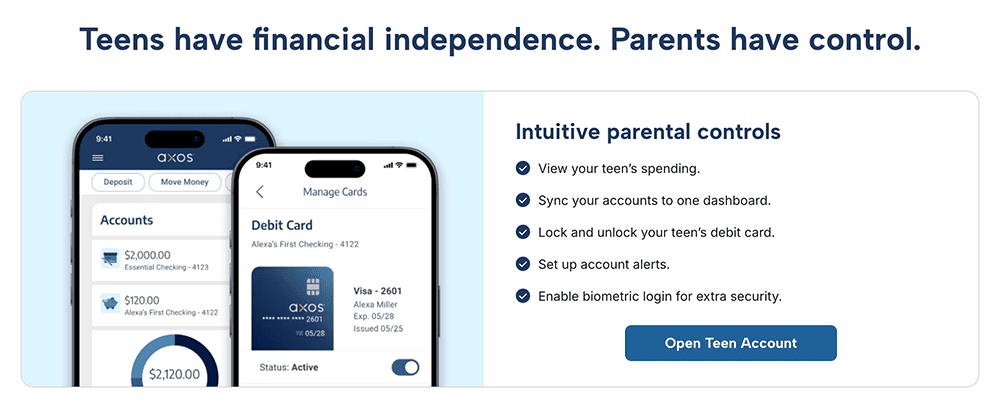
First Checking offers teens and their parents (or other adult owners of the account) a free debit card, peer-to-peer transfers, direct deposit, bill pay, extensive security features, even interest payments.
The Axos First Checking account comes with a debit card—you can choose either Visa or Mastercard—that you can use to spend in store and online, as well as to withdraw cash. While Axos Bank doesn’t have its own ATM system, Axos offers fee-free access to 91,000 ATMs nationwide, and it reimburses up to $12 in third-party ATM fees every month.
If you’re worried that your (or your teen’s) card is lost or stolen? You can lock and unlock the card from your Axos account. And the card limits cash withdrawals to $100 daily and debit transactions to $500 daily.
Axos First Checking charges zero monthly maintenance fees, overdraft fees, and non-sufficient fund fees. It’s designed for teens between ages 13 and 17 (up to 18 years old in Alabama). And once your teen reaches adulthood, it’s easy to convert to another Axos checking account, giving the newly minted adult full control.
Read more in our Axos First Checking Account review.
- Axos Bank First Checking is a joint checking account targeted for teenagers ages 13-17 and their parents.
- Account holders get a Visa or Mastercard debit card that can be used to spend online or in person, or to withdraw cash at any ATM. (Axos provides up to $12 in monthly domestic ATM fee reimbursements.)
- No monthly maintenance, overdraft, or non-sufficient fund fees.
- The debit card's security features include account alerts, card locking, and daily transaction alerts of $100 (cash) and $500 (debit).
- Currently, you can earn up to 0.10% APY on any balance.
- Free (no monthly maintenance fees)
- ATM fee reimbursements (up to $12 per month)
- Converts to adult checking account after minor reaches age of majority
- No paired investment account
- No robust financial literacy resources

Related: 5 Best Investment Accounts for Kids [Child Investment Plans]
7. Current (Best for Transferring to Adulthood)
- Available: Sign up here
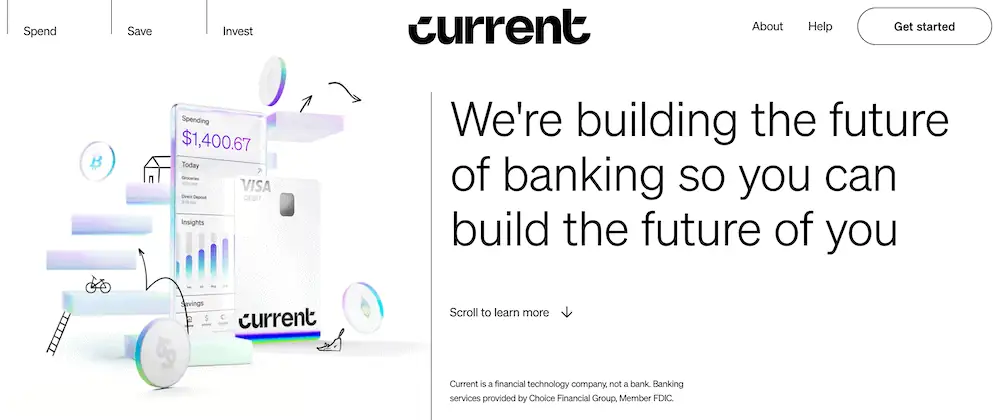
Current is a financial app designed for families that charges no monthly fees. It offers both Current Accounts (parents) and Teen Accounts, with the latter acting like prepaid debit cards that parents load for their children. Still, while it acts like a checking account/debit card in some ways, the Current app has a number of features that make it seem like a high-powered savings account, too.
Current Account users get three virtual Savings Pods, which can hold up to $2,000 each and have no restrictions on how often money is moved in and out of the Pod. Each Teen Account also gets a virtual Savings Pod. At the moment, Savings Pods earn an annual percentage yield (APY) of up to 4.00%, which is higher than even top high-yield savings accounts. Payments are applied to the balance daily. (Just note that bank interest rates change, so you should always confirm account yields before signing up. Also, Teen Accounts do not earn an APY on Savings Pods.)
Another savings feature: Account holders can use Round-Ups to round purchases to the nearest dollar amount, then store the difference in Savings Pods.
Other noteworthy Current features include:
- Track your teen’s spending in real-time, set limits on how much your children can spend, and even block specific merchants on Current’s Visa-enabled debit cards.
- Get paid up to two days early when you enroll in direct deposit. (Current Accounts only.)
- No minimum required balances, no fees on transfers to other Current and Teen Accounts, and no hidden fees.
- Earn up to 15x points, which can be redeemed for cash, when you swipe with more than 14,000 participating merchants. (Current Accounts only.)
- Giving Pods that allow your children to donate to charities of their choice.
- Withdraw money fee-free from more than 40,000 Allpoint ATMs across the country.
- Buy and sell 27 different cryptocurrencies with zero trading fees.
Teens will love easy allowance deposits, a card they can use in stores or online, and instant gas hold removals when buying gas. They’ll also have the opportunity to learn about financial responsibility and financial independence through Current’s Budgets feature, which allows them to track their spending and even receive alerts when they get too close to (or exceed) a predetermined limit.
This mobile banking app has no specifically stated minimum age requirement, but the marketing suggests teens are the target audience. However, you might be able to open an account for a younger child.
Once they’ve reached adulthood, your children can enjoy many of the same perks with a standard Current Account.
- Current is a financial technology platform that lets teens enjoy not just traditional banking basics, but numerous features meant to simplify spending, streamline saving, and set them on the path toward more organized finances.
- Teens can spend with the Current Visa debit card, which allows them to purchase in-store and online, as well as withdraw money fee-free from more than 40,000 in-network Allpoint ATMs.
- Current Teen Accounts also come with Savings Pods, which earn 0.25% APY and allow you to round up purchases (overages are funneled into your savings). Keep a qualifying direct deposit of $200 or more in your account, and you'll earn a full boosted rate of up to 4% annually.
- Parents can monitor their kids' spending, adjust maximum ATM withdrawal and spending limits, and even toggle spending categories (and the Current debit card itself) on and off.
- Parents can also automate allowance payments, pay for chores, instantly transfer money to their teens, and more.
- Free account (no monthly maintenance fees)
- Good parental controls
- Fee-free ATMs
- Cash reloads
- Gas hold deposits
- 24/7 email and live-chat support
- No direct deposit
- No paired investment account
- No card customization

Related: 10 Best Free Debit Cards for Kids & Teens [Earn, Save & Spend]
8. USAlliance MyLife Savings for Kids Account (Credit Union Account)
- Available: Sign up here
Some parents might prefer to get their child’s first savings account via a credit union. A credit union offers many of the same products as a bank, but whereas banks are run for profit, credit unions are not-for-profit organizations where the earnings are typically reinvested to provide better rates to their customers.
The USAlliance MyLife Savings for Kids Account is one of the kid-friendliest accounts among credit unions, including a birthday bonus among its various perks. USAlliance will deposit $10 in “Birthday Bucks” into your child’s account through age 12.
At age 13, the child can transition to a MyLife Savings account, or if they’d prefer an account with a debit card, a MyLife Teen Checking account.
This FDIC-insured account also includes a very competitive APY boost (currently 2.00%) on the account’s first $500 to further encourage your child to save, though savings above the $500 threshold deliver an APY below the national average.
Children can monitor their savings from a mobile device or a computer.
One hurdle for joining credit unions is that they’re typically local in nature. Indeed, Rye, New York-based USAlliance Financial largely serves New York state, New Jersey, Massachusetts, and Connecticut, and membership is largely determined based on living, working, or some other connection to those places. However, USAlliance has an interesting end-around for people who don’t meet those criteria; you can also qualify for USAlliance membership by becoming a member of one of several local nonprofits.
9. BECU Early Saver Youth Account (Competitive Interest Rate from a Credit Union)
- Available: Sign up here
BECU, originally the Boeing Employees Credit Union, was founded back in 1935 to serve workers at the aviation company. However, the credit union has since expanded membership to many more communities, employment connections, and membership associations, across Washington state, Oregon, and Idaho.
The BECU Early Saver Youth Account offers an extremely high APY (currently 6.17%) on your child’s first $500 saved, and an above-average APY (0.50%) on any balances over that. The account has no required minimum balance, and it charges no monthly fees.
Parents with a credit union account can make automatic transfers into their kid’s savings accounts.
Once the child turns 18, the account converts into either a standard savings account or checking account, and they will continue to earn the high interest rate on their first $500. It can remain a joint account with the parent or become an individual savings account.
Like with most credit unions, the parent must be eligible for a credit union membership to open an Early Saver savings account. If you’re outside BECU’s region, we recommend reviewing youth savings accounts at local credit unions.
- The BECU Early Saver Youth Account is a fee-free, no-minimum-balance savings account with extremely high low-balance savings rates and an attractive APY across all balances.
- Early Saver accounts come with a free ATM card that can be used to withdraw or deposit cash.
- No monthly fees
- Free ATM card
- Extremely high savings rates (6.17%) on first $500
- Reasonable savings rates (0.50%) after first $500
- Small, regional network of branches and ATMs
- Online banking not available to children under 13
- Must meet regional qualifications to become a member

Related: Best Bar Mitzvah Gift Ideas
Other Financial Accounts for Kids
10. Acorns Early (Best for Customer Service)
- Available: Acorns Early Lite | Acorns Gold
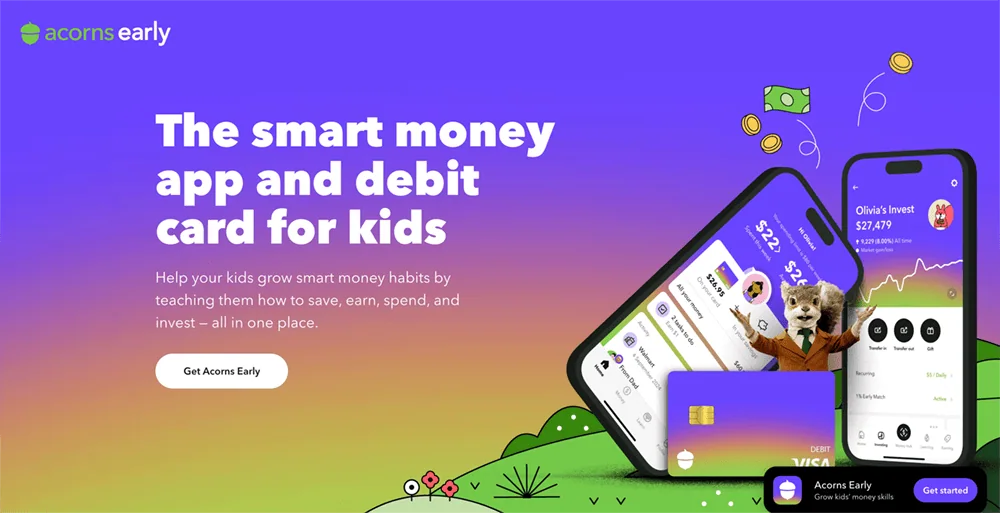
It might feel a little scary opening a bank account for your child and letting them start to make financial decisions. Fortunately, the member services team at Acorns Early is available for any assistance you need, every day of the week, via phone or live chat.
Acorns Early is a financial solution tailored for minors age 6 to 17 that includes an app, prepaid debit cards, and even financial lessons. Parents enjoy some peace of mind thanks to parental controls such as real-time spending notifications, card lock/unlock, adjustable spending limits, and more.
Acorns Early is also dedicated to teaching your kids financial literacy by hosting educational materials to help children and teens alike develop good money habits. One of the more impressive aspects of the program is that it’s explicitly segmented into different age groups, starting with money basics for kids in single-digit ages, then becoming more advanced over time, so the lessons really appear to grow as your children do.
Acorns Early offers a number of ways to fund the account. Parents, of course, can send money in a pinch whenever they want with instant transfers. They can also set up a regular allowance, or tie payment to chores. (And parents get to approve chores before they pay out—no half-done dishes allowed.) Teens can also receive ACH deposits from their employers. And loved ones can either get “Relative accounts” that allow them to send money to your kids, or they can send money via Acorns Early “Giftlinks,” which act similarly to an e-gift card.
Acorns Early has no minimum age requirements but recommends starting at age 6 or older. Parents have two ways of signing up for Acorns Early:
- Sign up for Acorns Early Lite. This subscription level provides you with everything mentioned above for up to four children.
- Sign up for Acorns Gold. Acorns Gold is the top Acorns subscription tier for adults, and it provides a wealth of banking, investing, and other features. However, it also includes a subscription to Acorns Early (again, good for up to four children), and it unlocks Acorns Early Invest: a UGMA/UTMA custodial account you can use to invest for your kids’ future.
Acorns frequently offers small bonuses for anyone who signs up with our links. You can check out current offers in the box below, or read more about this app in our Acorns Early review.
- Acorns Early is a debit card and financial app designed to provide education, experience, and confidence in saving, spending, and earning, to kids ages 6-18.
- Accounts come with a smart money app and up to 4 Visa debit cards, which allows your kids to spend in stores and online, and withdraw money from ATMs.
- Kids can also earn allowance, complete chores for money, set savings goals, even give to charity.
- Parents can rest easy knowing there are plenty of guardrails in place, including chip-and-PIN technology, fraud protection, and parental controls such as spending notifications, card locking, and adjustable spending limits.
- Acorns Early also provides educational resources tailored for kids of all ages, as well as sterling customer service (including everyday phone availability and 24/7 chat).
- All of the above is available via the Acorns Early Lite subscription.
- An Acorns Gold subscription delivers everything in Acorns Early Lite, as well as access to Acorns Early Invest (a UGMA/UTMA custodial account where you can save toward your kids' future and get a 1% match on up to $7,000 in contributions annually). Parents also enjoy banking and investing features such as an IRA with a 3% match for your first year, a high APY on emergency savings, Acorns' "Round-Ups," and more.
- Special offer (1): Get a free 30-day trial and $5 allowance when you sign up for Acorns Early Lite.
- Special offer (2): Get a $20 bonus investment when you sign up for Acorns Gold.
- Strong parental controls (including card-use controls and adjustable spending limits)
- Chores and allowance
- FDIC insurance
- Allows for ACH payments
- Convenient "Giftlinks" for non-accountholders to give money to kids' accounts
- Customizable cards (with fee)
- Must sign up for Acorns Gold to get investing
- No fee-free ATM network
What Is a Kids Savings Account?

A kids savings account is similar to a standard savings account at banks or credit unions in that it allows people to store their money safely, and it typically pays interest on the money in the account to help the funds grow.
Some adults just open a standard joint savings account for their child. However, the best savings accounts for kids offer far more features.
A kids savings account will often come with parental controls that let adults view transactions and limit how much money minors can spend and what locations are allowed. It also might come with an attached ATM or spending card so children can begin to practice responsible use of the account.
These accounts also should make it easy for parents to set automatic transfers from their own savings or checking account to their kids’ savings accounts—say, for allowances—or have payments triggered by chore completion.
You’ll also find savings bonuses in many kids savings accounts. For instance, banks, credit unions, and other financial firms might offer higher-than-standard interest rates on small balances to incentivize savings. Some accounts even let kids “round up” purchase amounts, with the rounded-up amount automatically sent into savings.
Ultimately, the best savings account for you and your child will tackle the basics while delivering at least a few features.
What Features Should You Consider in a Kids Savings Account?
Fees
The best savings accounts for kids charge little or no fees. Considering that kids savings accounts typically don’t contain much money in the first place, fees can substantially cut into savings. If you’re looking for a purely savings-only account, only consider one with no or very limited fees.
Interest rates
The interest rates for a kids savings account will vary significantly. But in general, the higher the interest rate (often referred to as the annual percentage yield, or APY), the faster it will help your child’s money grow.
Minimum opening deposit
A minimum opening deposit is a typically small amount of money (say, $25, $100) you need to fund the account when you open it. However, the best savings accounts for kids have a low (or no!) minimum. The sooner you open a savings account, the more time your child’s money has to compound, so don’t wait around saving for an account with a high minimum opening deposit.
Minimum balance requirement
Sometimes a savings account or checking account will charge a fee if the account balance dips below a predetermined number. This minimum balance requirement typically will be low, too—for example, Alliant Credit Union requires an daily average minimum balance of $100 in its high-yield savings account. Minimum balances can be determined in several ways, be it an average monthly balance or sometimes a daily required balance. But in general, given the low dollar amounts your children will be saving, we recommend avoiding savings accounts that penalize your child for a low balance.
Additional banking services
Always review additional banking services provided by the bank or credit union. This can be anything from online banking or easy transition to adult accounts, to parental controls or integration with Apple Pay and Google Pay.
Mobile banking app
Children and teens today are accustomed to being able to do anything from their phones that can be done on a desktop. Banking is no different. Your kids should be able to access their savings accounts from a user-friendly mobile banking app.
Connection with parent bank account
If a parent already banks with a credit union or bank that offers a top kids savings account, it’s easy to stick with that bank. Banking under the same provider means the parent doesn’t have to open a new account for themselves, it should be simpler to transfer money between accounts, and the adult should already be familiar with the banking interface.
However, not all major banks offer special savings accounts for kids, so having a connection with a parent bank account isn’t a realistic option for all people.
Financial literacy content to teach basic money concepts
Kids need to build financial literacy skills, but not all parents have the time and expertise to fully teach their children these skills. Fortunately, some banking apps provide financial literacy content to help kids learn the basics.
Gifting features
Grandparents and other relatives usually are interested in contributing to a child’s savings account. Top banks and credit unions make it simple for multiple people to contribute directly, so everything doesn’t have to go through the parents.
Automatic savings plan
Consistency is an essential part of saving. Using an automatic savings plan, adults can automatically transfer funds from a checking account into a youth savings account. These automatic transfers ensure you never forget to set money aside.
Mobile deposit
Whether it’s a celebratory check from a family member or a teen’s paycheck, mobile deposit lets kids and their parents skip a trip to the credit union or bank. A quick photo, and the money goes right into a savings or checking account!
How Can I Open a Bank Account for My Child?

Opening a bank account for your child is simple. Often, you can apply online with just basic identification information, such as your kid’s birthday and Social Security number. If your bank or credit union has a physical location, you can sign up in person. (And a handful of credit unions still require in-person sign-up.)
Some institutions require an adult to have an account with the institution before creating a youth savings account. Additionally, some accounts require a minimum deposit to get started.
You are usually allowed to open multiple accounts if you want to bookmark money for different purposes, such as one account for recreational spending and another account for saving up for a car.
Do You Pay Taxes on Children’s Savings Accounts?
The money in a kid’s savings account earns interest, which is considered “unearned income.” If the unearned income (the interest or dividends if it’s an investment account) from your child’s account is less than $1,350 (as of 2025), no taxes need to be paid on that money.
If it’s higher than $1,350, the next $1,350 is taxed at the child’s tax rate, which is often 0%, meaning taxes aren’t paid on that amount either. However, if your child accumulates more than $2,700 in unearned income in a year, that money is taxed at the parents’ tax rate.
What Is the Best Kids Savings Account?
The best savings accounts for kids have little to no fees, high interest rates, and ample kid-friendly features that differentiate them from adult savings accounts. Consider the banks and credit unions above as these have many useful features, such as automatic allowance payments, payment roundups, important parental controls, and more.
If your local bank offers a competitive children’s savings account option, that might be the easiest choice. For many, online banking accounts do the job just fine.
Related:
- Best Custodial Accounts: How to Start Investing for Kids
- 7 Best Investments for Kids [Investing for Children]
- The 7 Best Index Funds for Beginners
Disclosures
Revolut <18
1 Customized cards may require fees.
Cash App Families
Cash App is a financial services platform, not a bank. Banking services provided by Cash App’s bank partner(s). Prepaid debit cards issued by Sutton Bank, Member FDIC. Cash App Visa® Debit Flex Cards issued by Sutton Bank, Member FDIC, and The Bancorp Bank, N.A., pursuant to a license from Visa U.S.A. Inc. See terms and conditions for the Sutton prepaid card, Sutton debit flex card, and Bancorp debit flex card. Savings provided by Cash App, a Block, Inc. brand.
* Card use fees apply. Free Cash App Cards come in black, white, pink, or glow-in-the-dark.
** Parents and legal guardians can open a managed account for kids 6-12. To view the eligibility requirements for sponsoring a teen or child, please visit the Sponsored Accounts section of the Cash App Terms of Service.
*** With a Cash App Card, your money is eligible for FDIC pass-through insurance through Wells Fargo Bank, N.A., Sutton Bank, and/or The Bancorp Bank, N.A., Members FDIC, for up to $250,000 per customer when aggregated with all other deposits held in the same legal capacity at each bank, if certain conditions are met. See the Cash App Terms of Service.
Cash App is a financial services platform, and not an FDIC-insured bank. Prepaid debit cards issued by Sutton Bank, Member FDIC. Cash App Visa® Debit Flex Cards issued by Sutton Bank, Member FDIC, and The Bancorp Bank, N.A., pursuant to a license from Visa U.S.A. Inc.
1 Cash App will pass through a portion of the interest paid on your savings balance held in an account for the benefit of Cash App customers at Wells Fargo Bank, N.A., Member FDIC. To earn interest on your Cash App savings balance, you need to have sponsor approval. Exceptions may apply. Savings yield rate is subject to change.