
The Vanguard Total Stock Market ETF (VTI) and the Vanguard Total Stock Market Index Fund (VTSAX) are commonly confused for each other.
That’s in part because they largely reflect similar underlying investment holdings. Not to mention, both of these investment funds have gained prominence for their diverse holdings of U.S. stocks, low fees, and utility as core positions in any investment portfolio.
However, while these Vanguard funds do share quite a bit in common, they aren’t exactly the same and can’t be spoken about interchangeably.
Keep reading for a breakdown of both VTI and VTSAX, including their similarities, key differences, and how you can invest in them.
Table of Contents
What Is VTSAX?
The Vanguard Total Stock Market Index Fund (VTSAX) is a large-blend mutual fund centered around the U.S. market. It is passively managed; rather than being run by human fund managers, it tracks a rules-based index that determines what stocks the fund should hold.
Specifically, VTSAX tracks the CRSP U.S. Total Market Index. That’s a combination of large-, mid-, and small-cap stocks. (“Cap” is short for market capitalization, which measures a company’s size by multiplying its stock price by its number of shares outstanding.) At the moment, VTSAX allocates roughly 70% of assets to large companies, 20% to midsized firms, and the remaining 10% to smaller businesses.
This index fund represents almost 100% of the U.S. investable equity market and is the world’s largest index fund at around $2 trillion in assets.
Vanguard Total Stock Market Index is a market cap-weighted fund, which means the larger the company, the more assets are used to invest in that company’s shares (and thus the more influence those stocks have on the fund’s performance). As a result, the largest holdings right now include Nvidia (NVDA), Microsoft (MSFT), and Apple (AAPL). From a sector perspective, VTSAX allocates the largest percentage of its assets (about a third) to technology stocks, though it also has significant weights in consumer discretionary, industrial, and financial companies.
VTSAX has virtually no exposure to international stocks, but many of the companies represented in the index are American multinationals that do a great deal of business overseas. For example, major technology and tech-related companies like Nvidia, Microsoft, and Google parent Alphabet (GOOG, GOOGL) generate significant portions of their revenues internationally. So in an indirect way, they still provide some exposure to international economies.
The risk level of VTSAX is comparable with the S&P 500, though you can check out my more thorough comparison of VTSAX vs. VFIAX (Vanguard’s S&P 500 index mutual fund) for how they differ further.
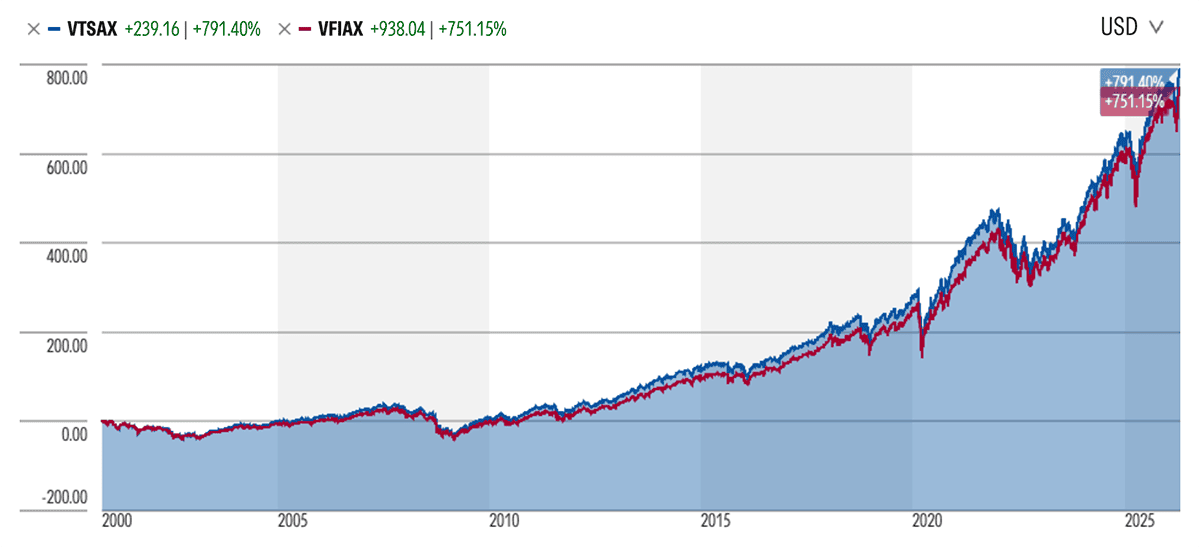
Below, you can see the total return (price plus dividends) performance of VTSAX since the fund’s inception in 2000, compared to the S&P 500, using the Vanguard 500 Index Fund Admiral Shares (VFIAX) as a proxy.
→ VTSAX vs. S&P 500 Performance Since Inception
What Is VTI?
The Vanguard Total Stock Market ETF (VTI) is an extremely well-diversified, market capitalization-weighted index exchange-traded fund (ETF) that measures the whole investible U.S. equity market that was created in 2001.
More importantly: It’s simply the Vanguard ETF share class of Vanguard Total Stock Market Index Fund.
In other words, the two funds are virtually the same.
Like VTSAX, VTI tracks the CRSP U.S. Total Market Index, which means it holds large-, mid-, and small-cap companies. Its shares account for about $560 billion of the strategy’s overall assets under management, making it one of the largest ETFs today.
This Vanguard index fund is by definition also passively managed. It boasts a very low expense ratio (its annual cost) as well as a low turnover rate (the rate at which a mutual fund or ETF replaces its investment holdings on a yearly basis). These features makes VTI an ideal holding for just about any type of investment account, and one of the best ETFs for beginners.
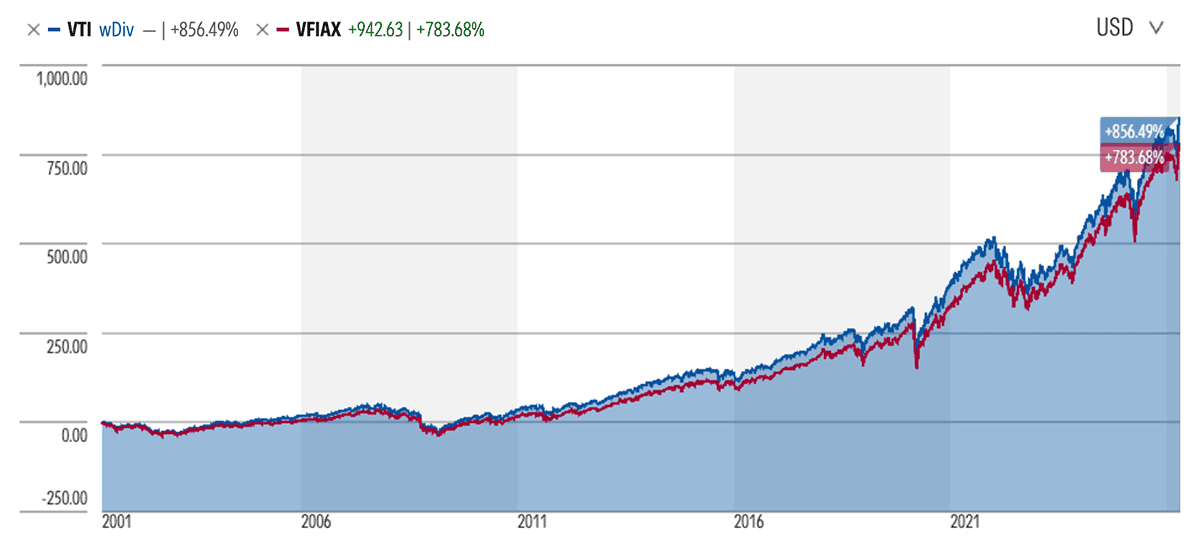
Unsurprisingly, VTI’s performance is very similar to VTSAX’s since its inception in 2001.
→ VTI vs. S&P 500 Performance Since Inception
Why Do Investors Choose VTI and VTSAX?
While it might seem advantageous to start investing money in individual stocks on your own, there are benefits to investing in index funds.
Like all investments, VTSAX and VTI carry the inherent risk of loss associated with owning assets that follow the stock market during major market volatility. In other words, when the broader stock market turns negative, the funds’ underlying assets can decline in value, dragging the funds down with them.
Still, because VTI and VTSAX (and similar investments) come with built-in diversification, they involve less risk than individual stocks and bonds.
While you can’t capture alpha (outperforming the market) like you might with the individual stocks you’d find using the best stock research apps and software, you also won’t do worse than it.
You could take the time to analyze countless individual stocks and morph them into your ideal portfolio with a service like M1 Finance, or invest in some stock picking services to attempt to beat the market. But purchasing VTI or VTSAX is, if nothing else, simpler.
Of course, you could also do both, holding VTI or VTSAX to form the core of your portfolio, then try to outperform by supplementing your portfolio with individual stocks.
Other Top Investment Opportunities to Consider
Check out some of these other investment options for a complete listing of every fintech-enabled investment opportunity popping up. They might represent some of the best assets to buy for your portfolio.
|
Best Real Estate Investing Platform

|
Best CRE Investing Platform for Accredited Investors
|
Private Market Investing

|
|
Primary Rating:
4.3
|
Primary Rating:
4.2
|
Primary Rating:
3.8
|
|
Minimum Investment: $10. Fees: Fundrise: 0.15% annual advisory fee. Fundrise Pro: $10/mo. paid monthly, or $99/yr. paid annually.*
|
Minimum investment: $5,000.
|
Minimum investment: Varies, as little as $10 for some products.
|
What Are the Similarities Between VTI and VTSAX?
In 1975, investor John “Jack” Bogle founded Vanguard, which ultimately created VTSAX in 2000, then its sister ETF, VTI, in 2001.
When you look at the commonalities between VTI and VTSAX, it becomes clear why people often mistake one for the other. They’re the same fund; one is just in mutual fund form, while the other one is in ETF form. Bogle believed it’s better to follow the stock market than to fight it, hoping to capture some alpha from choosing individual securities. Hence, many of Vanguard’s best funds are index funds like VTSAX and VTI.
VTI and VTSAX both track the CRSP U.S. Total Market Index and cover nearly the entire U.S. stock market. As of May 1, 2026, VTSAX’s shares boasted roughly $425 billion of the strategy’s $2 trillion in assets, while VTI accounted for another $560 billion.
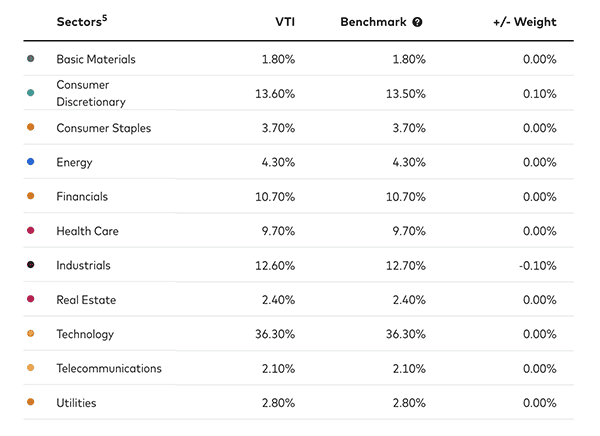
They both hold roughly 3,500 stocks. The technology sector accounts for about a third of each fund’s assets, followed by double-digit weightings in consumer discretionaries, financials, and industrials.
To get a sense for how their holdings vary by sector, have a look at the following chart for both VTSAX and VTI (updated as of 6/30/2023):
Meanwhile, here are the top 10 holdings for both VTSAX and VTI.
| Company | Ticker | Weight |
|---|---|---|
| Nvidia | NVDA | 6.41% |
| Apple | AAPL | 5.93% |
| Alphabet | GOOG / GOOGL | 4.77% |
| Microsoft | MSFT | 4.37% |
| Amazon | AMZN | 3.20% |
| Broadcom | AVGO | 2.33% |
| Meta Platforms | META | 1.99% |
| Tesla | TSLA | 1.66% |
| Berkshire Hathaway | BRK.B | 1.36% |
| Eli Lilly | LLY | 1.24% |
As for the specific similarities between VTI vs. VTSAX, consider the following items:
- Very similar expense ratios, with VTI at 0.03% and VTSAX at 0.04%.
- Extremely similar returns over equivalent periods of time.
- These income-generating investments have identical yields: 1.2% (as of May 1, 2026). You can choose to reinvest this passive income.
- Vanguard still assesses a $25 annual account service fee if your account with them has less than $10,000 in assets invested. However, you can avoid this fee simply by going paperless and opting for digital communications.
- These are solid options for investors who don’t want to pick out a bunch of individual stocks.
In almost all dimensions, the two funds are identical. However, as you’ll learn in the next section, while VTI and VTSAX have many similarities, there are a few key differentiators.
What Are the Differences Between VTI and VTSAX?
→ Price
Again, VTI charges 0.03% annually, while VTSAX charges 0.04%. That means you pay 30¢ for every $1,000 you invest in VTI, but 40¢ for VTSAX. Both are among the cheapest fees you’ll pay for this kind of exposure. But over time, VTI will let you keep a little more of your returns. With enough money invested and enough time in the market, that can translate into a few thousand dollars in extra eturns over time.
→ ETF vs. Mutual Fund
The clearest distinction between VTI and VTSAX is that VTI is an ETF while VTSAX is a mutual fund.
ETFs trade like stocks do with real-time pricing while the stock market is open. However, a mutual fund’s price settles at the end of market trading each day. Its net asset value (NAV) is calculated based on the buy and sell orders put in place since the last settlement date. This means on any particular day, you receive the same price as anybody else, regardless of what time of day you put in your order. It also means you won’t know the exact amount you pay until the trading day has finished.
Depending on your stock trading platform (consider some of these best Robinhood alternatives if you want a self-directed, zero commission broker), you might or might not have to pay a trading fee with an ETF. If you want to trade more quickly, an ETF represents the better option because it establishes better price certainty and timing on execution.
However, if you want to make a long-term investment without much dependence on market timing, the difference is negligible.
Access is perhaps the biggest difference here. Most 401(k)s don’t permit investors to hold ETFs, so VTSAX might be the only way you can invest in Vanguard Total Stock Market Index. However, some investment apps don’t permit investors to hold mutual funds, so VTI might be your only point of access.
→ Automated Investing
Another factor to consider is that sometimes with mutual funds, enrollment in automated investing can be easier because mutual funds do not have a set price level for additional investment. In other words, you do not need to set aside a specific amount of money per share like you might when buying a share of an ETF or stock because mutual funds trade on fractional shares.
For example, if you had $50 to purchase a share of a mutual fund but its price was $100/share, you could purchase half of a share with your $50. With an ETF, if it trades at $150 and you have $2,000 set aside for investing, you can’t put the full $2,000 in the ETF.
With most brokerages, you can invest $1,950 of that sum by purchasing 13 shares in the ETF, but you would either have to save the remaining $50 or invest it in a handful of penny stocks.
Now, some fintech investing services like M1 Finance allow you to purchase fractional shares in stocks and ETFs. It works when the service breaking shares into 1/100,000th of a share, thereby allowing you to trade specific dollar amounts which can better match your portfolio targets.
However, some mutual funds still have minimum initial investment thresholds established by the fund companies and are not something a discount broker can overcome.
For example, the minimum investment to purchase VTSAX is $3,000, which may be intimidating to new investors. Once you’ve hit the minimum, you can invest any amount over it that you want.
VTI has no minimum initial investment beyond the cost of purchasing one share. You simply have to buy at least one share at the current market price. At the time of this writing, VTI costs around $355. That’s much more accessible for many investors.
Related: Best Investing Apps for Teens Under 18 [Stock Trading Apps]
→ Tax Efficiency
Generally speaking, ETFs have greater tax efficiency than mutual funds. In this case, VTI would count as a more tax-efficient investment than VTSAX.
The primary reason for this involves the nature of how the fund structures investor share balancing, specifically whether the fund counts as an open-ended or closed-end fund:
- Open-ended vs. closed-end fund. Mutual funds and ETFs are either: open-end—meaning the investment trades between an investor and the fund with a limitless number of shares available to the investing public; or closed-end—the fund issues a fixed number of shares for public investment, regardless of investor demand.
When an investor sells shares in a mutual fund, such as VTSAX, the investor sells the shares back to the fund (open-end), causing the fund to redeem the shares and sell the underlying assets to provide the investor with cash equivalent to the investment. Alternatively, mutual funds can keep cash on hand to avoid selling the underlying assets at an inopportune time.
Regardless, this sale counts as a taxable event to the investor and can trigger capital gains to other holders of the mutual fund when the fund realizes net capital gains from the sale of fund shares during the calendar year.
Additionally, the investor may have to pay capital gains taxes on a proportionate share of the fund’s capital gains realized during the year. In the event the mutual fund sells securities for a net profit (meaning the gains cannot be offset by losses), the law requires the mutual fund to distribute these capital gains to shareholders. Typically, these capital gains distributions occur toward the end of the year as the fund may generate offsetting losses toward the end of the year, thereby avoiding distributing these capital gains to investors.
With ETFs, on the other hand, assets trade person-to-person as opposed to person-to-fund like with most mutual funds (closed-end). Therefore, when someone sells, the fund doesn’t need to sell the underlying assets and redeem the shares.
The best target-date funds also encounter this same tax efficiency dynamic depending on whether they are structured as ETFs or mutual funds.
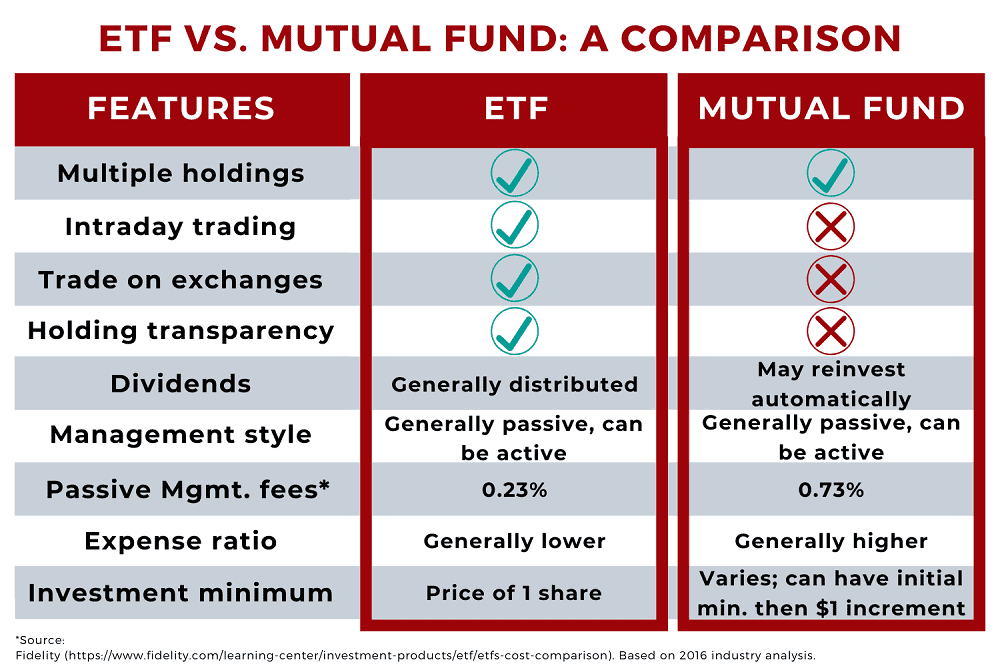
To get a better sense of how ETFs and mutual funds compare, have a look at the infographic I created below.
The difference becomes fairly negligible if you plan to hold either as a long-term investment. The logical question you’re likely asking yourself right now is, “Which should I invest in?” Fortunately, because you’re likely to see very similar returns, this isn’t a question to stress yourself out about too much. To decide, ask yourself a few questions, including:
- Am I investing long-term or short-term? If long-term, either works. For short-term, VTI may be better, but both are ideally long-term to build wealth.
- Do I want to dedicate a specific sum to my investment or do I mind it being slightly higher or lower depending on share price? If you can adjust the amount you invest, either works. If there is a specific amount you set aside, VTSAX may be better because of the fractional share purchasing opportunity presented by mutual funds unless you invest with a service like M1 Finance which allows fractional share purchases on stocks and ETFs.
- Do I currently have at least $3,000 to invest? If yes, either works. If no, you can only invest in VTI.
Remember that, while both VTI and VTSAX are historically some of the safer investments over long periods of time, there is still a degree of risk always involved when investing in the stock market.
With that risk often comes gains much more significant than that of a high-yield savings account or even Certificates of Deposit (CD) (both recommended as some of the best short-term investments for young investors), but this money isn’t insured like money put into savings. Carefully weigh the risks and benefits.
If you already know you want to invest in VTI or VTSAX, your next step is deciding what platform to invest through. With this question, you quickly learn that another difference between VTI and VTSAX is that you’re able to invest in VTI through many more trading platforms than VTSAX.
Related: 8 Best Debit Cards for Teens [Reviewed by a CPA + Father]
Track Your Net Worth with Either Fund Type
Regardless of whether you choose to invest in VTI or VTSAX, you’ll be happy you made an excellent long-term investment for building wealth. Investing smartly for the future is a core tenet of personal finance.
Additionally, it’s always a smart idea to diversify your portfolio, whether that be with more standard investments (such as real estate) or more alternative investments.
Track Your Investments With Empower
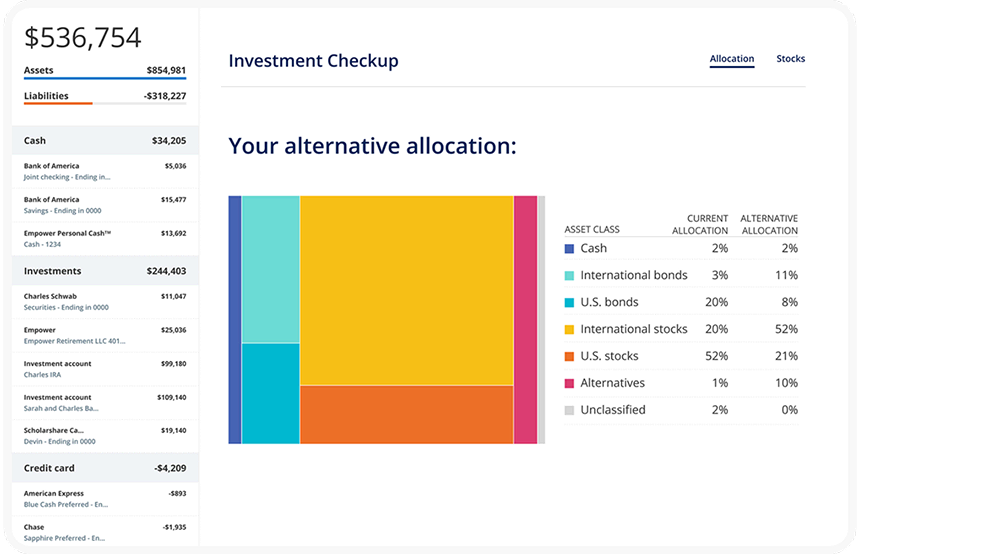
Empower is one of our top-rated financial services firms for people of any income level thanks to its suite of free-to-use tools.
The free Personal Dashboard makes it easy for people to add all their financial accounts (including credit cards, savings, checking, loans, and tax-advantaged investment accounts) in one place.
Empower offers a number of investing and personal finance tools that you’d expect from a free service, such as the Savings Planner, Retirement Planner, and Financial Calculators—all intuitive and well-built.
But where I think Empower really shines is its free Investment Checkup tool. The tool assesses your portfolio risk, analyzes past performance, and even provides a target allocation for your portfolio. Many people don’t realize how much of their varying mutual funds and ETFs overlap with one another—but the tool can actually help you identify overweight and underweight sector investments (maybe you have too many assets in utilities and not enough in health care) and assess your true diversification.
You can even compare your portfolio to both the S&P 500 and Empower’s “Smart Weighting” Recommendation, which suggests that investors more equally weight their portfolios across size, style, and sector—unlike the S&P 500, where the biggest stocks have the most effect on the portfolio, and there are huge differences in how much each sector is weighted.
Use our exclusive link to sign up for the Empower Personal Dashboard. If you have $100,000 or more in investible assets, you’ll also be able to schedule a free initial 30-minute financial consultation with an Empower professional.
- Empower offers both a free set of portfolio, net worth, and cash flow tracking tools, as well as paid asset management service.
- Link Empower to your bank and investing accounts, credit cards, and more to see a single view of useful information and data, including your net worth.
- Empower Advisory Group offers a comprehensive wealth management service known as Personal Strategy. This managed account solution provides clients with discretionary investment management, personalized portfolio construction, and access to financial planning support. Accounts investing $100k to $250k receive unlimited advice and retirement planning help from financial advisors, as well as a professionally managed ETF portfolio with reviews upon request. Higher asset tiers offer access to dedicated advisors, estate planning, and tax specialists, plus additional investment options like access to private equity.**
- Special offer: If you have $100k+ in investible assets, sign up with our link to schedule a free initial 30-minute financial consultation with an Empower professional.
- Free portfolio tracker (Dashboard)
- Free net worth, cash flow, and investment reporting tools (Dashboard)
- Tax-loss harvesting (Personal Strategy)
- Dividend reinvestment (Personal Strategy)
- Automatic rebalancing (Personal Strategy)
- Low investment expense ratios (Personal Strategy)
- High number of investment accounts supported (Personal Strategy)
- Low $100k minimum for investment management (Personal Strategy) compared to traditional advisors.
- Moderately high investment management fee (0.89% AUM) compared to other online advisors (Personal Strategy)
- No dedicated advisor unless you have $250k+ in assets
Related: Personal Capital Alternatives to Manage Your Portfolio
Plynk
- Available: Sign up here
- Platforms: Web, mobile app (Apple iOS, Android)
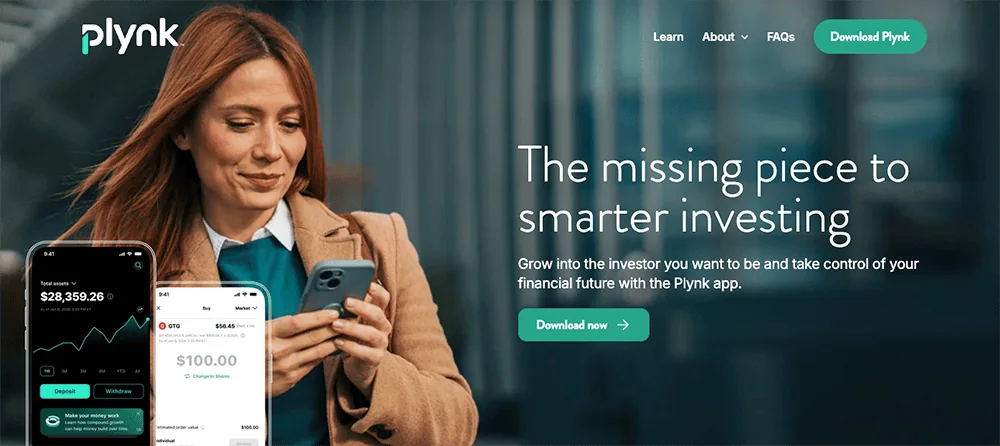
Plynk® is an investing app designed to not only help you start putting your money to work, but teach you about the markets and your money along the way. It charges no account opening fees.
With the Plynk app, you can start investing with as little as $1. It offers commission-free trades on 5,000 stocks and nearly 2,000 ETFs, and also provides access to more than 50 mutual funds and four cryptocurrencies. You can use the app as a traditional brokerage account, but if you’d prefer the potential tax advantages of retirement accounts, the Plynk app also allows you to open traditional IRAs and Roth IRAs.
The app is more than appropriate for seasoned investors, but it’s also extremely friendly to beginners. It’s light on jargon and instead uses straightforward, easy-to-understand language to explain investing concepts in its tips and how-tos. The Plynk app also offers expert ratings on stocks and funds that novice and experienced investors alike can use to identify high-quality opportunities.
Want to start building good investing habits right off the bat? The Plynk app offers automatic investing—you choose how much you want to invest, in which securities, and how often, and the app processes the trading from there. Want help building a consistent habit? Plynk’s Steady Start feature is a 52-week ramp-up program that starts your contribution at $1 in the first week, then ups that contribution by a dollar each week—so by the time you’re done, you’ll have contributed $1,378 in a year.
The Plynk app’s educational tools are among the best from the apps we’ve reviewed. Beginners will want to check out Plynk Think—a series of tips and how-to explanations that help you grow as an investor. Curious about how certain investments would’ve worked? Plynk’s virtual portfolios let you “invest” virtual money to see how any portfolio you can think up would have performed depending on when you started investing in its underlying stocks and ETFs. You can even build experience without using real money thanks to the app’s simulated trading feature, which shows you how to buy and sell stocks and funds, and lets you test out your trading strategies.
Plynk’s customer support is staffed by knowledgeable professionals, and your account is backed by encryption, multifactor authentication, and 24/7 fraud monitoring.
Begin today: Sign up with Plynk using our exclusive link to kick-start your investing journey.
- Plynk® is an effective yet beginner-friendly way to start investing in thousands of stocks, ETFs, mutual funds, and cryptocurrencies.
- Start investing for as little as $1.
- Enjoy commission-free trades on 5,000 stocks and nearly 2,000 ETFs. Plynk also supports mutual funds and cryptocurrencies.
- Put your investing on autopilot with automated investing or Steady Start.
- Track dividends and interest with Income Hub.
- Just getting started? Plynk Think tips and how-tos get you spun up on important investing concepts, while virtual trading and virtual portfolios help you get your feet wet and build experience without putting any money at risk.
- No account fees
- Smart design and smooth user experience
- Fractional shares
- Designed for beginning investors
- Virtual portfolios and virtual trading
- One of the best automated investing programs we've seen (Steady Start)
- Elite educational resources and tools
- Lacks features such as options trading and advanced charting that more experienced traders prefer
Related: Best Debit Cards for Kids
Disclosures
Plynk
All Plynk disclosures can be viewed here.