

So, you’re interested in investing in stocks or funds (or crypto or … you get the point). And you’ve also saved up a little money to put toward your future.
That’s great! Then all that’s really left to get you started is an investment app—preferably one geared toward a beginner like yourself.
But what exactly does that look like?
The best investment apps for beginners don’t fit a single mold, largely because beginners come in different shapes, sizes, and (most importantly) interests. Some want a set-it-and-forget-it account with automated investing so they can plow their money into a few index funds that match their goals. Others want access to as many types of investments as possible, as well as all the learning tools they’ll need to master each one of them. And still others are hands-on learners that just want quick-and-easy access to the stock market sandbox—they’ll figure out the rest from there.
Today, we’re going to evaluate the best investment apps for beginners with all of these various needs in mind. Because while there is no one-size-fits-all-solution, the best investing apps are better than the rest at catering to certain sets of needs.
Below, we’ve looked at a host of investing apps for beginners through various lenses. Among our considerations: breadth of offered investments (stocks, ETFs, mutual funds, etc.), ease of use, robo-investing and other automated investing features, educational resources, intangible features (say, social aspects), and, of course, cost.
One last note: The key word here is “invest.” Many apps can serve multiple groups—in fact, some of the apps below serve both active traders and buy-and-hold investors. For active traders, we’ve evaluated these and other programs as stock trading apps. But if you just want to grow your money over time, with maybe only the occasional trade, keep reading as we evaluate the best investment apps for beginners.
Best Investment Apps for Beginners—Our Top Picks
|
Best Investment App for Beginners
|
Best Stock Trading App for Beginners

|
Popular Micro-Investing and Financial App

|
Best Investing App w/ Personal Finance

|
|
Primary Rating:
4.6
|
Primary Rating:
4.5
|
Primary Rating:
3.9
|
Primary Rating:
4.4
|
|
Free to use, no commissions* on stocks and ETFs.
|
No commissions on stock and ETF trades. Robinhood Gold: Free 30-day trial, then $5/mo.
|
Acorns Bronze: $3/mo. Acorns Silver: $6/mo. Acorns Gold: $12/mo.
|
No commissions on stock and ETF trades.
|
The Top Beginner Investment Apps
| App | Apple App Store Rating / "Best For" | Fees | Promotions |
|---|---|---|---|
 Robinhood Robinhood | ☆ 4.3 / 5 Basic stock and ETF investing; options | No-commission stock, ETF, and options trades. Robinhood Gold: Free 30-day trial, then $5/mo. or $50/yr. | Earn $5-$200 in cash to put toward stock when you sign up and fund your account with at least $10. |
 Plynk Plynk | ☆ 4.6 / 5 Beginning and intermediate investors | Free to access, no commissions* on stocks and ETFs. | Earn up to $250 annually with a 25% cash match on your dividends. |
 Acorns Acorns | ☆ 4.7 / 5 Automated investing | Bronze: $4/mo. Silver: $8/mo. Gold: $12/mo. | $20 bonus when you set up recurring investments and make your first successful recurring investment |
 SoFi Invest® SoFi Invest® | ☆ 4.8 / 5 Personal finance-focused investors | No-commission stock and ETF trades. SoFi Robo-Investing: 0.25%/yr. AUM advisory fee. SoFi Plus: $10/mo. | Fund a new account with at least $50 within 30 days of opening an account, and get up to $1,000 in stock.* |
 Betterment Betterment | ☆ 4.7 / 5 Passive investors seeking tax-loss harvesting capabilities | $5/mo. or AUM fee charged based on balance*; Premium: 0.65% annual AUM fee.** | None |
 M1 Finance M1 Finance | ☆ 4.7 / 5 Passive investors | No-commission stock and ETF trades; $3/mo. for accounts with balances under $10,000 | None |
 Firstrade | ☆ 4.7 / 5 Mutual fund and target date fund investors | Commission-free trades | Free account bonus commensurate with contributed funds |
 Public.com Public.com | ☆ 4.7 / 5 Investors seeking traditional and alternative investments | Public: Zero-commission U.S.-listed stock, ETF, and options trades. Premium: $96/yr., $10/mo., or free w/ balance of $50,000 or more | None |
 E*Trade E*Trade | ☆ 4.7 / 5 Beginning-to-intermediate traders | No-commission stock and ETF trades | Free account bonus commensurate with contributed funds |
 Vanguard Vanguard | ☆ 4.7 / 5 Vanguard fund investors | Commission-free trades | None |
 Schwab Schwab | ☆ 4.8 / 5 Investors and traders of all experience levels | No-commission stock and ETF trades | Free account bonus commensurate with contributed funds |
 J.P. Morgan Self-Directed Investing J.P. Morgan Self-Directed Investing | ☆ 4.8 / 5 Self-directed investors and Chase customers | No-commission stock and ETF trades | Free account bonus commensurate with contributed funds |
| Note: Apple App Store Rating as of Sept. 24, 2026. | |||
A quick note about these apps. In any of our review articles, we only list products that meet certain quality thresholds—so if a product is listed, regardless of how it ranks, we still believe it’s worth using.
However, this group of products stands out in how close they are in quality to one another. In some product reviews, there can be a stark difference between the best-ranked product and the worst. But in reviewing the best investment apps for beginners, we feel that each product has a significant, unique value proposition to offer novice investors—it’s ultimately a question of what that novice investor is looking for.
A long way of saying: This is a very competitive field. Do we believe the top-listed investment apps are better than those at the bottom? Yes. But based on which features you value, you could easily find your best match later on in the list.
Now, on to the reviews:
1. Robinhood (Best Simple Stock Trading App for Beginners)
- Available: Sign up here
- Best for: Beginner traders
- Platforms: Web, mobile app (Apple iOS, Android)
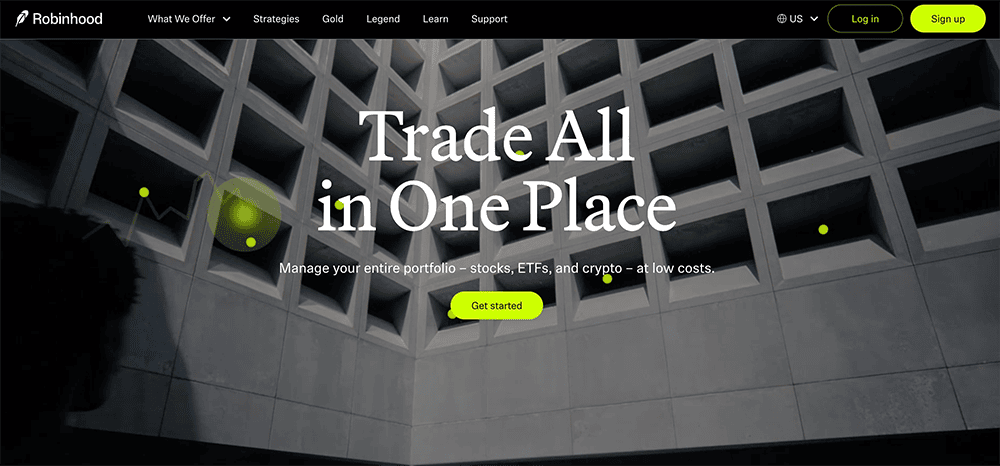
Robinhood jumped into the investing public’s consciousness in 2013 when they rolled out commission-free trading. They remain a standout option for cost-minded investors thanks to their continued $0 commissions on stocks, ETFs, options, and cryptocurrency; 24/7 trading; and the use of fractional shares, which allow people to invest with as little as $1.
Robinhood has long catered to beginner investors with its gamified interface and growing library of educational content. But Robinhood has grown up, too—from a bare-bones app to a full-featured platform, chock full of tools and capabilities designed to both build up notice investors, and help beginners get the most out of their accounts from the get-go.
For instance, Robinhood now offers traditional individual retirement accounts (IRAs) and Roth IRAs via Robinhood Retirement. We love that investors have the option of self-selecting all their investments, having Robinhood recommend a portfolio (made up of five to eight ETFs), or mixing the two by starting with Robinhood’s recs and tweaking to your own preferences. IRA investors can choose from stocks, ETFs, and options, but not crypto.
But Robinhood Retirement has really made a name for itself by offering matching funds. If you open up an IRA with Robinhood Retirement, Robinhood will match 1% of any IRA transfers, 401(k) rollovers, and annual contributions to your account—typically almost immediately after you make your contribution. (Robinhood Gold subscribers get a 3% match on new contributions, though rollovers and transfers are still 1%.)
Robinhood also has tools for budding traders. Advanced Charts, for instance, provides simple and customizable charts with a variety of technical features. Robinhood’s Options Strategy Builder simplifies the options-trading process by helping you build a strategy based on what you expect your target stock or ETF will do in the future. Robinhood also offers 24/7 commission-free cryptocurrency trading with Robinhood Crypto (though you’ll still have to pay a spread), allows extended-hours trading, and lets users earn interest through stock lending.
Sign up for a Robinhood brokerage account or Robinhood Retirement account today.
- Robinhood is a pioneer in the investing app world, offering commission-free trades on stocks, ETFs, options, and cryptocurrency, as well as one of the deepest libraries of investing educational content.
- Investing for retirement? Robinhood will match 1% of any IRA transfers or 401(k) rollovers, as well as any annual contributions*, made to your Robinhood Retirement account—and you can get a 3% match on any new contributions if you subscribe to Robinhood Gold.
- Want more advanced trading tools? Download Robinhoold Legend—a desktop trading platform with real-time data, customizable layouts, deeper asset analysis, and more—for free.
- Robinhood's robo-advisory service, Robinhood Strategies, will build you a custom portfolio of stock and bond ETFs (and individual stocks for accounts with at least $500), for a low 0.25% in AUM, which is capped at $250 annually for Robinhood Gold members.
- Robinhood Gold also includes Level II market data provided by Nasdaq, higher interest rates on uninvested brokerage cash, lower margin trading rates, bigger Instant Deposits, and access to the Robinhood Gold Card (a 3% cash-back Visa credit card).
- Special offer: Sign up for Robinhood, link a bank account, and fund your account with at least $10, and receive a randomly selected cash amount between $5 and $200 to put toward certain fractional shares.
- Very good selection of available investments in brokerage accounts
- 1% match on rollovers, IRA transfers, and new contributions to IRAs and Roth IRAs (3% new-contribution match with Robinhood Gold)
- Automated recommended portfolios
- Intuitive interface
- Robo-advisory service (Robinhood Strategies)
- Extensive educational library
- No mutual funds in brokerage or IRAs
- Match doesn't apply to Robinhood Strategies accounts
Related: 12 Best Stock Trading Apps + Platforms for Beginners
2. Plynk (Best Investment App for Beginners)
- Available: Sign up here
- Platforms: Web, mobile app (Apple iOS, Android)
- Best for: Beginner investors
- Price: Free to access, no commissions* on stocks and ETFs
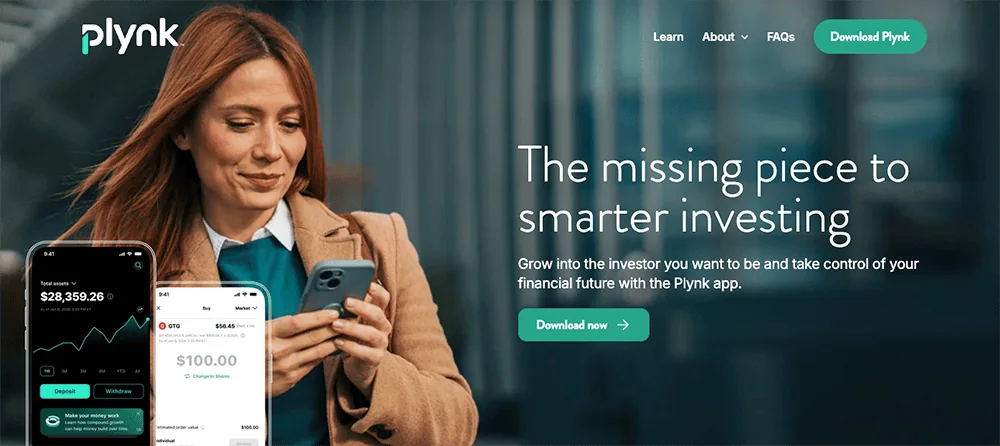
Plynk® is an investing app designed to not only help you start putting your money to work, but teach you about the markets and your money along the way—and now it will help you grow your dividend income.
The Plynk app charges no account opening fees and lets you start investing with as little as $1. It offers commission-free trades on 5,000 stocks and nearly 2,000 ETFs, and also provides access to more than 50 mutual funds and four cryptocurrencies. You can use the app as a traditional brokerage account, but if you’d prefer the potential tax advantages of retirement accounts, the Plynk app also allows you to open traditional IRAs and Roth IRAs.
One of the app’s newest features is a dividend match. Plynk will provide a cash match of 25% on dividends generated within the account, allowing you to earn up to $250 extra annually.
The app is more than appropriate for seasoned investors, but it’s also extremely friendly to beginners. It’s light on jargon and instead uses straightforward, easy-to-understand language to explain investing concepts in its tips and how-tos. The Plynk app also offers expert ratings on stocks and funds that novice and experienced investors alike can use to identify high-quality opportunities, and it allows you to browse stocks and ETFs using thematic categories, such as AI, gaming, and dividend stocks.
Want to start building good investing habits right off the bat? The Plynk app offers automatic investing—you choose how much you want to invest, in which securities, and how often, and the app processes the trading from there. Want help building a consistent habit? Plynk’s Steady Start feature is a 52-week ramp-up program that starts your contribution at $1 in the first week, then ups that contribution by a dollar each week—so by the time you’re done, you’ll have contributed $1,378 in a year. Want to see how much you’ve been paid in interest and dividends? Check out Plynk’s Income Hub.
The Plynk app’s educational tools are among the best from the apps we’ve reviewed:
- Beginners will want to check out Plynk’s simulated trading feature, which lets you use virtual money in a real-market environment as you learn how to make trades, test strategies, and gain experience.
- Curious about how certain investments would’ve worked? Plynk’s virtual portfolios let you “invest” virtual money to see how any portfolio you can think up would have performed depending on when you started investing in its underlying stocks and ETFs.
- The Plynk website’s “Learn With Plynk” section teaches investors about important basic concepts such as diversification, dividends, and dollar-cost averaging.
Plynk’s customer support is staffed by knowledgeable professionals, and your account is backed by encryption, multifactor authentication, and 24/7 fraud monitoring.
Begin today: Sign up with Plynk using our exclusive link to kick-start your investing journey. Or if you want to learn more, check out our Plynk review.
- Plynk® is an effective yet beginner-friendly way to start investing in thousands of stocks, ETFs, mutual funds, and cryptocurrencies.
- Plynk charges no account opening fees, and you can start investing for as little as $1.
- Enjoy commission-free trades* on 5,000 stocks and more than 3,400 ETFs. Plynk also supports mutual funds and cryptocurrencies.
- Boost your yield with a cash match of 25% on dividend income.**
- Earn a 3.48% APY on uninvested cash.
- Track dividends and interest with Income Hub.
- Put your investing on autopilot with automated investing or Steady Start.
- Just getting started? Simulated trading and virtual portfolios help you get your feet wet and build experience without putting any money at risk.
- No account fees
- Smart design and smooth user experience
- Fractional shares
- Designed for beginning investors
- Virtual portfolios and simulated trading
- Earn interest on uninvested cash
- One of the best automated investing programs we've seen (Steady Start)
- Elite educational resources and tools
- Lacks features such as options trading and advanced charting that more experienced traders prefer
Related: How to Invest Money: 5 Steps to Start Investing w/Little Money
3. Acorns (Invest Simply With Pre-Built ETF Portfolios)

- Available: Sign up here
- Best for: Investors looking for simple, automated investing
- Platforms: Web, mobile app (Apple iOS, Android)
Acorns is a micro-investing app geared toward young adults and millennials that’s perhaps best-known for its “Round-Ups” program.
With Acorns Round-Ups, the app rounds up purchases made on linked debit and credit cards to the nearest dollar, investing the difference on your behalf. For example, if you purchase a coffee for $2.60 on a linked credit card, Acorns automatically rounds this charge up to $3.00 and puts the 40-cent difference aside. Once those Round-Ups reach at least $5, they can be transferred to your Acorns account to be invested.
The Acorns investment offering itself is a simple, automated platform that uses pre-built portfolios of ETFs to keep investors exposed to stocks and bonds, which is similar to many robo-investing offerings. Acorns’ basic approach makes it one of the best investment apps for beginners.
Here’s more about what you can expect from Acorns’ varying subscription options:
- Acorns Bronze: Includes an Acorns Invest investment account, as well as Acorns Later for tax-advantaged investment options such as Roth IRAs. Also includes Acorns Checking, a bank account that has no account fees, lets you withdraw fee-free from more than 55,000 ATMs nationwide, and is paired with a debit card that can go into your digital wallet; Smart Deposit, which allows you to automatically invest a bit of each paycheck into your Acorns accounts; and, of course, Round-Ups.
- Acorns Silver: Everything in Acorns Bronze (Acorns Invest, Later, Checking, etc.), plus Premium Education, which includes live Q&As with Acorns’ expert investment team, invite-only sessions with the Acorns Support Team, access to a quarterly market report, and more; Emergency Savings with a high APY; and a 25% bonus on Acorns Earn rewards (up to $200 per month).
- Acorns Gold: Everything in Silver, plus custom portfolios that allow you to hold individual stocks; live Q&As with financial experts; a 50% match on Acorns Earn rewards (up to $200 per month); $10,000 in life insurance; even the ability to set up a will for free. Parents also get Acorns Early access for up to four children. And Gold is the only way to unlock Acorns Early Invest: a custodial account for your child that lets you invest for them while they’re a minor.
Silver and Gold also feature a powerful way to accelerate your savings: Later Match. While most people are aware that employers will sometimes match funds you contribute to your 401(k), “matches” are virtually unheard of in retirement accounts like IRAs, where there’s no employer to kick in extra cash. However, Acorns itself will match 1% or 3% on new contributions to IRAs for Silver and Gold subscribers, respectively.
Learn more in our Acorns review, or use our link to sign up with Acorns today.
- Acorns allows you to sign up for investment, retirement, and checking accounts for you and your family, learn how to earn more money, and grow your investing knowledge.
- Famous for investing spare change automatically through Round-Ups, this all-in-one financial app helps younger generations start investing earlier.
- Invest in expert-built portfolios made up of diversified ETFs.
- Silver tier includes perks such as a 25% match on Acorns Earn rewards (up to $200/mo.), generous APYs on Checking and Emergency Fund, and live Q&As with investing experts.
- Gold tier includes perks such as a 50% match on Acorns Earn rewards (up to $200/mo.), $10,000 in life insurance, and picking individual stocks for your portfolio.
- Gold also comes with a free Acorns Early account for up to four children. It's also the only tier to offer Acorns Early Invest: a UGMA/UTMA custodial account where you can save toward your kids' future and get a 1% match on up to $7,000 in contributions annually.
- Earn even more with Later Match: Acorns will match up to 1% (Silver) or 3% (Gold) of all new IRA contributions in your first year.*
- Special offer: Get a free $20 bonus investment when you sign up with our link and start making recurring investments.**
- Robo-advisor with affordable fees (on larger portfolios)
- Fixed fee model
- Round-ups
- FDIC/SIPC insurance
- IRA match (Silver and Gold)
- High fixed fees for small balances
- Limited investment selections
- Must subscribe to Gold for any self-directed investing options
Related: Best Custodial Accounts: How to Start Investing for Kids
4. SoFi Invest® (Best for Personal Finance-Focused Investors)
- Available: Click “Start Today” below
- Best for: Traders looking for an all-in-one personal finance experience
- Platforms: Web, mobile app (Apple iOS, Android)
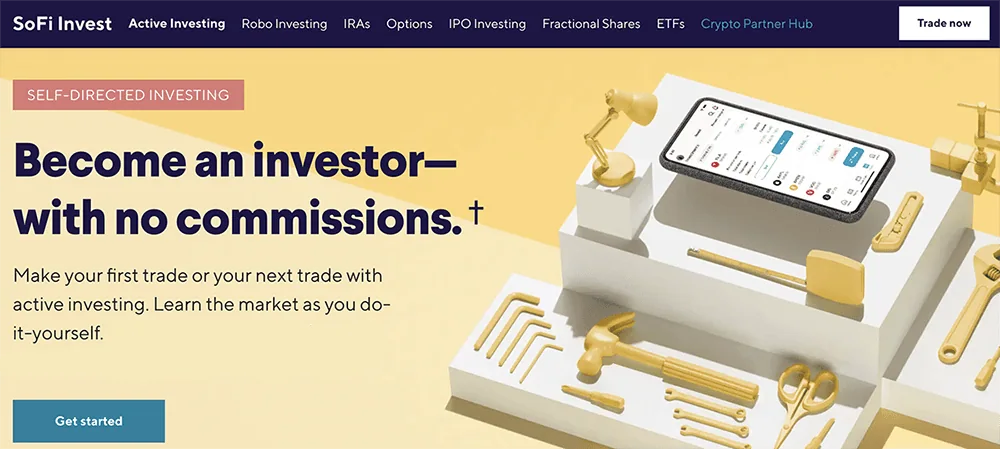
SoFi is a multi-faceted financial company that offers everything from credit cards and insurance to student loans and mortgages … and they also allow you to trade and invest through its SoFi Invest app.
With SoFi Invest, you can invest as actively or as passively as you’d like.
The SoFi Active Invest Brokerage Account has no required minimum balance, charges no commissions on stock, ETF, and options trades, and its options trading is free of contract fees, too. Want to put your portfolio on autopilot? SoFi’s robo-advisory services will create a portfolio for you for an annual 0.25% assets under management fee (that can be designed to address one or several goals) and auto-rebalance it for you as necessary over time.
The interface is still very much geared toward younger, less experienced investors—everything is focused on simplicity and ease of use, rather than an expanse of sophisticated tools. SoFi also offers budget-friendly features such as fractional shares, which allow you to invest for as little as $5. And SoFi even provides a social element, such as bringing SoFi members together at exclusive events.
Unlike many brokerage companies that might have more limited offerings, SoFi’s app allows you to manage a much wider range of financial services and products, such as banking, student loans, insurance, and mortgages.
Want to put your portfolio on autopilot? SoFi’s robo-advisory services will create a portfolio for you for an annual 0.25% assets under management fee (that can be designed to address one or several goals) and auto-rebalance it for you as necessary over time.
While SoFi Invest is free to use, you can also subscribe to SoFi Plus—a $10-per-month subscription tier that can unlock more than $1,000 per year in extra value. SoFi Plus perks include a match on recurring investment deposits, preferred access to initial public offerings, higher cash-back rewards on certain SoFi credit cards, home mortgage discounts, rate discounts on student loan refinancing and new personal loans, and a temporary boost on SoFi Savings APY, among others.
SoFi also occasionally has sign-up bonuses attached to its brokerage accounts, which you can read about in the box below. Want to open an account? Click “Start Today.”
- SoFi Invest allows you to trade or invest in stocks, ETFs, and options with no commissions and no account minimums. You can also participate in some initial public offerings (IPOs).
- Invest for as little as $5 with fractional shares.
- Robo-advisory services, including goal planning and auto-rebalancing, available for annual 0.25% AUM fee.
- Subscribe to SoFi Plus to unlock more than $1,000 per year in extra value, including a 1% match on recurring investment deposits, preferred IPO access, higher cash-back rewards on certain SoFi credit cards, a six-month APY boost, and more.
- Special offer: Get up to $1,000 in stock when you open and fund a new Active Invest account.*
- Good selection of available investments
- No options contract fees
- DIY and robo-investing options
- Fractional shares
- No mutual funds
- Limited trading tools
- No tax-loss harvesting
- No socially responsible robo-advisor functionality
Related: Best Debit Cards for Kids
5. Betterment (Best Investment App for Tax-Loss Harvesting)

- Available: Click the “Get Started” button below
- Best for: Investors who prioritize simplicity, tax-loss harvesting
- Platforms: Web, mobile app (Apple iOS, Android)
Betterment is a robo-advisor platform that allows you to invest in pre-built portfolios—with different themes and goals—in taxable accounts as well as individual retirement plans.
Betterment’s primary offering is ETF-only portfolios that provide varying types of exposure depending on your risks and interest. For instance, Core is a stock-and-bond portfolio that keeps you invested in most domestic and international securities, in the ratio of stocks to bonds that’s most appropriate for you. Social Impact buys stocks and bonds of companies with “a demonstrated focus on supporting social equity and minority empowerment.”
There are no self-directed options, however. The portfolios buy fractional shares of ETF index funds tracking benchmarks like the S&P 500 to keep you invested in stocks and bonds. But the service does not allow you to invest in individual stocks or bonds. The app has added crypto portfolios holding digital currencies such as Bitcoin and Ethereum, but again, you can’t buy them individually—only through pre-built portfolios held in separate crypto accounts.
That makes Betterment one of the best investment apps for beginners—especially those who don’t want to be particularly active in selecting what they hold.
One interesting perk that stands out: Betterment’s tax-loss harvesting feature.
If you invest in a taxable account, and you sell an investment for a gain, you’ll owe taxes on those gains. (What you owe differs depending on whether you’ve held that investment for more than a year.) However, if you sell an investment for a loss, you can use that to offset your capital gains, and thus the taxes you’d pay on them, or if your loss is more than your gains (or you don’t have any gains at all), you can even reduce taxes owed on your personal income, subject to a $3,000 annual cap.
It can be a complicated strategy, but Betterment’s Tax Loss Harvesting+ automates the process for you. It will regularly check your portfolio for tax-loss harvesting opportunities, then take the proceeds from selling those investments and reinvest them where it makes sense for you.
Just note that Betterment is different from many traditional brokers in that it’s a subscription-based product. Betterment charges $4 per month to start; however, if you set up recurring monthly deposits totaling $250, or reach a balance of at least $20,000 across all Betterment accounts, the fee changes to 0.25% of all assets under management. Betterment Premium provides unlimited financial guidance from a Certified Financial Planner™. Premium costs 0.65% annually, and upgrading requires having at least $100,000 in assets with Betterment.
- The Betterment app gives you the tools, inspiration, and support you need to become a better investor.
- Start with as little as $10 and use the top-rated mobile app to set up automatic investing into diversified ETF portfolios. You can also purchase individual stocks or ETFs, and the platform also supports fractional shares.
- You can also invest in diversified preset cryptocurrency portfolios.
- Customize your risk tolerance and investment goals with guidance available at any time.
- By upgrading to Premium, you can unlock unlimited financial guidance from a Certified Financial Planner™.
- Betterment customers with at least $100,000 in assets may be eligible for an interest-rate discount on select mortgages, as well as hundreds of dollars in closing-cost credits.
- Hands-off investment management
- Diversified portfolio that automatically rebalances
- Low-cost investment selection
- Fractional shares
- Limited investment selections
- Limited crypto diversification in cryptocurrency portfolios

Related: Federal Tax Brackets and Rates [2024 + 2025]
6. Vanguard (Best for Vanguard Fund Investors)

- Available: Sign up here
- Best for: Basic trading options with cheap mutual fund investing
- Platforms: Web, mobile app (Apple iOS, Android)
Vanguard has long been regarded as the low-cost index fund investing service provider. In fact, in 1975, John Bogle launched the first U.S.-listed index fund available to retail investors. Now, Vanguard offers numerous dirt-cheap index products in both its mutual fund and exchange-traded fund lineups.
But Vanguard also offers low-cost investing, and no account minimums, through its brokerage and other accounts. That means commission-free trading not just on Vanguard products like VTI or VTSAX, but also on stocks, all other ETFs, and all no-transaction-fee mutual funds. But investors and traders still shoulder some costs. Unless you have more than $1 million in your account, transaction-fee mutual funds cost $20 per trade. And if you have a higher risk tolerance, you can trade options on Vanguard—but while commission-free, you’ll still incur a $1 contract fee on options trades.
Vanguard’s web and mobile versions are very much geared toward beginning investors, though the latter is better-designed. The web version can be downright clunky at times, and it can be difficult to access some of the features. I used to use the app to manage my work’s 401(k) plan, and I’ll admit to its bloat and lack of clarity on calculating investment returns on a percentage basis. The mobile apps run more smoothly, and I like the secure two-step login. But certain features, such as price alerts, aren’t available on mobile.
My main beef with Vanguard’s apps is that they make it difficult to measure the performance of individual holdings. All that said, Vanguard might have made this by design, incentivizing you to check your funds less often and thus living by their buy-and-hold ethos.
Still, if you’re a beginner who’s not sure if you’ll be more into trading, or more into long-term investing, a Vanguard account is a good place to start.
- Vanguard's low-cost mission continues through its commission-free brokerage and other investment accounts. Invest in stocks, ETFs, and Treasuries with zero commissions.
- Pay $0 to trade Vanguard mutual funds and no-transaction-fee mutual funds.
- Want to trade options? You can do that on Vanguard, too.
- Vanguard's mobile app is simple and easy to understand.
- Good selection of available investments
- Commission-free Treasuries
- Some commission-free mutual funds
- Can purchase fractional shares of mutual funds
- Can optimize your portfolio with Vanguard Portfolio Watch
- Limited investing and research tools
- Somewhat clunky web interface
- High options contract fees
- Limited features on mobile app
- No fractional shares of stocks or ETFs unless reinvesting through a DRIP plan

7. Public.com (Stock Investing App With Alternative Assets)

- Available: Sign up here
- Best for: New investors with limited capital
- Platforms: Web, mobile app (Apple iOS, Android)
Public.com, which is geared toward Millennials and Gen-Zers, is different from many other investing apps.
Yes, Public has the basics: Users can trade individual stocks and ETFs with no commissions. It’s also a micro-investing app thanks to its fractional shares feature, which allows users to spend as little as $5 to invest. But Public has also been widening its investment lineup—while it still doesn’t offer mutual funds, it does provide access to options, individual bonds, 40 different cryptocurrencies, and even alternative assets, from art to sneakers.
That last point really sets Public apart. Alternative assets are a relative rarity among investing apps. They can be difficult to research (and thus difficult to properly invest in), but they can provide uncorrelated returns compared to the stock and bond markets, so many savvy investors like to diversify into these assets.
The “Public” part of the name nods to the platform’s social aspect. You can make your portfolio holdings open to other users, and conversely, you can look through other Public users’ portfolios. Investors can also connect with corporate founders and CEOs through live “Town Hall” meetings.
Users can also upgrade their experience with the $10/month Public Premium subscription.
Public Premium offers some features that are included in some free brokers’ services, but other features help to justify the cost. For instance, Premium offers extended-hours trading (8 to 9:30 a.m., and 4 to 8 p.m. EST) and stock price alerts—several competitors, such as TradeStation and E*Trade, offer these services at no charge. However, Premium also provides:
- Advanced data on companies—Public.com’s examples include Tesla quarterly deliveries by model or Apple’s annual sales by continent
- Institutional-grade research provided by Morningstar
- Members-only analysis about events including major economic report releases, earnings announcements, and more
- Up to four years’ worth of companies’ earnings calls, decks, and reports
- Exclusive audio programming by Public.com’s expert analysts
You can read more in our Public.com investing app review, or sign up today using our exclusive link.
- Public.com offers zero-commission trading on thousands of stocks and ETFs, available as fractional shares. The app also allows you to invest in cryptocurrency, options, and bonds as well, and it's one of the rare brokerages that allows its users to buy alternative assets.
- Lock in a 5.3% yield with Public.com's Bond Account, which allows you to invest in a diversified portfolio of investment-grade and high-yield bonds.
- Use a social feed where members can share why they believe in certain companies (or don't) and can post comments on others' trades.
- Invest in curated lists of stocks and ETFs for people to aggregate investments by interest area or values.
- Subscribe to Public Premium for features such as advanced company-level data, Morningstar insights, and exclusive audio content from Public.com's expert analysts.
- Special offer: Receive an uncapped 1% match on transfers into a Public IRA.
- Fractional shares
- Good selection of investible assets
- Allows you to trade alternative assets
- No payment for order flow (PFOF)
- Creative social investing features
- Doesn't support mutual funds
- Limited investment research and other tools

For Public.com disclaimer, please see the fine print at the bottom of this article.
Related: The 7 Best Closed-End Funds (CEFs) to Buy
8. Firstrade (Ideal for Beginner Investors + Traders)
- Available: Sign up here
- Best for: Beginners, traders looking for low options fees
- Platforms: Web, mobile app (Apple iOS, Android)
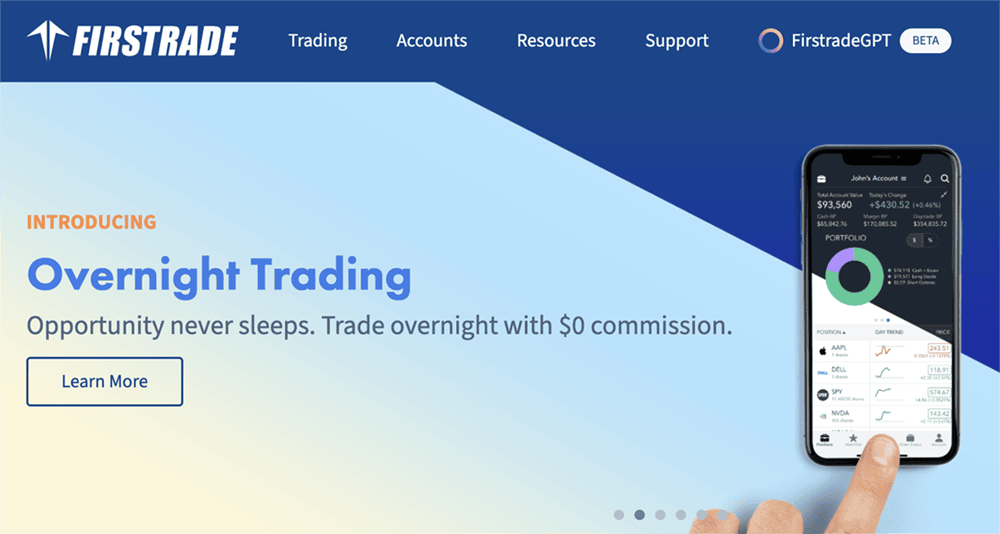
Firstrade might not have the same name recognition among younger investors as platforms such as Robinhood and Acorns. But it’s easily one of the best investment apps for beginners.
For starters, Firstrade has some of the best trading fees among all investing apps.
On the investing front: $0 commissions on stock and ETF trades are par for the course. But where Firstrade stands out is mutual funds, offering free trading of no-load mutual funds, load mutual funds, and no-transaction-fee (NTF) mutual funds. It’s also pretty friendly to beginner traders: Firstrade goes a step above the zero-commission options trading offered at other apps by also not charging contract fees nor assignment fees.
Firstrade also allows investors to buy and sell roughly 40 digital currencies—a better selection than some other beginner investing apps, though not as robust as some higher-powered platforms. Crypto trading is technically commission-free, too. But like other brokers, it adds a markup (Firstrade charges 1%) on both sides of each crypto trade.
The mobile apps, for iOS and Android, are user-friendly; features include Face ID login, charting, and real-time streaming quotes. Users should know that the mobile experience is pared down compared to the primary web experience, but we view that as a plus for when you start investing.
Meanwhile, Firstrade’s educational resources include primers on many basic investment types, explanatory videos, and an A-to-Z glossary to help you become more familiar with vital investing terms.
Firstrade also frequently offers matching bonuses on account fundings, IRA transfers, 401(k) rollovers, and new contributions. You can check out the current offer in the box below. Use our link to sign up with Firstrade today.
- Firstrade is a low-cost leader in trading stocks, ETFs, mutual funds, and options. In addition to standard commission-free offerings of stocks, ETFs, and options, Firstrade charges no options contract fees, and offers free trading of mutual funds as well.
- Also trade cryptocurrency and bonds on Firstrade.
- Beginners can get up to speed with Firstrade's robust education center, which offers written and video lessons covering everything from the basics of stocks to advanced options concepts.
- Special offer: FirstTrade is offering a 3% matching bonus on net new contributions, and a 2% match bonus on net IRA transfers and 401(k) rollovers.
- Very good selection of available investments
- Commission-free mutual funds
- No options contract fees
- High margin rates
- Below-average customer support

Related: 10 Best Stock Advisor Websites & Services to Seize Alpha
9. M1 (Customizable Robo-Advisor for Passive Investors)
- Available: Sign up here
- Best for: Passive investors
- Platforms: Web, mobile app (Apple iOS, Android)
Automated investing is one of the best solutions for beginner investors because it’s a way that people with very little financial knowledge can still put their money to work effectively and efficiently. Thus, several of our favorite investment apps for beginners have some sort of robo-advisory feature.
M1 provides something similar. We consider it a hybrid between self-directed (you manually choose what to invest in, and determine when to buy and sell) and automated investing (AI helps make decisions for you and manages your account). The result is effectively a highly customizable robo-advisory service—one executed so well that it’s our favorite robo-advisor service.
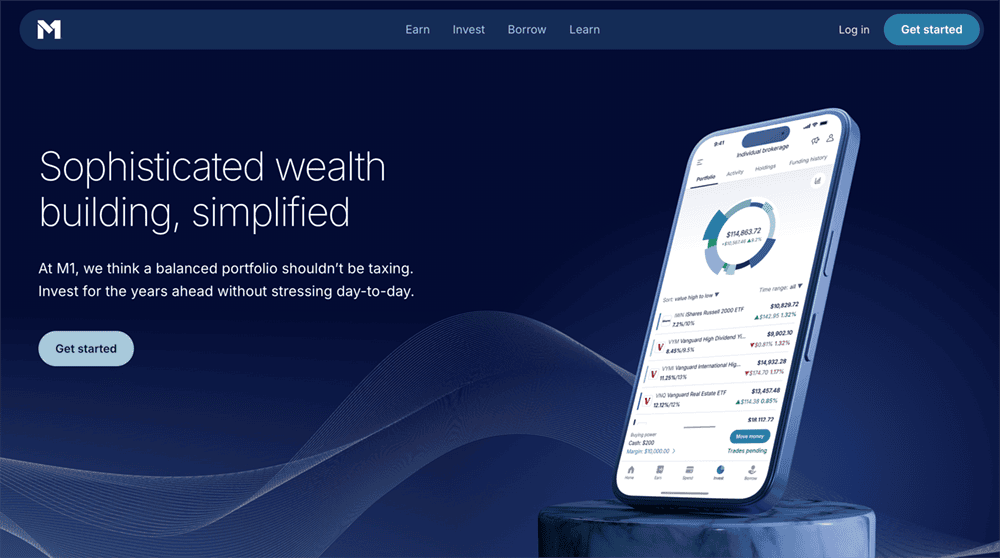
M1’s investing platform is based around Pies. Your portfolio is represented as a Pie (a pie chart); every stock and ETF you decide to buy becomes a slice of that pie—and because M1 supports fractional shares, you can add virtually any stock or ETF to your portfolio. From there, you set each holding’s “weight”—what percent of your Pie each slice should account for, so, say ETF X will always be 25% of your portfolio, while Stock X should always be just 5%.
After that, whenever you fund your M1 account, it will automatically invest your money based on these targets. And you can take automated investing even further by setting up recurring deposits into your M1 account.
From there, M1 can automatically rebalance your portfolio for you, or you can go in and manually change how small and large each Pie slice is. If you really want to put it on autopilot, you can invest in M1’s Expert Pies—professionally pre-built portfolios designed for different investment goals. (And if you want something in the middle, you can even combine Expert Pies with your own custom choices.)
Just understand that while M1 offers premade portfolios aligned to several investing goals, it’s technically not an advisory service.
Also worth noting is that, unlike traditional online brokers, you cannot trade stocks and ETFs throughout the trading day. M1 has two trading windows—at 9:30 a.m. and 3:30 p.m. every day the New York Stock Exchange is open—during which it processes all of the orders it has received before then.
That’s something of a blessing and a curse. On the one hand, on the rare occasion you would need to jettison a position immediately during the trading day, you couldn’t do that with M1. And that single window is an extreme hindrance to people who want to trade stocks. But for beginner investors who want to avoid trading stocks and prefer to simply buy and hold, that single window won’t stop you from achieving your goals—and it could actually prevent you from panic-selling in the middle of the day.
Consider opening an investment account with M1, or read more in our M1 review.
- The M1 investing app is a basic robo-advisory system that acts almost like a 401(k). You build a "Pie" by choosing the stocks and ETFs you want to invest in, as well as the percentage of your portfolio that should be invested in each "Slice," and M1 uses that information to allocate your money each time you contribute.
- If you want help putting together a list of stocks and funds, you can use M1's model portfolios, which cover goals such as general investing, planning for retirement, income earners, and more.
- Enjoy a 4.00% APY on uninvested cash.
- Get a line of credit against your brokerage's account value at low fees (currently 6.40%) compared to other brokerage lines of credit.
- M1 lets you open individual, joint, and custodial brokerage accounts; traditional, Roth, and SEP IRAs; trusts; and cryptocurrency** accounts.
- Robo-advisor with self-directed investing elements
- Attractive APY on uninvested cash
- Borrow against your assets
- Limited selection of investible assets
- Doesn't allow trading throughout the trading day
- Monthly fees for account balances <$10,000

Related: 33 Best Passive Income Ideas [Income Investments to Consider]
10. E*Trade (Ideal for Intermediate Investors + Traders)
- Available: Click “Open Account” below
- Best for: Intermediate investors
- Platforms: Web, mobile app (Apple iOS, Android)
E*Trade has long been seen as a leading stock trading app for retail investors. It allows you to invest in a wide array of assets, and it provides educational resources that will help you with investment research, portfolio analysis, and building a diversified set of holdings.
E*Trade, like most of the best stock investing apps, offers zero-commission stock, ETF, and options trading (though options still incur a 50- to 65-cent contract fee). It also has a leg up on some platforms by offering $0 commissions on mutual fund, Treasury, and new-issue bond trading. Investors also have access to futures, micro futures, and futures options, among other investment types.
If you use E*Trade, you’ll do so via one of two platforms—both of which are free, and both of which have web and mobile versions:
Power E*Trade
Power E*Trade is designated for more intermediate-to-advanced traders. Features include:
- Advanced charting that includes intraday and historical options; more than 100 studies; over 100 drawing tools; and the ability to automatically identify technical patterns
- Snapshot Analysis, which lays out risk-reward probabilities in your options trading
- Powerful stock and trade scanner; use preset filters or customize as you wish
- Paper trading to test out strategies without putting your money at risk
- Ability to design exit strategies
Like with the Power E*Trade web platform, the Power E*Trade app is a more powerful version of its basic counterpart. This app allows you to use preset scans, work with interactive charts, place complex options trades, and more.
E*Trade
The “basic” E*Trade web platform might be more suitable for beginning-to-intermediate traders and investors, but that doesn’t mean it’s short on features.
E*Trade’s main web platform includes everything you need to keep up to date on your portfolio, including real-time quotes, charts, market commentary, and stock news. The latter includes free access to Bloomberg TV, Thomson Reuters, and TipRanks research. Meanwhile, you’ll have ample research tools at your disposal, including stock, mutual fund, bond, and ETF screeners; trade optimizers; backtesters; and more.
Other considerations
E*Trade also touts its educational resources, which includes articles, videos, and classes, as well as monthly webinars and live events. While we wish the educational content were a bit easier to sort through, it’s a high-quality collection that will benefit investors who want to learn along the way.
Want to keep it simple? E*Trade also offers an automated investing platform, called Core Portfolios, where you can let E*Trade manage as little as $500. Answer a few questions about yourself, your goals, and your risk tolerance, then E*Trade will provide you with a suggested portfolio that you can either accept or personalize more before putting it to work. From there, E*Trade will automatically invest funds for you and manage the portfolio. Fees are 0.30% annually, or $30 on every $10,000 invested.
Read our review to learn more, or visit E*Trade and sign up by clicking “Open Account” below.
- E*Trade is one of the best online and mobile trading platforms among discount brokers, offering a full range of investments (including professionally managed accounts). It allows you to invest in stocks, ETFs, mutual funds, options, bonds, futures, micro futures, and futures options.
- $0 commission trading for online U.S.-listed stocks, ETFs, options, mutual funds, Treasuries, and new-issue bonds. (Options have a 65¢ contract fee, or 50¢ at certain volume thresholds.)
- Opening an account is easy and only takes a couple of minutes.
- Bonus: Get between $50 and $10,000* when you click the box below, then open and fund a new investment account using promo code "OFFER26."
- Excellent selection of available investments
- Commission-free mutual funds and Treasuries
- Automated portfolio builders and prebuilt mutual fund and ETF portfolios
- Separate apps for power users and casual users
- Limited availability of fractional shares (only in DRIP plans or robo-created portfolio)
- No direct cryptocurrency trading
Related: 7 Best Investments for Kids [Investing for Children]
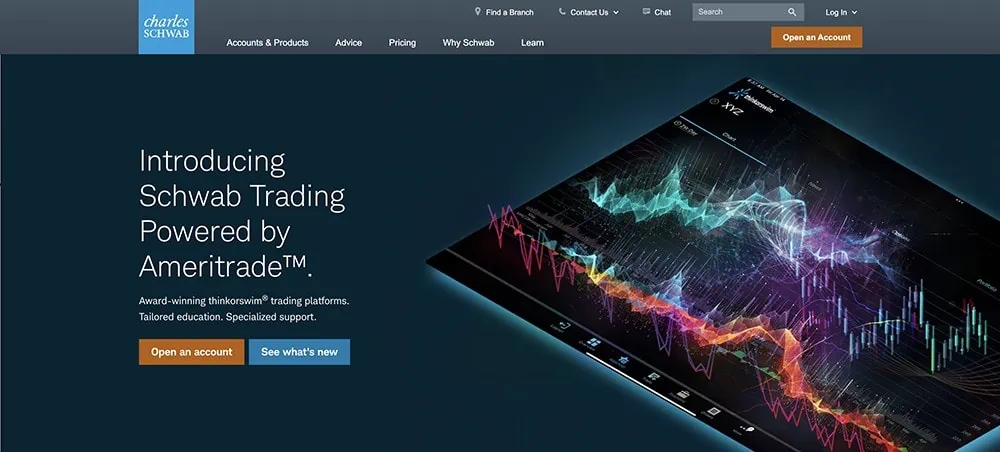
11. Schwab
- Available: Sign up here
- Best for: Intermediate investors
- Platforms: Web, mobile app (Apple iOS, Android)
Investors looking for maximum flexibility and low (or no) trading costs should explore a brokerage or retirement account with Schwab.
Schwab offers commission-free stocks, ETFs, thousands of mutual funds (from Schwab Mutual Fund OneSource), and even Treasury trades. Additional investment selections include corporate bonds, options, money market funds, futures, E-mini futures, and foreign exchange (forex), and you can even participate in some initial public offerings (IPOs) through the Schwab platform.
Want to learn more? Check out the review here, and from there, click the “Visit Site” button to visit Schwab and sign up.
- Charles Schwab is one of the best online and mobile trading platforms among discount brokers, offering a full range of investments (including professionally managed accounts). It allows you to invest in stocks, ETFs, mutual funds, options, bonds, futures, micro futures, and futures options.
- $0 commission trading for online U.S.-listed stocks, ETFs, options, mutual funds, and Treasuries. (Options do have a 65¢ contract fee.)
- More experienced traders can find plenty of horsepower in the Thinkorswim platform, which provides advanced charting, screening, complex options trades, access to a trading community, and more.
- Learn with Schwab, too. Schwab offers a wide variety of educational resources and stock news. The accounts offer regular market commentary, tax planning and retirement advice, stock and fund screeners, Schwab courses ranging from “Income Investing” to “Directional Options: Single Options and Spreads," and even access to Onward—Schwab’s quarterly financial magazine.
- Opening a Schwab account is easy and only takes a couple of minutes.
- Excellent selection of available investments
- Commission-free mutual funds and Treasuries
- Schwab Intelligent Portfolios (robo-advisory)
- Thinkorswim platform (absorbed from TD)
- Fractional shares
- No direct cryptocurrency trading

Related: 7 Best Stock Portfolio Management Software Tools + Apps
12. J.P. Morgan Self-Directed Investing (Ideal for Intermediate Investors)

- Available: Sign up here
- Best for: Self-directed investors, Chase customers
- Platforms: Web, mobile app (Apple iOS, Android)
J.P. Morgan Self-Directed Investing acts as an investing solution offered from Chase and is accessible through the Chase Mobile® app or Chase.com.
You can use this investing app to make unlimited commission-free trades in thousands of investment options, including a wide range of stocks, ETFs, fixed income, mutual funds and options.
The investing app allows you to utilize tools to build your portfolio including screeners and watchlists—both useful for building diversified portfolios and staying on top of market activity.
The app provides personalized news and J.P. Morgan research and market analysis to empower informed investment decisions. You can leverage these resources to design your own target allocation for your investments.
Consider using J.P. Morgan’s Self-Directed Investing platform if you’d like the flexibility to invest as much as you want without paying any commissions on equity and options trades. Some regulatory fees and fund expenses may apply.
You can choose an account that’s right for you: an individual taxable account, Traditional IRA or Roth IRA. All carry a $0 minimum.
Open your J.P. Morgan Self-Directed Investing account today and get up to $700 when you open and fund an account with qualifying new money:
- $50 when you fund with $5,000-$24,999
- $150 when you fund with $25,000-$99,999
- $325 when you fund with $100,000-$249,999
- $700 when you fund with $250,000 or more
Learn more by visiting J.P. Morgan Self-Directed Investing’s website to see if it’s the right fit for your needs.
- J.P. Morgan Self-Directed Investing delivers unlimited commission-free online stock, ETF, mutual fund, fixed-income, and options trades.
- Choose an account that's right for you: General Investing, Traditional IRA or Roth IRA.
- Access your account through the secure, easy-to-use trading experience online or through the Chase Mobile® app.
- Use J.P. Morgan's powerful tools and resources to help you take control of your investment.
- Special offer: Open an account today and earn a cash bonus of between $50 and $700 when you open and fund an account with qualifying new money.*
- Better-than-average commission-free asset selection (includes mutual funds and Treasury bonds)
- Multiple investment account types
- Integration with other Chase banking accounts
- Extremely smooth and intuitive mobile experience
- Limited research and other investing tools
- Must have at least $2,500 in your account to use Portfolio Builder tool

Related: 15 Best Stock Research & Analysis Apps, Tools and Sites
Frequently Asked Questions (FAQs) About The Best Investment Apps for Beginners
What are fractional shares and how do they work?
Typically, if you want to invest in a company, you have to buy at least one share of stock, whatever the price—$1, $10, $100, $469,919.81 (no really, that was the price of Berkshire A shares as I wrote this article). The same goes with ETFs—if you want to invest in that fund, you have to buy at least one share, whatever the cost.
However, with fractional shares, you can buy as much of a stock or ETF as you want with however much money you have. If you have just $1 to invest, brokerages with fractional shares can make it happen.
But it’s not just for people with little money to invest. Say you want to invest $1,000 in a stock, but it costs $750 per share. Without fractional shares, your choices are to buy one share and then figure out some other way to use the $250, or find another $500 so you can buy two shares. But with fractional shares, you can spend exactly $1,000 on that stock—hence why the process is often referred to as “dollar-based investing.”
What apps are good for small investments?
Typically, any investment account that allows you to purchase fractional shares will be best if you have only a small amount of money to work with. Depending on your preference, that means SoFi Invest, M1, Robinhood, and Public.com. Betterment and Acorns also have fractional investing, but that’s done automatically through pre-built portfolios—not self-directed investing.
And it goes without saying: Minimal trading fees (or no trading fees whatsoever) matter much more for small-dollar investors. Generally speaking, you’ll also want products with no account minimum.
What types of assets do investment apps offer?
All sorts—it just depends on which platform you choose. Apps that prioritize simplicity and automatic investing typically only allow you to invest in ETFs and/or stocks. However, advanced investing apps that cater to traders offer oodles of possible investments on top of stocks and ETFs, which can include mutual funds, options, bonds, cryptocurrency, foreign exchange, futures, and more.
Related:
Disclosures
Plynk
All Plynk disclosures can be viewed here.
Public.com
This does not constitute investment advice. Investing involves the risk of loss, including the potential loss of principal. Brokerage services for US-listed, registered securities available on Public are offered by Open to the Public Investing, Inc. (OTTP), a member of FINRA & SIPC, and a wholly-owned subsidiary of Public Holdings, Inc. Brokerage services for alternative investments are offered by the Dalmore Group, LLC, a member of FINRA & SIPC. Alternative investments are over-the-counter equity securities that have been issued pursuant to Regulation A of the Securities Act of 1933. Cryptocurrency trading is provided by Apex Crypto LLC (NMLS ID 1828849). Apex Crypto is licensed to engage in the virtual currency business by the New York State Department of Financial Services.